
Hexagram Study
Hexagram 15 (Modesty) in Study: I Ching Guidance for Learning and Growth
What does Hexagram 15 (Modesty) teach about study and learning? It is the law of heaven to make fullness empty and to make full what is modest; when the sun is at its zenith, it must, according to the law of heaven, turn tow... See how the I Ching guides intellectual growth, skill development, and the discipline of deepening knowledge.
Hexagram 15 (Modesty) in Study: I Ching Guidance for Learning and Growth
Introduction
You've been studying for weeks—maybe months—and you're starting to feel competent. Perhaps you aced a practice exam, received praise from a mentor, or finally grasped a concept that once seemed impossible. That small surge of confidence feels good, but something else stirs alongside it: a subtle unease. You remember the last time you felt this sure of yourself, just before you discovered how much you didn't know. The learning journey has a rhythm, and you sense you're approaching a turning point.
This is precisely the moment when the ancient wisdom of Hexagram 15, Modesty, becomes your most valuable companion. In the I Ching, Modesty appears as the fifteenth hexagram, composed of Earth (Kun) above and Mountain (Gen) below. Its Judgment speaks of a universal law: fullness is made empty, and what is modest is made full. The sun at its zenith must turn toward setting; the moon when full begins to wane. This isn't a mystical warning—it's a description of how growth actually works in learning, in nature, and in life. The mountain of your growing knowledge is real, but it rises from the earth of what you have yet to learn.
If you've ever felt the strange loneliness of early expertise, or the fear that showing your uncertainty will undermine your credibility, or the quiet suspicion that your accomplishments might vanish if you don't defend them—this hexagram speaks directly to you. It offers not a promise of easy success, but a pattern for sustainable growth that honors both what you've achieved and what remains unknown.
Where This Guide Is Most Useful
• You're transitioning from beginner to intermediate competence and feel the pressure to prove yourself, but sense that overconfidence might close doors that humility would keep open.
• You're studying in a competitive environment—graduate school, professional certification, or a high-stakes field—where peers and colleagues measure progress against each other, and you need a way to stay grounded.
• You've experienced a significant learning setback after a period of success, and you're trying to understand whether your previous confidence was misplaced or whether this is simply part of a larger pattern.
Understanding Modesty in Learning & Study Context
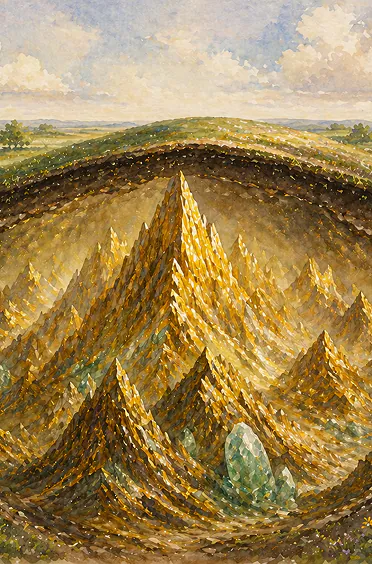
The structure of Hexagram 15 is deceptively simple: Mountain below, Earth above. In the natural world, this represents a mountain hidden within the earth—its height is real, but it doesn't dominate the landscape. The wealth of the earth in which a mountain is hidden is not visible to the eye, because the depths are offset by the height. This is the image of modesty in learning: your knowledge has substance, but it does not announce itself. It exists in relationship with what you don't know, and this relationship is what makes further growth possible.
The Judgment describes a law that operates in learning as surely as in nature: "It is the law of heaven to make fullness empty and to make full what is modest." When you study, you accumulate knowledge. That accumulation follows a predictable pattern. Early on, you know you know nothing, and you learn voraciously. Then you reach a point where your knowledge feels substantial—perhaps even complete. This is the zenith. And just as the sun must set, this fullness must be emptied if learning is to continue. The student who remains open to being wrong, who can say "I don't know" without shame, creates space for new understanding to enter.
The trigrams reinforce this. Earth (Kun) above represents receptivity, the willingness to be shaped by experience. Mountain (Gen) below represents stillness, the solid foundation of what has already been learned. Together they create a learning posture that is both grounded and open. You are not empty—you have substance. But you are not arrogant about it. The mountain of your knowledge supports the earth of your continued receptivity.
What makes this hexagram so powerful for learners is that it reframes humility not as self-deprecation or false modesty, but as accurate self-assessment. The modest learner knows what they know and knows what they don't know, and treats both with equal respect. They do not diminish their accomplishments, but they also do not let those accomplishments close off further growth.
The modest learner builds on a foundation of honest self-assessment, neither inflating nor deflating their knowledge, but seeing it clearly in relation to what remains unknown.
How Modesty Shows Up in Real Learning & Study Situations
Consider the experience of studying for a comprehensive exam. You've covered the material once, twice, three times. You can recite key concepts from memory. Your practice scores are good. The temptation is to relax, to feel that you've arrived. But Hexagram 15 warns that this is exactly when the pattern of fullness turning to emptiness operates. The student who becomes complacent stops noticing gaps. They stop asking questions. They stop being curious. The mountain of their knowledge becomes a barrier rather than a foundation.
In group study settings, modesty manifests as the ability to listen more than you speak, even when you know the answer. The learner who constantly demonstrates their knowledge may impress others, but they also close themselves off from the insights that come from genuine dialogue. The modest learner asks questions that reveal their uncertainties, and in doing so, they invite others to share their own understanding. This creates a learning environment where everyone grows.
Another common scenario: receiving feedback on your work. The immodest response is defensive—you explain why your approach was correct, you justify your errors, you protect your image of competence. The modest response is curious. You ask clarifying questions. You consider the possibility that the feedback reveals something you hadn't seen. This doesn't mean accepting all criticism uncritically, but it does mean approaching feedback as data rather than as threat.
Hexagram 15 also speaks to the relationship between teacher and student. The wise teacher remains modest about their own knowledge, creating space for students to discover things for themselves. The wise student remains modest about their progress, recognizing that mastery is not a destination but a practice. This mutual modesty creates a learning relationship that is generative rather than hierarchical.
Modesty in learning is not about thinking less of yourself—it's about thinking of yourself less, so you can think more about the subject at hand.
From Reading to Action: Applying Modesty
The I Ching is not a book of passive wisdom; it offers specific guidance for action. Hexagram 15's six moving lines describe different situations a learner might encounter and how modesty should be expressed in each.
Line 1 speaks to the beginning of a learning endeavor. The text describes a dangerous enterprise—like crossing a great stream—that is made easier when approached simply and without excessive claims. For the learner, this means starting new subjects with beginner's mind. Don't bring your credentials from other fields as if they entitle you to skip the basics. Don't assume your general intelligence will carry you through specific ignorance. Approach each new subject as if it were the first thing you've ever studied. This line is especially relevant when you're starting something that feels beneath your level—the modest learner knows that foundational knowledge is never wasted.
Line 3 is the center of the hexagram, where its secret is disclosed. This line addresses the moment when your achievements become visible to others. You've done good work, and people are noticing. The danger is that fame—or even modest recognition—will distract you from the work itself. The modest response is to accept recognition without letting it define you, to continue working as if no one were watching. For the student, this might mean receiving praise for a paper or project and then immediately turning back to the next challenge without dwelling on the compliment.
Line 5 corrects a common misunderstanding. Modesty is not weak good nature that lets things take their own course. When you hold a responsible position—as a teaching assistant, a study group leader, or a senior student mentoring newcomers—you must sometimes take energetic measures. You must correct errors, enforce standards, and make difficult decisions. Modesty in this context means doing so without personal offense, without boasting of your superiority, and with purely objective measures. The modest leader in learning acts decisively but without ego.
Line 6 addresses the most challenging situation: when enmity or conflict arises. The text warns against the false modesty of withdrawing and feeling self-pity. Genuine modesty in conflict means beginning by disciplining your own ego—examining your contribution to the problem before assigning blame. For the learner, this might mean acknowledging when your own pride or defensiveness has damaged a collaborative relationship, and taking the first step toward repair.
The action of modesty is not to diminish yourself, but to see yourself accurately and act accordingly—whether that means stepping forward or stepping back.
Practical Examples
Example 1: The New Expert
Situation: You've just completed a professional certification in data analytics. Colleagues now look to you as the expert. In meetings, you feel pressure to have immediate answers to every question. When you don't know something, you're tempted to bluff or deflect.
How to read it: This is Line 3 territory. Your achievement is real, but the mountain of your knowledge must remain embedded in the earth of what you don't know. The pattern of fullness turning to emptiness will operate if you let your expertise close you off from further learning.
Next step: Before your next meeting, prepare a phrase you can use honestly: "I don't have that information right now, but I'll find out and follow up." Practice saying it without apology. Recognize that admitting uncertainty actually increases your credibility with thoughtful colleagues.
Example 2: The Competitive Exam Prep
Situation: You're studying for medical board exams with a group of peers. Everyone shares their scores openly. You've been scoring in the top percentile, and you notice others becoming discouraged or competitive around you. You're tempted to downplay your performance, but that feels dishonest.
How to read it: This is about the difference between modesty and false humility. The Judgment says that when a man holds a high position and is nevertheless modest, he shines with the light of wisdom. Your high scores are real. The modest response is to acknowledge them without making them the center of conversation, and to redirect attention to the material itself.
Next step: When scores come up, state yours briefly and immediately pivot to a question about the material: "I got 92%. But I'm still confused about the mechanism of action for that drug class—can we go over it?" This honors your achievement while keeping the focus on collective learning.
Example 3: The Career Changer
Situation: You have fifteen years of experience in marketing and are now studying software development. Your background gives you valuable perspective, but you're a beginner in coding. You find yourself wanting to reference your past success to establish credibility with younger classmates.
How to read it: This is Line 1 territory. Crossing the great stream of career transition is made easier when you impose no demands or stipulations. Your past accomplishments are real, but they don't transfer directly. The modest approach is to be a beginner fully, without trying to import status from another domain.
Next step: For one week, consciously avoid mentioning your previous career in study settings. Focus entirely on the material at hand. Notice how this changes your learning experience—you may find yourself asking more questions, making more mistakes, and learning more deeply.
In each of these examples, modesty is not about hiding your strengths but about seeing your situation clearly and choosing the response that serves continued growth.
Common Mistakes
• Confusing modesty with self-deprecation. Modesty is accurate self-assessment, not putting yourself down. The I Ching does not ask you to deny your achievements; it asks you to hold them lightly. False humility is still a form of ego—it's just ego expressed negatively.
• Believing modesty means never advocating for yourself. Hexagram 15's Line 5 makes clear that modesty can coexist with decisive action. In academic or professional settings, you may need to assert your qualifications, negotiate for resources, or defend your work. The modest approach is to do so factually, without exaggeration or personal attack.
• Waiting until you feel ready to share what you know. Some learners withhold their insights because they fear being wrong or appearing arrogant. But the Image of Hexagram 15 shows a mountain within the earth—the knowledge is there and should eventually be visible. Modesty is not about hiding; it's about the right timing and manner of revelation.
• Using modesty as an excuse to avoid challenges. "I'm too humble to apply for that fellowship" or "I'm not good enough to speak at that conference" is not modesty—it's fear dressed in virtuous clothing. The Judgment says the modest person can carry out work to the end without boasting. The work itself is the point.
Frequently Asked Questions
How is Modesty different from insecurity in learning?
Insecurity is rooted in fear—fear of being exposed as inadequate, fear of judgment, fear of failure. Modesty is rooted in accurate perception. The insecure learner hides what they don't know; the modest learner acknowledges gaps openly and works to fill them. Insecurity contracts your learning; modesty expands it.
Can Modesty hold me back from advancing in my career?
Only if you confuse it with passivity. Hexagram 15's Line 5 explicitly addresses this concern: modesty in a responsible position means taking energetic action when needed, but doing so without personal offense or boasting. The modest professional is often more trusted and more effective than the self-promoter, because their competence speaks for itself.
How do I practice Modesty when I'm the most knowledgeable person in the room?
The Judgment says that when a man holds a high position and is nevertheless modest, he shines with the light of wisdom. Being the most knowledgeable doesn't require you to pretend otherwise. Modesty in this situation means using your knowledge to elevate others—asking questions that draw out their insights, acknowledging contributions they make, and remaining curious about perspectives different from your own.
What if modesty leads others to underestimate me?
This risk is real, especially in competitive environments. But Hexagram 15 suggests that the law operates in your favor: "men also hate fullness and love the modest." People are drawn to those who don't need to prove themselves. The modest learner who demonstrates quiet competence over time builds a reputation that is more durable than one built on self-promotion.
Does Modesty mean I should never feel proud of my accomplishments?
Not at all. The hexagram does not forbid pride; it warns against the fullness that closes off further growth. You can feel genuine satisfaction in your achievements while remaining open to what you don't know. The sun at its zenith is beautiful—the problem comes only when you try to prevent it from setting.
Closing Reflection
Hexagram 15 offers a profound paradox for learners: the path to mastery runs through the willingness to remain a beginner. The mountain of your knowledge is real, and it should grow. But it must always remain embedded in the earth of what you don't know, because it is that earth—the humility of ongoing receptivity—that allows the mountain to rise higher. The modest learner is not the one who thinks little of themselves, but the one who thinks accurately about their relationship to knowledge itself. They know that every answer opens new questions, every skill reveals new depths of ignorance, and every achievement is a platform for further growth. In this way, modesty is not a limitation but a practice of sustainable learning—the quiet discipline of staying open, staying curious, and staying true to the work itself, without needing to prove anything to anyone.
Turn this guide into your own reading
After reading the explanation, cast with a real question. We will carry your question into the reading flow so the result can be interpreted and saved.
Sources & References
Zhouyi / I Ching primary text
The received text of the Book of Changes, including the Judgment, Image, and line statements.
The I Ching or Book of Changes, Richard Wilhelm / Cary F. Baynes
Princeton University Press translation used as a major English-language reference point for names, structure, and commentary framing.
The Sacred Books of China: The Texts of Confucianism, James Legge
Classical English reference used for comparative reading of source terminology and commentarial tradition.
The Classic of Changes, Richard John Lynn
Modern scholarly translation consulted for comparative interpretation and editorial cross-checking.
Related Hexagrams
Continue from this guide into specific hexagram study.
Related Guides
Continue with adjacent guides for more context and deeper study.