
Hexagram Study
Hexagram 48 (The Well) in Study: I Ching Guidance for Learning and Growth
What does Hexagram 48 (The Well) teach about study and learning? In ancient China the capital cities were sometimes moved, partly for the sake of more favorable location, partly because of a change in dynasties. The style of... See how the I Ching guides intellectual growth, skill development, and the discipline of deepening knowledge.
Hexagram 48 (The Well) in Study: I Ching Guidance for Learning and Growth
Introduction
You've been studying for months—maybe years—and something feels off. You've collected books, taken courses, built spreadsheets of notes. Yet when you sit down to learn, you feel like you're drawing from a dry well. The information goes in but doesn't sustain you. You wonder if the problem is your method, your motivation, or something deeper. This is precisely the moment when the ancient wisdom of the I Ching offers its most surprising and useful guidance.
In the classical Chinese Book of Changes, Hexagram 48 is called The Well (Ching). Its judgment speaks of something that remains constant through all political changes and dynastic shifts: the well itself. The style of architecture changes, but the shape of the well stays the same. The trigram structure places Water (K'an) above and Wind (Xun) below—wood drawing water upward, nourishing everything it reaches. This is not a hexagram about finding new knowledge, but about returning to the source that has always been there.
If you've been struggling with your studies, feeling like you're working harder but learning less, The Well invites you to stop digging new holes and instead ask whether you're actually drawing from the water that's already present. The problem may not be your effort, but your relationship to the source itself.
Where This Guide Is Most Useful
• When you feel stuck in your learning progress despite consistent effort, and you suspect the issue isn't intelligence or discipline but something about how you're approaching the material itself
• When you're preparing for a major academic or professional milestone (exam, certification, presentation) and need to ensure your foundation is solid enough to sustain the pressure
• When you've been studying for a long time and feel your motivation draining—the initial excitement is gone, and you need to reconnect with why the knowledge matters in the first place
Understanding The Well in Learning and Study Context
The judgment of Hexagram 48 makes a remarkable claim: "The shape of the well has remained the same from ancient times to this day." In learning, this points to something fundamental about how humans acquire and internalize knowledge. No matter how technology changes—from scrolls to books to screens to AI—the basic structure of genuine learning remains constant. We must go down to the foundations. We must draw water. We must use what we receive.
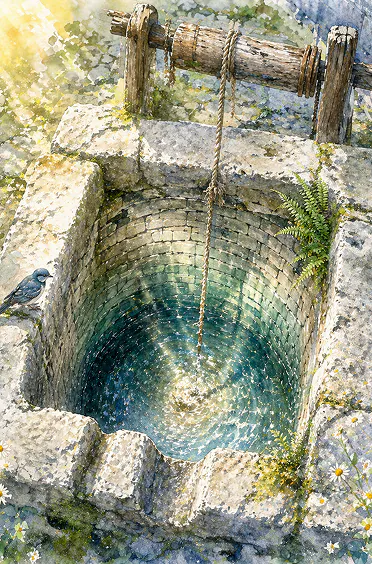
The Image of the well shows wood (the lower trigram, Wind) drawing water upward (the upper trigram, Water). This is not a passive process. The wood doesn't just sit in the water—it actively lifts it. In study, this means that learning is always an act of bringing something hidden up into the light. The knowledge may be there, deep in the well of your potential understanding, but it requires your active participation to make it available.
The two dangers named in the judgment are devastatingly relevant to modern learners. First, we may fail to "penetrate to the real roots of humanity and remain fixed in convention"—this is the student who memorizes formulas without understanding principles, who collects credentials without gaining wisdom. Second, we may "suddenly collapse and neglect self-development"—the burnout that comes from treating learning as a product to be acquired rather than a well to be tended.
The well does not change. What changes is whether we draw from it, and how carefully we handle the water.
How The Well Shows Up in Real Learning and Study Situations
Consider the student who has taken six online courses on the same subject but still feels like a beginner. Each course introduces new terminology, new frameworks, new promises. But nothing sticks because they never stop to deepen—they only widen. This is the person who keeps moving the capital city (the judgment's metaphor for changing external structures) but never returns to the well itself.
The Well appears most clearly in the gap between knowing and understanding. You can know facts about a subject—dates, definitions, procedures—without understanding its living water. The hexagram warns against "partial education" that is "as bad as none." This is not a judgment on your intelligence but an observation about the nature of real learning. If you haven't gone deep enough to reach the source, all your surface knowledge will eventually dry up.
Another recognizable pattern is the learner who has excellent material but a broken vessel. The second line describes a clear well whose water is not used because the jug is broken. In study, this might look like having access to great teachers, books, or resources but lacking the discipline or structure to actually receive what they offer. Your attention is fractured. Your note-taking system is chaotic. Your study schedule is inconsistent. The water is there—you just can't hold it.
The quality of the well matters, but so does the integrity of the vessel you bring to it.
From Reading to Action: Applying The Well
The first step in applying Hexagram 48 to your studies is to stop treating learning as acquisition and start treating it as cultivation. The well is not a library you visit; it is something you tend. This means returning to the same material repeatedly, but each time at greater depth. Read the same chapter three times. Explain the same concept to someone else. Practice the same skill until it becomes automatic.
The moving lines offer specific guidance for different situations. Line 1 speaks of someone who "wanders around in swampy lowlands" and loses significance for others. If you find yourself jumping between subjects, never settling long enough to reach depth, this line is for you. The answer is not more variety but more focus. Choose one well and dig until you reach water.
Line 3 describes an able person who is available but unused. In study, this often means you have the capacity to learn but you're not putting yourself in situations where your knowledge can be tested or applied. You may be studying alone when you need a study group, or reading theory when you need practice problems. The line says, "One wishes that the prince might learn about it"—meaning you need to bring your learning into a context where it can be seen and used.
Line 5 is perhaps the most important for serious learners. It describes a well fed by a spring of living water, but notes that the character for "good fortune" is left out. Why? Because the best water is only a potentiality until it is drawn. You can have the most brilliant insights, the deepest understanding, but if you never express, apply, or share what you know, it remains unrealized. The line is a direct challenge: don't just learn—draw.
Line 6 offers the promise of the fulfilled learner: the well that is "there for all" and "never runs dry." When you have truly internalized a subject, your knowledge becomes generative. The more you share it, the more you have. This is the opposite of the scarcity mindset that hoards information. Real mastery gives freely and grows in the giving.
Draw the water. The well will not run dry.
Practical Examples
Example 1: The Exam Preparer
Situation: You have six weeks until a major certification exam. You've been studying for three months but feel like you're drowning in material. Every time you review one topic, you forget another. Your practice scores have plateaued.
How to read it: This is the broken jug of Line 2. The water is clear—you have good study materials and the ability to learn—but your vessel is cracked. You're trying to hold too much at once without a system. The well is not the problem; your container is.
Next step: Stop adding new material. For one week, focus only on consolidating what you already know. Create a single-page summary of each major topic. Practice explaining concepts aloud without notes. Repair your vessel before trying to draw more water.
Example 2: The Skill-Builder
Situation: You're learning to code (or play an instrument, or speak a language). You've been at it for a year. You can follow tutorials but can't create anything original. You feel like a fraud.
How to read it: This is Line 3—the able person who is not being used. You have the foundation, but you're not putting yourself in situations that require you to actually produce. You're studying in isolation, never testing your knowledge in real conditions.
Next step: Find a project or performance that scares you a little. Build something from scratch. Have a conversation with a native speaker. Play in front of one person. The water is there; you need to draw it by applying pressure to yourself.
Example 3: The Lifelong Learner
Situation: You love learning and have studied many subjects over the years. But lately, you feel scattered. You have superficial knowledge of fifteen topics and deep knowledge of none. You're starting to wonder if all this learning has actually changed you.
How to read it: This is Line 1—wandering in swampy lowlands. You've been moving from well to well, never staying long enough to reach the water. The judgment calls this losing "all significance for mankind." In gentler terms, you're spreading yourself so thin that your learning doesn't take root.
Next step: Pick one subject—just one—and commit to studying it at depth for the next three months. No new courses. No browsing. Read the same books twice. Write about what you learn. Teach someone else. Let yourself go deep enough to taste the living water.
Depth, not breadth, is what transforms the learner.
Common Mistakes
• Confusing the well with the water. The well is the structure that holds the water, not the water itself. In study, this means confusing your system (the schedule, the app, the method) with the actual learning. A beautiful well with no water is still useless.
• Thinking you need a new well. The judgment explicitly says the shape of the well remains the same. When your studies feel stale, your first instinct may be to change subjects, change teachers, change methods. Often the real need is to go deeper in the same place.
• Neglecting the vessel. Many learners focus entirely on the quality of their sources (the well) and ignore the condition of their attention, memory, and discipline (the jug). You can have the best teacher in the world and learn nothing if your vessel is broken.
• Hoarding water instead of drawing it. Line 5 warns that even the best well is worthless if no one drinks. Some learners collect knowledge like a miser collects coins, never spending it through teaching, writing, or application. This turns living water into stagnant storage.
Frequently Asked Questions
What does The Well mean for students who feel like they're not smart enough?
The Well suggests that the problem is rarely intelligence and almost always depth. You may be trying to learn from the surface when you need to go deeper. The foundations of human nature are the same in everyone, the judgment says. The water is there. The question is whether you're digging deep enough to reach it.
How is The Well different from other study-related hexagrams?
Unlike Hexagram 4 (Youthful Folly), which addresses the beginner's need for humility and guidance, The Well speaks to the mature learner who already has access to knowledge but needs to draw it properly. Unlike Hexagram 26 (The Taming Power of the Great), which is about accumulating and storing, The Well is about accessing and using.
Can The Well apply to group study or collaborative learning?
Absolutely. The Image describes the superior man who "organizes human society so that its parts cooperate for the benefit of the whole." In a study group, each member is a different well. The group's task is to create structures (the social well) that allow everyone to draw water together.
What should I do if I've been studying for years and still feel empty?
This is the broken jug of Line 2, but at a deeper level. You may have been drawing water but never drinking it. Review your study habits honestly: Are you actually absorbing what you study, or just going through the motions? The well is inexhaustible, but you must stop and drink.
Is The Well a good hexagram for choosing a field of study?
Yes, with an important caveat. The Well suggests that the shape of genuine knowledge is universal, but the specific well you choose matters. The judgment says the foundations are the same for everyone, but not everyone needs to draw from the same location. Find the subject that feels like living water to you, then commit to it.
Closing Reflection
The Well asks you to stop treating learning as a transaction and start treating it as a relationship. The knowledge you seek is not out there waiting to be captured; it is already present, deep in the structure of your own mind and the traditions you've inherited. Your task is not to find a new well but to tend the one you have—to go deeper, to repair your vessel, and above all, to draw the water and drink. The generations come and go, but the well remains. What matters is not how many wells you visit, but whether you take the time to draw from the one you're standing at right now.
Turn this guide into your own reading
After reading the explanation, cast with a real question. We will carry your question into the reading flow so the result can be interpreted and saved.
Sources & References
Zhouyi / I Ching primary text
The received text of the Book of Changes, including the Judgment, Image, and line statements.
The I Ching or Book of Changes, Richard Wilhelm / Cary F. Baynes
Princeton University Press translation used as a major English-language reference point for names, structure, and commentary framing.
The Sacred Books of China: The Texts of Confucianism, James Legge
Classical English reference used for comparative reading of source terminology and commentarial tradition.
The Classic of Changes, Richard John Lynn
Modern scholarly translation consulted for comparative interpretation and editorial cross-checking.
Related Hexagrams
Continue from this guide into specific hexagram study.
Related Guides
Continue with adjacent guides for more context and deeper study.