
Hexagram Study
I Ching Hexagram Meanings: How to Read the 64 Patterns
Understand how I Ching hexagram meanings work, from the overall pattern to the image, line statements, and modern interpretation.
I Ching Hexagram Meanings: How to Read the 64 Patterns
You sit down with your copy of the I Ching, perhaps after a difficult conversation that left you unsure of your next move. You cast your coins, note the lines, and open to a hexagram. But then you face a wall of text: a judgment, an image, six line statements, and commentaries piled upon commentaries. What are you supposed to do with all of this? You are not alone. Most people who turn to the Book of Changes feel this way at first. The 64 hexagrams are not fortune-telling symbols to be decoded like a horoscope. They are patterns—situational archetypes that describe the movement of energy, the timing of events, and the quality of the moment you are living through.
This guide will give you a practical, grounded method for reading any hexagram. You will learn how to approach the judgment, interpret the image, understand the trigram structure, and work with the line texts. We will use The Creative (Hexagram 1) and The Receptive (Hexagram 2) as our primary examples because they show the complete architecture of a hexagram and reveal how context shifts meaning. By the end, you will have a repeatable process for turning symbolic language into insight you can actually use—whether you are facing a career decision, a relationship crossroads, or a period of uncertainty about your direction.
Where This Guide Is Most Useful
• You are searching for a practical way to understand I Ching hexagram meanings without getting lost in abstract commentary or mystical jargon.
• You want a reading or study method that connects symbolic language to a real decision, relationship, or period of uncertainty in your life.
• You are looking for guidance that stays grounded enough to use, but still respects the logic and depth of the Book of Changes as a classical text.
What Makes a Hexagram: The Core Structure
Every hexagram is built from six lines, stacked from bottom to top. These lines are either solid (yang, unbroken) or broken (yin, divided). The bottom three lines form the lower trigram, and the top three lines form the upper trigram. Together, these two trigrams create a dynamic relationship—a picture of how the energy below is interacting with the energy above.
The classical text for each hexagram contains four main elements:
1. The Judgment (or Decision): The opening statement that describes the overall situation. This is the hexagram's "headline."
2. The Image: A short passage, traditionally attributed to Confucius, that draws a lesson from the natural scene depicted by the two trigrams.
3. The Trigrams: The specific trigrams that compose the hexagram. Understanding these helps you see the underlying tension or harmony.
4. The Line Texts: Six individual statements, one for each position, that describe how the situation unfolds or how you should act depending on your specific position.
To see how this works, let us examine The Creative (Hexagram 1) in detail.
The Creative (Hexagram 1): The Archetype of Active Power
The Creative is composed of six solid yang lines. Its lower trigram is Heaven (☰) and its upper trigram is also Heaven (☰). This is pure yang energy: initiative, creativity, strength, and the power of beginning.
The Judgment reads: "The Creative works sublime success, furthering through perseverance." This is not a promise of easy victory. It says that if you act with clarity, strength, and sustained effort, you will find success. The key word is "perseverance"—the Creative does not reward impulsive or scattered action.
The Image says: "Heaven moves with strength. Thus the superior person makes themselves strong and untiring." This is a call to action. The image of heaven moving ceaselessly becomes a model for human conduct: keep going, keep building, keep refining your character and your work.
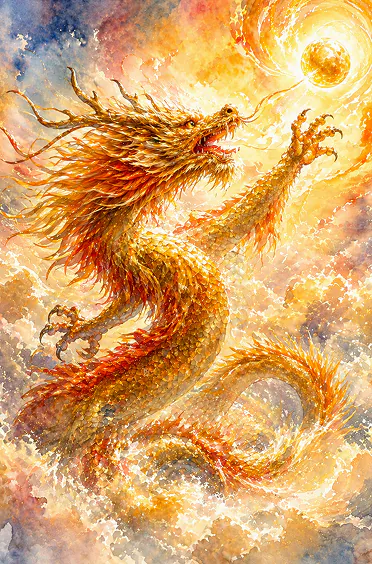
The Line Texts describe six stages of the Creative's energy, from the hidden dragon at the bottom to the overreaching dragon at the top. The famous line at the fifth position—"The flying dragon in the heavens. It furthers one to see the great man"—describes the moment when your power and position are at their peak. The line at the top—"Arrogant dragon will have cause to repent"—warns against overreaching.
The takeaway: When you receive Hexagram 1, you are being told that this is a time for confident, sustained action. You have the energy to initiate something important, but you must stay disciplined and avoid arrogance.
The Creative teaches that pure yang energy requires structure and perseverance to produce lasting results. Power without discipline becomes destruction.
The Receptive (Hexagram 2): The Complementary Pole
The Receptive is composed of six broken yin lines. Its lower trigram is Earth (☷) and its upper trigram is also Earth (☷) . This is pure yin energy: receptivity, devotion, endurance, and the power of supporting.
The Judgment reads: "The Receptive brings sublime success, furthering through the perseverance of a mare." Notice the difference from The Creative. The Creative succeeds through forward action; The Receptive succeeds through devoted service and patient endurance. The mare is the symbol—it serves the horse (the Creative) but does so with its own kind of strength.
The Image says: "The earth's condition is receptive devotion. Thus the superior person who has breadth of character carries the outer world." This is a profound inversion of the Creative's image. While The Creative urges you to move and act, The Receptive urges you to hold, contain, and support. The person of breadth "carries" the world rather than pushing against it.
The Line Texts trace the development of receptive energy. The first line—"Hoarfrost underfoot. Solid ice is near"—warns that small signs of decay, if ignored, will become hardened problems. The sixth line—"Dragons fight in the meadow. Their blood is black and yellow"—describes what happens when yin overreaches and tries to take the lead. The Receptive's power is real, but it must stay in its proper role.
The takeaway: When you receive Hexagram 2, you are being told that this is a time for patience, support, and careful attention to detail. Your power lies in your capacity to receive, nurture, and endure—not in forcing outcomes.
The Receptive shows that strength can also look like stillness, service, and patient endurance. Not every situation calls for forward action.
How Hexagram Meaning Shifts with Context
One of the most common mistakes beginners make is treating hexagram meanings as fixed. They read that Hexagram 1 means "success" and assume the outcome is guaranteed. But a hexagram's meaning changes dramatically depending on which lines are changing, what hexagram it is transforming into, and what question you asked.
Consider a reading where you cast Hexagram 3, Difficulty at the Beginning, with a changing line at the third position. The hexagram describes a situation of chaotic beginnings—like a sprout pushing through tangled roots. The third line says: "Whoever acts brings misfortune. If you persevere, danger threatens." This is a warning: do not force things. The situation is tangled, and pushing harder will only make it worse. But the changing line means the hexagram is moving toward Hexagram 46, Pushing Upward. This tells you that if you wait and let the situation clarify, the energy will eventually start rising in a positive direction.
The meaning is not "everything is difficult" or "everything will get better." The meaning is: right now, the energy is tangled. Your job is to stop pushing and let the situation breathe. If you do, upward movement will follow.
This is why you cannot read hexagram meanings in isolation. You must read them in relationship to:
• The changing lines (which tell you where the action is)
• The resulting hexagram (which shows where the energy is heading)
• The nuclear hexagram (the hidden pattern within the current one)
• The opposite hexagram (the complementary situation)
Practical Examples: Reading Hexagrams in Real Life
Example 1: A Career Decision
Situation: You have been offered a promotion that requires relocating your family. You cast the coins and receive Hexagram 37, The Family (The Clan), with a changing line at the fourth position.
How to read it: Hexagram 37 is about relationships, belonging, and the obligations of group life. The judgment says: "The family. The perseverance of the woman furthers." This is not about gender; it is about the receptive, binding energy that holds a group together. The fourth line says: "The head of the family. Good fortune." This line describes someone who takes responsibility for the well-being of the group. The changing line moves toward Hexagram 63, After Completion, which suggests a situation that is settled and ordered.
Next step: Your reading is telling you that the primary issue here is not the career opportunity itself but how it affects your family system. The hexagram advises you to take the role of the responsible leader—someone who considers the needs of everyone involved. The movement toward After Completion suggests that if you handle this with care and responsibility, things will settle into a good order. Do not decide based on ambition alone; decide based on what will hold your family together.
Example 2: A Relationship Conflict
Situation: You and your partner have been arguing about the same issue for months. You cast the coins and receive Hexagram 6, Conflict, with a changing line at the second position.
How to read it: Hexagram 6 is about open opposition. The judgment says: "You are sincere and are being obstructed. Be cautious halfway through." This is not a hexagram that promises resolution through fighting. The second line says: "One cannot engage in conflict. Return home, give way. The people of his town, three hundred households, remain free of guilt." This line describes a person who recognizes that continuing the fight will only cause more damage. They withdraw—not from weakness, but from wisdom. The changing line moves toward Hexagram 12, Standstill (Stagnation), which suggests a period of withdrawal and waiting.
Next step: The reading is telling you that continuing this conflict will not produce a resolution. The wise move is to step back and stop engaging. Let the tension cool. The movement toward Standstill indicates that there will be a period of distance, but that is better than escalating the fight. Use this time to reflect on what you actually need from the relationship, rather than trying to win the argument.
Example 3: A Creative Block
Situation: You are a writer who has not been able to produce anything for weeks. You cast the coins and receive Hexagram 4, Youthful Folly, with a changing line at the first position.
How to read it: Hexagram 4 is about the beginner's mind. The judgment says: "Youthful folly has success. It is not I who seeks the young fool; the young fool seeks me." This hexagram advises you to ask for help rather than trying to figure everything out on your own. The first line says: "A foolish youth. A person who makes a fool of themselves by not asking for guidance." The changing line moves toward Hexagram 41, Decrease, which suggests a need to simplify and let go of excess.
Next step: Your creative block is not a failure of talent; it is a failure of method. You are trying to force the work instead of opening yourself to learning. The hexagram advises you to seek out a teacher, a mentor, or even a new source of inspiration. The movement toward Decrease suggests that you need to strip away your expectations and perfectionism. Write badly. Write freely. Decrease your standards temporarily to get the flow moving again.
Common Mistakes When Reading Hexagram Meanings
• Treating hexagrams as fixed predictions. A hexagram does not tell you what will happen; it describes the quality of the present moment and the likely outcome if you continue on your current path. Change the path, and the outcome changes.
• Ignoring the line texts. Many people read only the judgment and assume they understand the hexagram. But the line texts are where the specific guidance lives. If you cast a hexagram with changing lines, those lines are the entire point of the reading.
• Confusing The Creative and The Receptive with good and bad. Neither hexagram is better than the other. The Creative is appropriate for initiating; The Receptive is appropriate for supporting. The mistake is trying to apply the energy of one to a situation that calls for the other.
• Reading hexagram meanings in isolation. A hexagram never stands alone. You must consider the changing lines, the resulting hexagram, and the question you asked. A hexagram that means "success" in one context may mean "danger of overreaching" in another.
Frequently Asked Questions
How do I know which line text to focus on in a hexagram?
The line texts you focus on are the ones that changed during your casting. If you cast a hexagram with three changing lines, you read all three. If no lines change, you read the judgment and the image only. The changing lines are where the energy is moving, and they tell you the most about your specific situation.
Can the same hexagram mean different things for different people?
Yes, because the hexagram describes a pattern of energy, not a fixed event. Two people asking different questions might receive the same hexagram but interpret it differently based on their context. The hexagram's meaning is shaped by the question, the changing lines, and the person's specific circumstances.
What if I get a hexagram that seems negative?
No hexagram is purely negative. Even hexagrams like Conflict (6) or Standstill (12) contain guidance for navigating difficult situations. The I Ching never tells you that you are doomed; it tells you what kind of energy is present and how to work with it. A "negative" hexagram is simply a more challenging pattern that requires more careful conduct.
How do I read a hexagram when no lines change?
When no lines change, you read only the judgment and the image. This is called a "stable" hexagram, and it indicates that the situation is settled and not in a state of transition. Your guidance comes from the overall pattern, not from any specific line. In this case, focus on the image text, which often contains the most practical advice.
Should I memorize all 64 hexagram meanings?
You do not need to memorize them. The I Ching is meant to be consulted, not memorized. With practice, you will naturally remember the patterns of the hexagrams you encounter most often. The goal is not to know every hexagram by heart but to develop a feel for how the trigrams combine and how the line positions create meaning.
Closing Reflection
The 64 hexagrams are not a code to be cracked. They are a language—a way of seeing the patterns that already exist in your life. When you learn to read them, you are not learning to predict the future; you are learning to recognize the present. The Creative shows you when to act. The Receptive shows you when to wait. The lines between them show you the thousand small movements that make up a human life. The more you read, the more you will notice these patterns appearing in your daily experience—a conflict that looks exactly like Hexagram 6, a moment of creative breakthrough that mirrors the fifth line of The Creative. This is not magic. It is pattern recognition, refined over three thousand years, offered to you as a tool for living with greater awareness and skill.
Turn this guide into your own reading
After reading the explanation, cast with a real question. We will carry your question into the reading flow so the result can be interpreted and saved.
Sources & References
Zhouyi / I Ching primary text
The received text of the Book of Changes, including the Judgment, Image, and line statements.
The I Ching or Book of Changes, Richard Wilhelm / Cary F. Baynes
Princeton University Press translation used as a major English-language reference point for names, structure, and commentary framing.
The Sacred Books of China: The Texts of Confucianism, James Legge
Classical English reference used for comparative reading of source terminology and commentarial tradition.
The Classic of Changes, Richard John Lynn
Modern scholarly translation consulted for comparative interpretation and editorial cross-checking.
Related Hexagrams
Continue from this guide into specific hexagram study.
Related Guides
Continue with adjacent guides for more context and deeper study.