

Foundations
I Ching vs Tarot vs Astrology vs Runes: A 3,000-Year Side-by-Side
I Ching vs Tarot vs Astrology vs Runes compared side-by-side. Same real question run through all four systems — see how each oracle answers differently and which fits your question.
You've probably tried tarot. Maybe you've skimmed your horoscope. But there's a good chance you've never seriously used the I Ching — even though it's roughly 3,000 years older than tarot, and arguably the oldest oracle still in continuous use anywhere on earth.
This article puts the four most popular divination systems side by side and runs the same real question through each one, so you can see — concretely — how they answer differently. No mystification, no "which one is best" hand-waving. By the end you'll know which system fits which kind of question, and whether you should be using more than one.
The Four Systems at a Glance
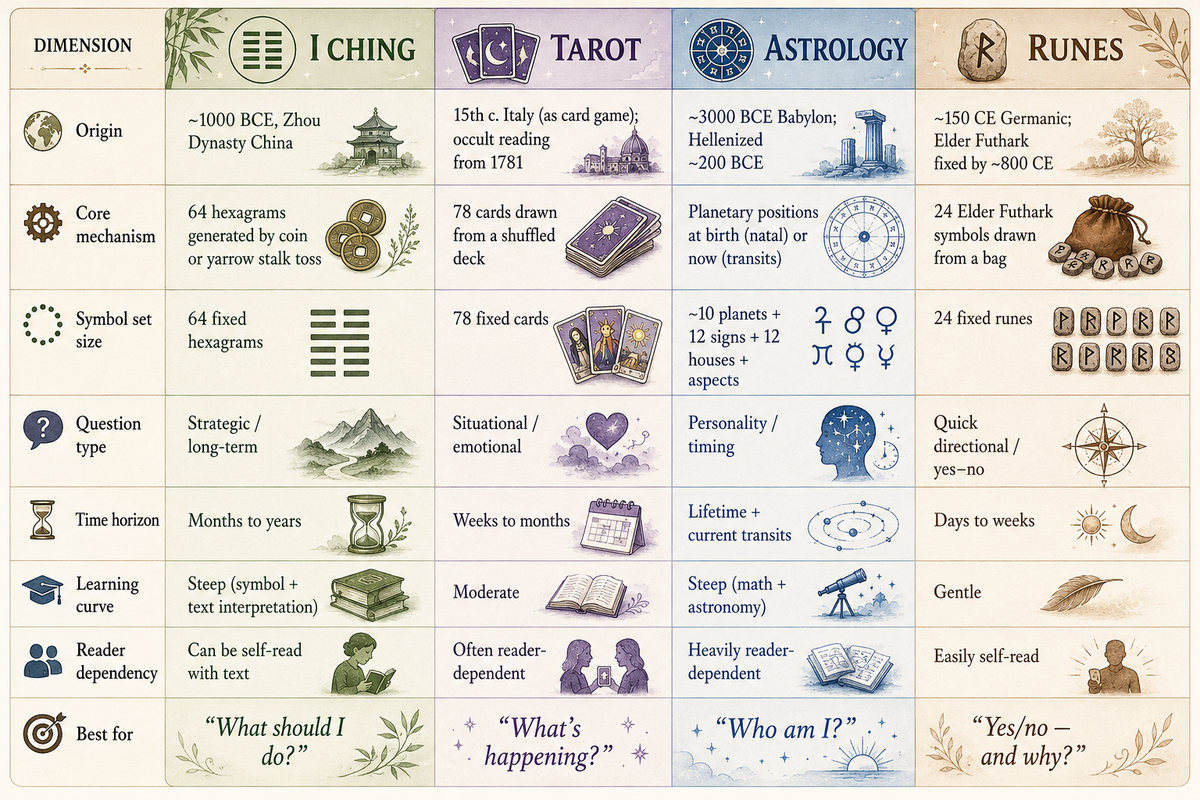
Before we get into philosophy and worked examples, here's the structural comparison. Most readers cite this table back to us, so we've kept it tight.
If you only remember one row, remember "question type". That's where most people mis-pick their oracle. Tarot readers who try the I Ching expecting a tarot-style reading almost always get a confusing answer — not because the I Ching is broken, but because they asked a tarot-shaped question.
Origin & Philosophy: Where Each System Comes From
I Ching — the Confucian oracle
The I Ching (易經, "Book of Changes") crystallized in China's Zhou Dynasty, around 1000 BCE, though its core ideas are older. Tradition attributes the hexagrams to King Wen of Zhou, who is said to have ordered the 64 figures and written judgments on them while imprisoned by the Shang. His son, the Duke of Zhou, is credited with the line texts. Whether or not the attribution holds, the textual layering is real: the jing (core text) is Bronze Age, the zhuan (commentaries) are Confucian-era, and the dominant Western translation by Richard Wilhelm (1950) layers both.
Philosophically, the I Ching isn't a "fortune-telling" book in the pop-culture sense. It's an ontology of change. The 64 hexagrams are generated from binary lines (yin / yang), and the central claim is that any situation contains its own transformation — every hexagram can change into any other by flipping lines. The methodology page on this site walks through how that works in practice.
The crucial consequence: the I Ching answers what you should do, not what will happen. It's advisory, not predictive.
Tarot — playing cards that became an oracle
Tarot starts in 15th-century Italy as a card game called tarocchi, played by northern Italian nobility. The 78-card structure (Major Arcana + Minor Arcana in four suits) existed for a century before anyone used it for divination. The occult turn comes in 1781, when Antoine Court de Gébelin published an essay claiming — wrongly — that the cards encoded ancient Egyptian wisdom. From there, Éliphas Lévi, the Golden Dawn, and eventually Arthur Edward Waite's 1909 Rider-Waite-Smith deck turned tarot into the system most readers recognize today.
The philosophical shift matters: tarot's symbol set is fixed but its interpretation is improvisational. Unlike the I Ching, where each hexagram has a written text you can look up, tarot spreads rely heavily on the reader's intuition about card combinations, positions, and reversals. This is why two tarot readers can give very different readings for the same cards — and why tarot is so often used for emotional exploration rather than strategic decision-making.
Astrology — the Babylonian sky-watch
Astrology is the oldest of the four by a wide margin. Babylonian priests were tracking planetary omens by 3000 BCE; the system was Hellenized around 200 BCE (giving us the 12-sign zodiac and aspects); and the Indian (Jyotish) and Western lineages diverged from there.
Astrology is also the only one of the four that doesn't generate symbols through chance. Your natal chart is fixed by the time and place you were born. Transits — current planetary positions hitting your natal positions — produce timing information: when a Saturn return happens, when a Jupiter transit opens a window. The implication: astrology answers "who am I, and when", not "what should I do today."
Runes — Odin's gift
The Elder Futhark — the 24-symbol runic alphabet used in modern divination — emerged among Germanic peoples around 150 CE and was fixed in form by about 800 CE. The mythic origin story (Odin hanging from Yggdrasil for nine nights to win the runes) is post-conversion literary framing, but it captures the symbolic logic: runes come from ordeal and reveal hidden structures.
In practice, modern runic divination uses 24 tiles (sometimes a 25th "blank rune," though purists reject it), drawn from a bag. The system is small and directional. Where tarot explores a situation in detail, runes tend to point — this, then this, with this obstacle. Most casts are 3 runes; complex casts rarely exceed 9.
How Each System Actually Answers a Question
This is where the comparison stops being academic. Let's take one real question and run it through all four systems.
The question: "Should I accept the job offer in Berlin?"
The questioner is a 34-year-old designer in Lisbon with a stable job, a partner, and a 2-year-old. The Berlin offer pays 40% more but requires relocation, a six-month probation period, and a switch from in-house design to agency work.
I Ching's answer
Casting three coins six times produces Hexagram 6, Song (Conflict / Contention), with the 9 in the third place changing. The changed hexagram is 47, Kun (Oppression / Exhaustion).
Reading the text: Hexagram 6 warns of a situation where two sides are locked in disagreement and counsel is needed — not court, not confrontation. The changing line in the third place is the most important line here: "He nourishes himself on ancient virtue. Perseverance brings danger. If he were to follow a king, the work could not be completed." The changed hexagram, 47, indicates exhaustion — being in a position where one's strength is insufficient to the situation.
The I Ching's advice: Don't sign yet. The conflict isn't about salary — it's about an underlying incompatibility you haven't articulated (likely the role change from in-house to agency, or the relocation impact on the partnership). Acting now leads to exhaustion. Wait. Articulate the conflict first. You can read the full text of Hexagram 6 and Hexagram 47 on this site.
Note what the I Ching did: it didn't say "yes" or "no." It said "here's the structure of your situation, here's what happens if you act from where you are now, and here's what to do instead." That's advisory, not predictive.
Tarot's answer
A three-card spread (situation / obstacle / advice) yields 8 of Swords / 2 of Wands / 4 of Pentacles.
The 8 of Swords (situation) shows the questioner feeling trapped — but the swords are loose, the blindfold is self-applied. The trap is mental, not material. The 2 of Wands (obstacle) shows someone at a threshold, holding the world in their hand but not yet stepping through. The 4 of Pentacles (advice) shows hoarding — clinging to what's already held.
Tarot's reading: The block isn't Berlin. The block is fear of the unknown coupled with attachment to current stability. The cards don't have an opinion on whether Berlin is right; they're pointing at the questioner's internal state, which is the actual obstacle to a clear decision.
Note the structural difference: tarot zeroed in on emotion and self-image. The I Ching zeroed in on structural conflict and time horizon. Same question, completely different lens.
Astrology's answer
Looking at current transits to the questioner's natal chart: transiting Saturn is one degree from a square to their natal Mercury, exact in 11 days. Saturn-Mercury squares mark periods when communication, contracts, and mental clarity are tested — exactly the kind of transit under which signing a contract feels heavier than it should.
Astrology's reading: This is a poor window for signing anything binding. The transit lifts in about three weeks. If Berlin is right, Berlin will still be right in late July. The decision itself isn't what's being tested; the timing is.
Again, notice: astrology spoke about when, not what.
Runes' answer
A three-rune cast (Odin's horn layout: overview / challenge / action) draws Thurisaz reversed / Ansuz / Kenaz.
Thurisaz reversed (overview) signals a thorn — a reactive, defensive energy, possibly a hasty decision. Ansuz (challenge) signals an incoming message or signal that needs to be heard — a conversation not yet had. Kenaz (action) signals the torch: illuminate, clarify, create through deliberate work.
Runes' reading: Hold. Something hasn't been said yet — possibly by the Berlin employer about the role, possibly by the partner about the move. Get that conversation done before deciding.
What the comparison shows
All four systems pointed at "not yet" — but for different reasons:
• I Ching: structural conflict in the offer itself
• Tarot: internal emotional block
• Astrology: timing / transit
• Runes: missing information
This is the single most useful insight from this exercise. Divination systems don't disagree because some are right and some are wrong. They disagree because each one is sensitive to a different layer of the situation. Use them like you'd use different instruments on a patient — the stethoscope and the MRI both tell you something true; they just see different things.
Which System Should You Use? — A Decision Framework
If you're choosing one system for a particular question, the decision comes down to two axes: what kind of question and what time horizon.
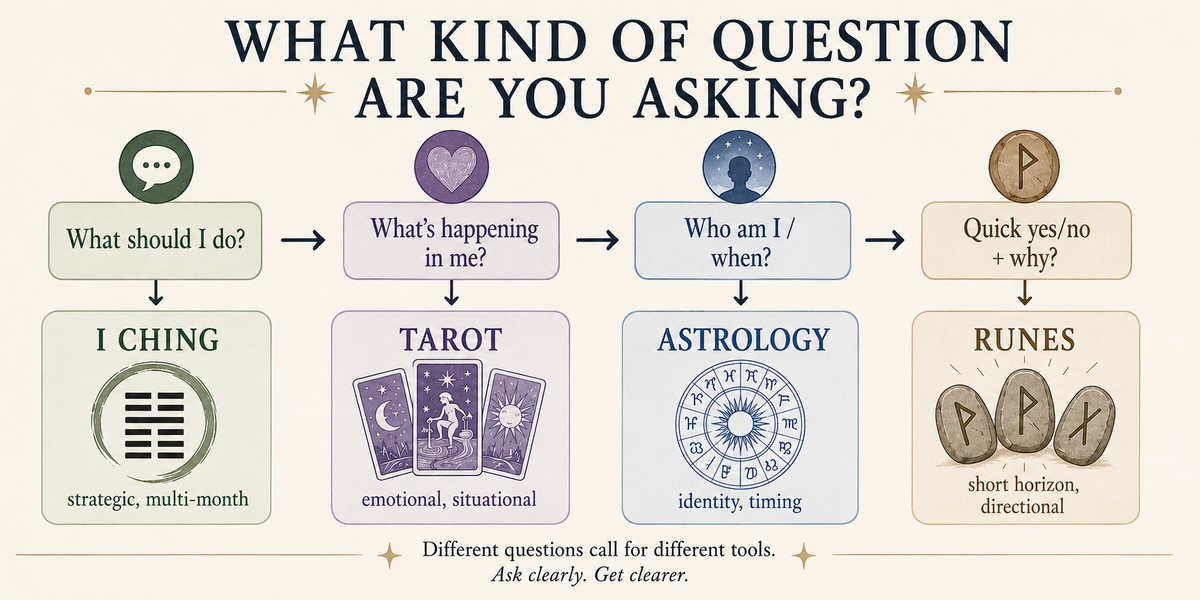
For readers who prefer a profile-based recommendation:
• The strategic decision-maker (career moves, business decisions, family questions with long tails) — I Ching. The fixed text and 64-symbol structure force you to confront the structure of your situation rather than your feelings about it. Try a free I Ching reading.
• The emotional explorer (relationship feelings, creative blocks, "why am I like this") — Tarot. The image-rich cards are designed to surface internal states; the reader-dependent interpretation is a feature, not a bug, when the question is about interiority.
• The self-knower (identity, life patterns, timing of major moves) — Astrology. The natal chart is a once-per-lifetime snapshot; nothing else on this list gives you that kind of durable self-model.
• The quick decider (do I send this email, is today good for the conversation, which option) — Runes. Small symbol set, fast casts, directional output.
A note on learning curves: tarot is the most accessible entry point for a complete beginner, because the images do a lot of the interpretive work. The I Ching has the steepest curve — you have to be willing to sit with a 3,000-year-old text and let it talk back to you. Many people who try the I Ching once and "don't get anything from it" are treating it like tarot and expecting image-driven intuition. It's a different mode of reading.
Can You Combine Them?
Yes, and serious practitioners often do — but with discipline. The mistake is to keep asking different systems until you get the answer you want. That's not divination; that's seeking permission.
A better pattern: pick a primary system for the question type, and use a second system only to check your interpretation of the first. For example:
1. Ask the I Ching for strategic advice on Berlin. Get Hexagram 6 → 47. Interpret: hold, there's hidden conflict.
2. Pull three runes to check what kind of conflict — get Thurisaz reversed (reactivity), Ansuz (unsent message), Kenaz (clarity through deliberate work). This refines the I Ching reading: the conflict is conversational, not material.
3. Don't then go pull tarot cards hoping for a "yes." That's the trap.
Used this way, the four systems are complementary instruments, not competing authorities. The 64 hexagrams on this site are designed to be referenceable from any reading — if a tarot reader pulls the 8 of Swords and wants to think structurally about being trapped, cross-referencing Hexagram 6 (Conflict) or Hexagram 29 (The Abysmal) can deepen the read without changing the system.
One genuine advantage of using the I Ching alongside Western systems: the I Ching is the only one of the four with a written canonical text that survives intact. You can read the original jing and decide for yourself what it means. Tarot has no canonical text (every reader interprets); astrology's texts are scattered across Hellenistic, Indian, and medieval traditions; runes have the rune poems but those are fragmentary. The I Ching gives you something to argue with.
A Note on "Accuracy"
People new to divination often ask which system is "most accurate." The question is malformed. Accuracy presupposes a fixed future being predicted. None of these systems — used well — claims to do that.
• The I Ching explicitly models situations as changing. The whole point is that the future isn't fixed; the reading tells you what this moment tends toward, so you can act differently.
• Tarot is a mirror, not a forecast. It shows the questioner's current state and the patterns around it.
• Astrology makes the strongest predictive claims, but they're about timing and archetypal weather, not specific events. Saturn return is real; whether it manifests as a career crisis or a divorce depends on the chart and the person.
• Runes are read as directional indicators — a thorn is in the path — not as guaranteed outcomes.
If a reader (human or AI) tells you a divination system "predicted" a specific event with certainty, you're dealing with theater. The value of these systems is structural insight at moments when ordinary thinking is stuck — not prophecy.
Conclusion
The four systems compared here have survived for between 600 and 5,000 years because each one does something the others can't. Tarot excels at the emotional interior. Astrology excels at identity and timing. Runes excel at quick directional clarity. The I Ching excels at strategic, structural, long-tail advice — and uniquely offers a written canonical text to argue with.
If you've only used tarot, the I Ching is the next system worth taking seriously. It will feel awkward at first — the answers come as texts, not images, and they don't flatter. But the discipline of reading a 3,000-year-old hexagram against a modern decision is, in our experience, where divination stops being entertainment and starts being useful.
Try a free I Ching reading → Start here.
Further Reading
• What is the I Ching? — a 5-minute primer
• The 64 Hexagrams, fully indexed — reference for any reading
• Our methodology — translations cited, AI boundary, editorial standards
• How to ask the I Ching a good question — the single biggest factor in getting useful answers
Turn this guide into your own reading
After reading the explanation, cast with a real question. We will carry your question into the reading flow so the result can be interpreted and saved.
Frequently Asked Questions
Sources & References
Zhouyi / I Ching primary text
The received text of the Book of Changes, including the Judgment, Image, and line statements.
The I Ching or Book of Changes, Richard Wilhelm / Cary F. Baynes
Princeton University Press translation used as a major English-language reference point for names, structure, and commentary framing.
The Sacred Books of China: The Texts of Confucianism, James Legge
Classical English reference used for comparative reading of source terminology and commentarial tradition.
The Classic of Changes, Richard John Lynn
Modern scholarly translation consulted for comparative interpretation and editorial cross-checking.
Related Hexagrams
Continue from this guide into specific hexagram study.
Related Guides
Continue with adjacent guides for more context and deeper study.