
Hexagram Career
Hexagram 60 (Limitation) in Career: I Ching Guidance for Work and Professional Life
What does Hexagram 60 (Limitation) mean for your career? Limitations are troublesome, but they are effective. If we live economically in normal times, we are prepared for times of want. To be sparing saves us from hum... Learn how the I Ching guides professional decisions, leadership, timing, and workplace dynamics.
Hexagram 60 (Limitation) in Career: I Ching Guidance for Work and Professional Life
You've been working seventy-hour weeks for months, chasing a promotion that keeps receding like a mirage. Or perhaps you're the manager who just imposed a strict new budget, and your team is bristling with resentment. Maybe you're the freelancer who said yes to every project until your calendar became a weapon of self-destruction. In each case, you're grappling with the same uncomfortable truth: something must give, and that something is you—your time, your energy, your willingness to say yes.
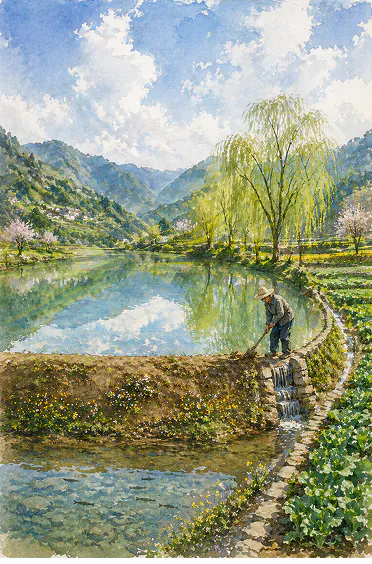
This is the territory of Hexagram 60, known in the Wilhelm/Baynes tradition as Limitation. Its structure—Water (Kan) above, Lake (Dui) below—pictures a finite body of water contained within a lake's shores. The water is inexhaustible in its source, yet the lake can hold only so much. The judgment tells us plainly: "Limitations are troublesome, but they are effective." This is not a hexagram about deprivation or punishment. It is a hexagram about form, about the shape that gives meaning to substance. In your career, this means understanding that boundaries are not your enemy—they are the vessel that makes your work possible.
Where this guide is most useful:
• When you feel overwhelmed by competing demands and need to set priorities without guilt
• When your organization is imposing new constraints (budgets, headcount, timelines) and you must adapt wisely
• When you recognize that your own lack of discipline is undermining your effectiveness and reputation
Understanding Limitation in Career & Work Context
The Image of Hexagram 60 describes a lake containing an infinite supply of water. This is not a metaphor for scarcity—it is a metaphor for discrimination. Just as the lake achieves its character by holding only what it can contain, you achieve professional significance by defining what you will and will not do. The Image text says: "Unlimited possibilities are not suited to man; if they existed, his life would only dissolve in the boundless. To become strong, a man's life needs the limitations ordained by duty and voluntarily accepted."
In career terms, this cuts against the grain of modern hustle culture. We are told to embrace abundance, to say yes to every opportunity, to keep our options open. But the I Ching observes that without limits, energy dissipates. Consider the difference between a river that spreads into a marsh—wide but shallow, losing itself in the soil—and the same river channeled between banks, gaining force and direction. Your career is that river. The limitations you accept—whether a specialized role, a manageable workload, or clear ethical boundaries—are what give your work power.
The trigram structure reinforces this. Water above (Kan) represents danger, the abyss, the unknown challenges that arise when boundaries are absent. Lake below (Dui) represents joy, openness, and the pleasure of completion. When water flows into a lake, it fills it peacefully. When it overflows, it becomes destructive. The judgment warns that we must "set limits even upon limitation"—meaning that excessive restriction is as harmful as none at all. The goal is not asceticism but appropriate form.
The judgment also offers a pragmatic economic insight: "If we live economically in normal times, we are prepared for times of want. To be sparing saves us from humiliation." This is not about penny-pinching. It is about building reserves—of time, energy, relationships, and resources—so that when your industry contracts, your company restructures, or your personal life demands attention, you have something to draw upon. The professional who works at a sustainable pace, maintains a network, and keeps skills current is living the wisdom of Hexagram 60.
How Limitation Shows Up in Real Career & Work Situations
Limitation appears in your professional life in patterns that are recognizable once you know what to look for. The most common is the boundary crisis: you take on one more project, accept one more meeting, respond to one more email after hours, and suddenly your work quality plummets. You become irritable, make errors, and resent the very career you chose. This is the lake overflowing its banks. The water has not changed—it is still abundant—but the container has failed. The solution is not to stop working but to rebuild the container.
Another pattern is the compliance trap. Your organization imposes new limitations—a hiring freeze, a travel ban, a mandate to cut costs by fifteen percent. Your instinct is to resist, to find workarounds, to lament the loss of freedom. But Hexagram 60 invites a different response: accept the limitation as the form within which you must now operate. The most effective professionals in constrained environments are those who treat the constraint as a creative parameter, not a prison. They ask, "Given these boundaries, what is now possible that wasn't before?" This is the wisdom of line 2, which says that when the time for action has come, hesitation is disastrous—but until that moment, collecting energy in stillness is essential.
The third pattern is self-imposed limitation that turns toxic. You decide to work weekends to get ahead. You commit to a zero-error standard. You refuse to delegate because "nobody else can do it right." These are limitations that violate the judgment's warning: "If a man should seek to impose galling limitations upon his own nature, it would be injurious." The line between discipline and self-violence is crossed when the limitation no longer serves your work but begins to consume it. Line 3 speaks directly to this: "If an individual is bent only on pleasures and enjoyment, it is easy for him to lose his sense of the limits that are necessary." But the opposite error—bent only on achievement, ignoring rest and joy—is equally destructive.
Takeaway: Limitation is not about how much you can endure. It is about what shape your work needs to take to be both effective and sustainable.
From Reading to Action — Applying Limitation
Applying Hexagram 60 in your career requires a shift from seeing boundaries as obstacles to seeing them as design elements. The first step is diagnostic: look at your current situation and identify where the container is either missing or cracked. Are you working without clear priorities? Is your team operating without defined roles? Are you spending energy on tasks that don't align with your core responsibilities? These are signs that Limitation is needed.
The second step is voluntary acceptance. The Image says the individual "attains significance as a free spirit only by surrounding himself with these limitations and by determining for himself what his duty is." This is crucial: the limitations must be chosen, not merely endured. Even if external constraints exist—a budget cut, a deadline, a scope reduction—you can choose how to interpret and embody them. That choice is where your freedom lives. Line 5 offers the model: "If a man in a leading position applies the limitation first to himself, demanding little from those associated with him, and with modest means manages to achieve something, good fortune is the result." Whether you lead a team or just yourself, start by applying the limitation to your own behavior before expecting it from others.
The third step is calibration. The judgment warns that "it is necessary to set limits even upon limitation." This means periodically reviewing whether your boundaries are still appropriate. Line 1 advises discretion: "If he rightly understands this and does not go beyond the limits set for him, he accumulates an energy that enables him, when the proper time comes, to act with great force." Notice the sequence: discretion first, then accumulated energy, then powerful action. You cannot skip to the power without the discipline. But line 4 warns against limitations that "require persistent effort"—these cost too much energy. A good limitation is like gravity: it operates naturally, without constant struggle.
Line 6 presents the danger of excessive severity: "If one is too severe in setting up restrictions, people will not endure them." This applies to self-imposed restrictions as well. The ascetic who denies all pleasure eventually rebels. The manager who micromanages every detail loses her team. The professional who refuses all social connection at work becomes isolated and brittle. The art of Limitation is knowing when to hold firm and when to yield.
Takeaway: Start with one area where you need better boundaries. Apply the limitation to yourself first. Observe the result. Adjust. Repeat.
Practical Examples
Example 1: The Overcommitted Freelancer
Situation: Maya is a graphic designer who built her business by saying yes to every client request. Now she works evenings and weekends, her creative quality has declined, and she dreads opening her email. She has no time for skill development or marketing, and her income has plateaued because she cannot take on higher-value work.
How to read it: Maya is living Hexagram 60's absence. Her lake has no shores—work flows in from every direction and she has no capacity to channel it. The judgment's warning about "galling limitations upon his own nature" applies here: her current approach is galling, but not because she has limits—because she lacks them. She needs to impose voluntary boundaries: a maximum number of projects, a minimum project fee, and defined non-working hours.
Next step: Maya should calculate her sustainable weekly capacity (say, 30 billable hours) and create a waiting list. When she reaches capacity, she stops accepting new work. She raises her rates by 20% for new clients. She blocks two hours each week for skill development. This will feel terrifying at first—line 1's discretion is required. But within three months, she will either earn the same for less work or earn more for the same work, and her creative energy will return.
Example 2: The Manager Facing a Budget Cut
Situation: David leads a marketing team that just learned their budget will be cut by 30% for the next fiscal year. His first instinct is to fight the decision, argue with leadership, and try to protect his team from the impact. His team senses his anxiety and morale is dropping.
How to read it: David is resisting the limitation rather than working within it. Hexagram 60 says limitations are "indispensable in the regulation of world conditions." The budget cut is a given—like winter following summer. David's task is not to deny winter but to prepare for it. Line 5 is his guide: he must apply the limitation to himself first, demanding less from his team while modeling frugality and focus.
Next step: David should meet with his team and acknowledge the constraint openly. Together, they identify the 20% of activities that produce 80% of results and commit to focusing on those. He cuts his own discretionary spending first—no conference travel, no new software subscriptions—before asking the team to sacrifice. He frames the limitation as a creative challenge: "Given what we have, what's the best work we can do?" This approach, grounded in the judgment's wisdom, will preserve morale and may even produce better work.
Example 3: The High-Achiever Burning Out
Situation: Priya is a senior consultant who prides herself on being available 24/7. She responds to emails within minutes, takes calls on vacation, and never says no to a new assignment. She has been promoted rapidly, but she is exhausted, her relationships are suffering, and she has started making small errors that are out of character.
How to read it: Priya has confused productivity with availability. Hexagram 60's line 3 warns: "If he gives himself over to extravagance, he will have to suffer the consequences, with accompanying regret." Her extravagance is not financial—it is the extravagance of overcommitment. She has lost the sense of limits that are necessary. The judgment says limitations "save us from humiliation"—and Priya is heading toward the humiliation of a major mistake or a health crisis.
Next step: Priya needs to establish non-negotiable boundaries: no email after 8 PM, one weekend day completely off, a maximum of four simultaneous projects. She should communicate these boundaries to her manager and clients not as a limitation but as a quality standard: "To give you my best work, I need to be fully present when I'm working, which means I need true rest when I'm not." She will likely face resistance initially—line 6's warning about severity applies—but if she applies the limitation to herself with integrity, others will adapt.
Takeaway: Each of these examples shows that the problem is not the limitation itself but the relationship to it. The right boundary, voluntarily chosen and consistently applied, creates freedom.
Common Mistakes
• Confusing Limitation with deprivation. The hexagram is not about punishing yourself or living in scarcity. It is about creating form that enables effectiveness. A musician does not resent the scale of the instrument—it is what makes music possible. Similarly, professional boundaries enable sustained high performance.
• Imposing limitations on others before yourself. Line 5 warns that restrictions will be resented if you evade them yourself. The manager who cuts team perks while keeping his own, the leader who demands punctuality while arriving late—these violations undermine the entire system of limitation.
• Applying one-size-fits-all boundaries. Hexagram 60 emphasizes due measure. What works for a startup founder may not work for a government administrator. The limitation must fit the situation. Line 4 notes that natural limitations—like water flowing downhill—require no struggle. Forced, unnatural limitations waste energy.
• Treating limitations as permanent. The judgment says we must set limits even upon limitation. Boundaries should be reviewed and adjusted as circumstances change. The discipline that served you during a product launch may become rigidity during a growth phase. Flexibility within form is the goal.
Frequently Asked Questions
What does Hexagram 60 mean for my career?
Hexagram 60 addresses the need for boundaries, structure, and discipline in professional life. It suggests that your current challenges may stem from a lack of clear limits—whether in time, energy, scope of work, or ethical standards. The hexagram advises you to voluntarily accept appropriate limitations to channel your efforts effectively. It is not about restriction for its own sake but about creating the container that makes meaningful work possible.
How can I use Limitation to improve my work-life balance?
The hexagram provides a framework for sustainable professional life. Start by identifying where your boundaries are weakest—perhaps you check email at all hours or take on projects without assessing capacity. Apply the limitation to yourself first: set specific work hours, define your maximum workload, and communicate these boundaries clearly. The judgment's economic principle applies here: conserve your energy in normal times so you have reserves when demands spike.
Is Hexagram 60 about being frugal at work?
Not exactly. The judgment mentions economy, but in the context of preparation and preservation, not stinginess. In career terms, this means investing your resources—time, attention, relationships—where they produce the greatest return. It means building professional reserves: a network you can call on, skills you can deploy, savings that give you negotiating power. Frugality without purpose becomes hoarding; economy with purpose becomes wisdom.
What if my company's limitations are unreasonable?
Hexagram 60 acknowledges that excessive limitation provokes rebellion (line 6). If your organization imposes constraints that genuinely harm your work or well-being, you have three options: work within the constraints to find creative solutions (line 5's approach), advocate for change by first demonstrating the value of the limitation you propose, or recognize that the environment is fundamentally incompatible with your needs and plan an exit. The hexagram does not counsel passive acceptance of destructive boundaries.
How do I know when I'm being too strict with myself?
The judgment provides the test: "If a man should seek to impose galling limitations upon his own nature, it would be injurious." If your self-imposed boundaries cause persistent misery, damage your health, or make you resent your work, you have crossed the line. Line 4 offers another clue: limitations that require "persistent effort" cost too much energy. A healthy limitation feels like a channel, not a cage. If you are constantly fighting your own rules, they are wrong.
Closing Reflection
Hexagram 60 does not promise that limitations will feel good. It promises that they will be effective. In your career, this means accepting that every path requires the exclusion of other paths. The specialist gains depth by forgoing breadth. The leader gains authority by accepting accountability. The sustainable performer gains longevity by accepting rest. The water in the lake does not resent the shore—it is the shore that gives the lake its identity, its stillness, its capacity to reflect the sky. Your work, too, needs its shores. The question is not whether you will accept limitations, but which ones you will choose, and whether you will choose them consciously and with integrity. That choice, made again and again, is what shapes a professional life worth living.
Turn this guide into your own reading
After reading the explanation, cast with a real question. We will carry your question into the reading flow so the result can be interpreted and saved.
Sources & References
Zhouyi / I Ching primary text
The received text of the Book of Changes, including the Judgment, Image, and line statements.
The I Ching or Book of Changes, Richard Wilhelm / Cary F. Baynes
Princeton University Press translation used as a major English-language reference point for names, structure, and commentary framing.
The Sacred Books of China: The Texts of Confucianism, James Legge
Classical English reference used for comparative reading of source terminology and commentarial tradition.
The Classic of Changes, Richard John Lynn
Modern scholarly translation consulted for comparative interpretation and editorial cross-checking.
Related Hexagrams
Continue from this guide into specific hexagram study.
Related Guides
Continue with adjacent guides for more context and deeper study.