
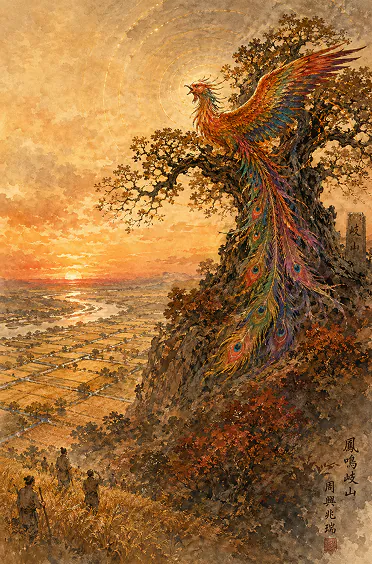
Hexagram Love
Hexagram 53 (Development [Gradual Progress]) in Love: I Ching Guidance for Relationships
What does Hexagram 53 (Development [Gradual Progress]) reveal about love and relationships? The development of events that leads to a girl’s following a man to his home proceeds slowly. The various formalities must be disposed of before the marriage ta... Explore how the I Ching guides emotional connection, dating, and partnership dynamics.
Hexagram 53 (Development [Gradual Progress]) in Love: I Ching Guidance for Relationships
You've been dating someone for six months, and everything feels right—but your friends keep asking why you haven't met their family yet. Or perhaps you're in a long-term partnership that's hit a plateau, and you're wondering whether to push for a commitment conversation or let things unfold naturally. Maybe you've just started seeing someone new, and the pace feels excruciatingly slow compared to your last relationship that burned hot and fast. In these moments, the ancient wisdom of the I Ching offers a perspective that feels counterintuitive to our speed-obsessed culture: slow progress is not failure—it is the foundation of lasting love.
Hexagram 53 (Development [Gradual Progress]) speaks directly to the art of allowing relationships to grow at their natural pace. The judgment describes "the development of events that leads to a girl's following a man to his home" as proceeding slowly, with proper formalities observed before marriage takes place. This image, drawn from classical Chinese courtship rituals, carries a universal truth: the most enduring bonds are built through patient, step-by-step development, not rushed declarations or forced intimacy. The hexagram's structure—Wind (Xun) above, Mountain (Gen) below—reinforces this wisdom. The mountain represents stability and stillness, the grounded foundation that cannot be hurried. The wind represents gentle, penetrating influence that shapes and molds over time, not through force. Together, they describe a relationship that develops through steady, organic growth rather than dramatic upheaval.
If you've been feeling anxious about the pace of your relationship, or if you're caught between the desire for deeper connection and the fear of moving too fast, this hexagram is your guide. It does not promise quick results or easy answers. Instead, it offers something more valuable: permission to trust the process of gradual development, and the wisdom to recognize when patience is not passivity but the most active form of love.
Where This Guide Is Most Useful
• You are in the early stages of a relationship and feel pressure (internal or external) to accelerate commitment before you're ready
• You are in a long-term partnership that has plateaued, and you're unsure whether to push for change or allow natural evolution
• You are healing from a relationship that burned out because it moved too fast, and you want to build something more sustainable this time
Understanding Development [Gradual Progress] in Love & Relationships Context
The judgment of Hexagram 53 opens with an image that might feel dated at first: "The development of events that leads to a girl's following a man to his home proceeds slowly. The various formalities must be disposed of before the marriage takes place." But strip away the historical context, and you find a timeless principle about relationship development. The "formalities" here are not bureaucratic hurdles—they are the natural stages of courtship, trust-building, and mutual discovery that cannot be skipped without cost. In modern terms, this means allowing a relationship to pass through its necessary phases: getting to know each other, establishing trust, navigating conflicts, building shared experiences, and only then making deeper commitments.
The Image of the hexagram—a tree growing on a mountain—deepens this understanding. The tree does not shoot up like a swamp plant; its growth proceeds gradually, and its development influences the landscape of the entire region. In relationships, this speaks to how two people's gradual development together shapes not just their own bond but the wider community around them—friends, family, and future generations. When you rush a relationship, you deny it the time needed to develop roots that can weather storms. When you allow gradual progress, you give your partnership the chance to become something that others can look to as an example.
The trigram structure offers further insight into how this plays out in love. The lower trigram, Mountain (Gen), represents stillness, stability, and the capacity to wait. This is the quality of being able to sit with uncertainty, to enjoy the present moment without constantly grasping for the next stage. The upper trigram, Wind (Xun), represents gentle penetration and adaptability. In relationships, this is the ability to influence your partner not through demands or ultimatums but through consistent, gentle presence that gradually shapes the dynamic. Together, they describe a relationship where both partners can hold steady while also being flexible and responsive to each other's needs.
Takeaway: Development [Gradual Progress] teaches that the most stable relationships are built through patient, step-by-step evolution, not rushed commitments or forced intimacy.
How Development [Gradual Progress] Shows Up in Real Love & Relationships Situations
Hexagram 53 often appears in situations where a relationship is moving at a pace that feels uncomfortable—either too slow for one partner or too fast for the other. The classic scenario is the early-stage relationship where one person wants to define the relationship after three dates while the other needs months to feel secure. But the hexagram can also manifest in long-term partnerships where growth has stalled, and the question becomes whether to force change or trust that development is happening beneath the surface.
Another common pattern involves relationships that form across significant differences—cultural, age, life stage, or personality. The judgment's emphasis on "correct relationships of co-operation" speaks to situations where two people must learn to work together despite their differences. This might look like a couple navigating different communication styles, or partners from different backgrounds learning to honor each other's traditions. The gradual progress principle applies here because such differences cannot be resolved in a single conversation; they require ongoing, patient negotiation and mutual adaptation.
The hexagram also speaks to the internal work of relationship readiness. The judgment notes that "the essential factor is a correct way of development through cultivation of one's own personality." This means that before you can build a healthy partnership, you must do the work of becoming someone capable of partnership. This might look like therapy, healing from past wounds, developing emotional regulation skills, or simply learning to be comfortable alone. Hexagram 53 reminds us that this preparatory work is not wasted time—it is the foundation upon which everything else is built.
Takeaway: When Hexagram 53 appears, it signals that your relationship is in a phase of organic growth that cannot be forced—trust the process and attend to your own development.
From Reading to Action: Applying Development [Gradual Progress]
The first step in applying Hexagram 53 to your relationship is to assess whether you are honoring the natural stages of development. This means asking honest questions: Have you truly gotten to know this person, or are you in love with the idea of them? Have you navigated real conflict together, or have you only experienced the honeymoon phase? Have you seen each other under stress, in mundane daily life, and in moments of vulnerability? If the answer to these questions is no, then rushing toward deeper commitment would be like trying to harvest fruit before it's ripe.
The moving lines offer specific guidance for different situations. Line 1 describes the initial stage—"the shore is reached"—where a young person is just starting out and no one comes to help. In relationship terms, this is the phase of first connection, where everything feels tentative and uncertain. The advice is to accept the slowness and allow the difficulties to keep you from being too hasty. If you're in this phase, resist the urge to force the relationship into a defined shape. Let it be what it is, even if that feels uncomfortable.
Line 3 warns against rushing into struggle: "If we do not let things develop quietly but plunge of our own choice too rashly into a struggle, misfortune results." This speaks directly to the temptation to force a "defining the relationship" conversation or to push for commitment before both partners are ready. The line advises that if you do not provoke conflict but instead maintain your position and ward off unjustified attacks, all goes well. In practice, this means expressing your needs without demanding immediate resolution, and trusting that the relationship will develop in its own time.
Line 5 addresses a more advanced stage where one partner may feel isolated or misjudged by the other. The line describes a high position where "one is misjudged by the very person on whom one is dependent." In a relationship, this might look like feeling misunderstood by your partner, or feeling that your efforts are not recognized. The wisdom here is that these misunderstandings clear away in the course of further development. The key is not to force reconciliation but to continue showing up with patience and consistency, trusting that time will reveal the truth.
Takeaway: Apply Development [Gradual Progress] by honoring each stage of your relationship's growth, resisting the urge to rush, and trusting that patient consistency will lead to lasting connection.
Practical Examples
Example 1: The New Relationship That Feels Too Slow
Situation: Maya has been dating Alex for four months. They have wonderful chemistry, deep conversations, and genuine affection. But Alex hasn't introduced Maya to any friends or family, and when Maya tries to talk about the future, Alex becomes evasive. Maya's friends tell her Alex is wasting her time.
How to read it: This is a classic Hexagram 53 situation, specifically resonating with Line 1's image of the young person just starting out, with no one coming to help. Alex may need more time to feel secure, or may be processing past relationship trauma. The hexagram advises against pushing for faster progress. The slowness is not rejection—it is the natural pace of development for this particular relationship.
Next step: Maya should communicate her feelings without making demands. She might say, "I want you to know I'm feeling ready to integrate our lives more, but I also want to respect your pace. Can we talk about what would feel comfortable for you?" This honors both partners' needs while keeping the door open for gradual progress.
Example 2: The Long-Term Partnership That Has Plateaued
Situation: David and Priya have been together for seven years. They love each other but feel stuck in a rut. David wants to try couples therapy; Priya feels the relationship is fine and doesn't need fixing. They've been having the same argument for six months.
How to read it: This situation aligns with Line 5 of Hexagram 53, where one partner feels misjudged by the other. David's desire for growth is being interpreted by Priya as criticism of the relationship. The hexagram advises patience: these misunderstandings clear away in the course of further development. The couple is in a plateau, not a decline.
Next step: David could approach the situation with gentleness rather than urgency. Instead of pushing for therapy, he might suggest a low-pressure activity that could spark new connection—a weekend away, a shared hobby, or simply asking Priya what she would like to explore together. The goal is not to fix the relationship but to create conditions for organic growth.
Example 3: The Relationship Forming Across Differences
Situation: Elena is 32 and recently divorced; James is 28 and has never been in a serious relationship. They connect deeply but feel the age and experience gap acutely. Elena worries James isn't ready for the kind of partnership she wants; James feels intimidated by Elena's life experience.
How to read it: This is a textbook Hexagram 53 situation, resonating with the judgment's emphasis on "correct relationships of co-operation" and the Image's tree growing on a mountain. The differences between Elena and James are not obstacles but features of their unique landscape. Gradual progress is essential because each partner must learn to navigate the other's world at a pace that feels safe.
Next step: Elena and James should create intentional spaces for learning about each other's experiences without pressure. James might ask Elena to share what she learned from her marriage, not as a warning but as part of getting to know her. Elena might ask James about his hopes for a first serious relationship. The key is curiosity without agenda, allowing understanding to develop naturally.
Common Mistakes
• Mistaking slowness for lack of interest: Hexagram 53's gradual progress is not the same as indifference or avoidance. A partner who needs time to develop trust is not necessarily one who doesn't care. The hexagram teaches that the pace of development is not a measure of love's depth.
• Rushing to define the relationship: Many people interpret the early uncertainty of a relationship as a problem to be solved by labeling it. Hexagram 53 warns that premature definition can destroy the organic development that leads to lasting commitment.
• Interpreting the hexagram as permission to stay in a stagnant situation: Gradual progress is not the same as no progress. The hexagram emphasizes perseverance—slow movement is still movement. If a relationship shows no signs of development over many months, this may not be Hexagram 53 but a different pattern entirely.
• Using the hexagram to avoid difficult conversations: Patience is not the same as silence. Hexagram 53 encourages gentle, penetrating communication (the wind above the mountain), not avoidance of necessary discussions. The key is how you communicate, not whether you communicate.
Frequently Asked Questions
How is Hexagram 53 different from Hexagram 52 (Keeping Still)?
Hexagram 52 is about stillness and withdrawal—knowing when to stop. Hexagram 53 is about gradual, forward movement. In relationships, Hexagram 52 might appear when you need to pause and reflect, while Hexagram 53 appears when you need to continue moving forward but at a natural, unhurried pace. Think of 52 as the brake and 53 as the slow, steady acceleration.
Can Hexagram 53 apply to a relationship that's already in crisis?
Yes, but with caution. If a relationship is in active crisis—betrayal, abuse, or fundamental incompatibility—gradual progress may not be the right frame. Hexagram 53 works best when the foundation is sound but the pace of development feels off. If the relationship is fundamentally unhealthy, other hexagrams (like 39, Obstruction, or 36, Darkening of the Light) may be more relevant.
How long does "gradual progress" typically take?
The I Ching does not give timelines, and the answer depends entirely on the specific relationship. For some couples, gradual progress might mean a few months of dating before commitment. For others, it might mean years of patient development. The key is not the calendar but the quality of the progression—are you actually moving forward, even if slowly?
What if my partner doesn't believe in "gradual progress"?
This is a common challenge. If your partner wants to move faster (or slower) than you do, Hexagram 53 advises gentle, penetrating influence rather than confrontation. You might share the hexagram's wisdom without using its language: "I feel like our relationship is developing in a really beautiful way, and I want to honor that by not rushing. Can we talk about what pace feels right for both of us?"
Does Hexagram 53 mean I should never initiate important conversations?
No. The hexagram does not advise passivity. It advises timing and approach. The wind (gentle influence) is active, not passive. You can and should initiate conversations about your relationship—but do so with gentleness, patience, and respect for your partner's process. The goal is not to force a particular outcome but to create conditions for mutual understanding to develop.
Closing Reflection
Hexagram 53 (Development [Gradual Progress]) offers a countercultural wisdom in a world that celebrates speed, instant connection, and rapid commitment. It reminds us that the most enduring love is not the one that burns brightest and fastest but the one that grows like a tree on a mountain—slowly, steadily, and with roots deep enough to withstand any storm. When you find yourself in a relationship that feels like it's moving too slowly, ask not whether the pace is wrong, but whether you are honoring the natural stages of development. Trust that the patience you practice today is the foundation of the love that will sustain you tomorrow. The wild goose does not rush its flight from shore to summit; it rests at each stage, calls to its companions, and arrives at its destination in its own time. So too can you arrive at the love you seek—not by forcing the journey, but by trusting the gradual progress of your own becoming.
Turn this guide into your own reading
After reading the explanation, cast with a real question. We will carry your question into the reading flow so the result can be interpreted and saved.
Sources & References
Zhouyi / I Ching primary text
The received text of the Book of Changes, including the Judgment, Image, and line statements.
The I Ching or Book of Changes, Richard Wilhelm / Cary F. Baynes
Princeton University Press translation used as a major English-language reference point for names, structure, and commentary framing.
The Sacred Books of China: The Texts of Confucianism, James Legge
Classical English reference used for comparative reading of source terminology and commentarial tradition.
The Classic of Changes, Richard John Lynn
Modern scholarly translation consulted for comparative interpretation and editorial cross-checking.
Related Hexagrams
Continue from this guide into specific hexagram study.
Related Guides
Continue with adjacent guides for more context and deeper study.