
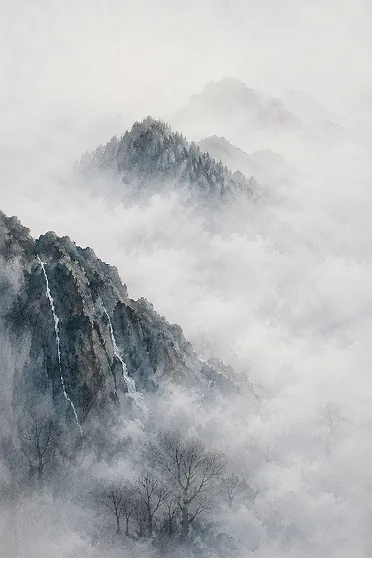
Hexagram Study
Hexagram 52 (Keeping Still [Mountain]) in Study: I Ching Guidance for Learning and Growth
What does Hexagram 52 (Keeping Still [Mountain]) teach about study and learning? True quiet means keeping still when the time has come to keep still, and going forward when the time has come to go forward. In this way rest and movement are i... See how the I Ching guides intellectual growth, skill development, and the discipline of deepening knowledge.
Hexagram 52 (Keeping Still [Mountain]) in Study: I Ching Guidance for Learning and Growth
Introduction
You've been studying for hours. Your eyes are dry, your notes are a blur, and the harder you push, the less you retain. Every time you try to force another concept into your tired mind, the words slide away like water off stone. You know you should stop, but the exam is looming, and stopping feels like failure. What if the most productive thing you could do right now is nothing at all?
This is the territory of Hexagram 52, known as Keeping Still [Mountain]. In the I Ching, this hexagram consists of the trigram Mountain resting above Mountain—a doubling of stillness that speaks to the profound power of knowing when to stop. The Judgment tells us that "true quiet means keeping still when the time has come to keep still, and going forward when the time has come to go forward." This is not laziness or avoidance. It is the highest form of wisdom in learning: the ability to recognize that mastery grows not only through action, but through the quality of our pauses.
If you have ever felt the frustration of diminishing returns in your studies, or sensed that your frantic effort was actually working against you, Hexagram 52 offers a radically different path. It teaches that the deepest learning happens when we learn to rest—not as a break from learning, but as an essential part of it.
Where This Guide Is Most Useful
• You are in the middle of an intense study period and feel your comprehension slipping. The material once made sense, but now you're rereading the same paragraph five times. You need to recognize that continuing forward is no longer serving you—the time for stillness has come.
• You struggle with information overload and cannot decide what to focus on next. Your desk is covered with books, articles, and notes, and every new piece of information seems to contradict the last. You need the stillness that allows you to see the shape of what you already know before adding more.
• You are preparing for a major assessment and feel anxious about your preparation. The pressure to perform creates a frantic energy that actually impairs your ability to think clearly. You need to understand that true preparation includes the discipline of stopping.
Understanding Keeping Still [Mountain] in Learning & Study Context
The Image of Hexagram 52 offers a striking observation: "The heart thinks constantly. This cannot be changed, but the movements of the heart—that is, a man's thoughts—should restrict themselves to the immediate situation. All thinking that goes beyond this only makes the heart sore." For the student, this is both a diagnosis and a prescription. Your mind will naturally race, worry about the future, replay past mistakes, and generate anxiety about what you haven't yet learned. The Mountain does not try to silence this activity by force. Instead, it teaches containment—bringing your attention back to what is directly in front of you.
When we apply this to study, the Mountain represents the discipline of staying within the bounds of your current task. If you are reading chapter three, your thoughts should stay with chapter three—not drift to the final exam, not worry about whether you're studying fast enough, not compare yourself to classmates. The Judgment describes this as "rest and movement are in agreement with the demands of the time." In learning, this means that there is a time for active engagement—taking notes, solving problems, testing yourself—and a time for passive stillness—letting the material settle, allowing connections to form unconsciously.
The doubling of Mountain over Mountain is significant. It suggests that stillness is not a single act but a sustained practice. One moment of stopping is easy; maintaining that orientation as a way of being in your studies is the real challenge. The trigram structure also points to the back, which in the classical commentary represents the nerve fibers that mediate movement. When these are stilled, "the ego, with its restlessness, disappears." For the learner, this means setting aside the ego's demands—the need to prove yourself, the fear of falling behind, the pride of getting it right—so that you can simply be present with the material.
"Whoever acts from these deep levels makes no mistakes." The deepest study is not about doing more, but about being fully where you are.
How Keeping Still [Mountain] Shows Up in Real Learning & Study Situations
The most recognizable manifestation of Hexagram 52 in study is the phenomenon of the "study plateau." You have been making steady progress, understanding new concepts, building competence. Then suddenly, you hit a wall. Nothing new seems to stick. Reviewing old material feels pointless, but moving forward feels impossible. This is the Mountain meeting Mountain—a natural boundary that signals it is time to stop pushing and allow what you have learned to integrate.
Another common scenario is the student who studies everything except what matters most. They read supplementary texts, watch related videos, organize their notes by color—all while avoiding the difficult core material. This is a form of restless movement disguised as productivity. Hexagram 52 exposes this pattern by asking: What would it look like to truly keep still with the hard thing? To sit with your confusion without immediately fleeing into easier tasks?
The third dynamic is the most subtle: the student who cannot stop thinking about studying even when they are not studying. They carry their books to dinner, feel guilty when they take a break, and mentally rehearse material during conversations. Their mind is never at rest. The Mountain teaches that this constant mental churn actually impairs learning. The Image warns that "all thinking that goes beyond this only makes the heart sore." When your study thoughts invade every moment of your life, you lose the restorative stillness that allows memory consolidation and insight to occur.
True stillness in study means being able to put the book down completely—not as a failure, but as a deliberate act of wisdom.
From Reading to Action: Applying Keeping Still [Mountain]
Applying Hexagram 52 to your study practice begins with a fundamental shift in how you view stopping. Most students see breaks as necessary evils—time lost that must be compensated for later. The Mountain teaches that stillness is not a loss of time but a different quality of time. The Judgment says that "the hexagram signifies the end and the beginning of all movement." Every period of active study should be bookended by intentional stillness, just as every exhalation is followed by an inhalation.
Start by examining your current study sessions. Where are you pushing when you should be pausing? The first moving line of Hexagram 52, "Keeping the toes still," speaks to halting before movement even begins. In practice, this means setting clear boundaries before you start studying. Decide in advance how long you will work, what you will cover, and when you will stop. This prevents the gradual erosion of your focus into restless, unfocused effort.
The fifth line, "Keeping the jaws still," addresses the problem of talking too much about your studies. Many students dissipate their learning energy by constantly discussing what they are studying, seeking reassurance, or explaining concepts before they have fully understood them. The line advises restraint in speech—letting your understanding crystallize in silence before you attempt to articulate it. This is especially valuable when you are confused. Instead of immediately asking for help or searching for explanations, sit with the confusion. Let the question deepen. The answer will emerge more clearly from stillness than from frantic searching.
For the advanced student, the sixth line represents "keeping still at the nape of the neck"—a complete surrender of the restless self. This is the state where you no longer need to prove anything through your studying. You study because the material itself is worthy of attention, not because you need a grade or a credential. When you reach this level, your learning becomes effortless because it is no longer burdened by ego. The line says this "confers peace and good fortune in relation to every individual matter."
The highest mastery in study is not knowing everything, but knowing when to rest in not-knowing.
Practical Examples
Example 1: The Exam Cram That Backfires
Situation: You have three days before a major exam and realize you have not covered half the material. Your instinct is to study every waking hour, cutting sleep and meals to maximize time. After eight hours of this, you cannot remember what you read ten minutes ago.
How to read it: This is a violation of the Judgment's core teaching: "keeping still when the time has come to keep still." Your mind is telling you it needs rest, but your fear is overriding that signal. The second line warns of the leg being stopped while the body continues to move—you are trying to halt your exhaustion while continuing to push forward. This creates a dangerous fall.
Next step: Stop studying for at least two hours. Sleep for a full eight hours tonight. When you resume, use the Pomodoro technique: 25 minutes of focused study followed by 5 minutes of complete stillness (no phone, no review, just silence). Trust that the rest will allow your brain to consolidate what it has already absorbed.
Example 2: The Over-Organizer
Situation: You spend more time organizing your study materials than actually studying. You have color-coded notes, multiple digital tools, and a complex system of flashcards, but you have not actually learned the core concepts. You feel busy but not productive.
How to read it: The third line of Hexagram 52 describes "enforced quiet"—trying to subdue the restless heart by forcible means. Your organizing is a form of resistance to the discomfort of actually learning. The Image warns that "fire when it is smothered changes into acrid smoke." Your forced productivity is creating mental pollution that makes real learning impossible.
Next step: Choose one subject. Close all your organizing tools. Open a blank notebook. Write down what you actually know about the subject without consulting any resources. Sit with your ignorance. Let the gaps in your knowledge be visible. This uncomfortable stillness is where real learning begins.
Example 3: The Constant Reviewer
Situation: You have already learned the material well, but you keep reviewing it because you are afraid of forgetting. You spend hours going over what you already know, never moving to new material. Your progress has stalled completely.
How to read it: This is a failure to recognize that "going forward when the time has come to go forward" is equally important as keeping still. The fourth line describes someone who can keep the heart at rest but has not yet been liberated from the ego's dominance. Your fear of forgetting is an ego attachment—you want to feel secure in your knowledge rather than trust the learning process.
Next step: Do a single, timed review of the material you know—no more than 30 minutes. Then close the book and move to new material. Trust that the old material is integrated. If you forget something, you will encounter it again naturally through application. The stillness of letting go is more powerful than the restless grip of review.
The Mountain does not cling to the clouds that pass over it. It simply remains.
Common Mistakes
• Confusing stillness with laziness. Keeping Still [Mountain] is not an excuse to procrastinate or avoid difficult work. It is a deliberate, disciplined pause that requires more courage than pushing forward. The Judgment explicitly says there is a time for movement as well as rest. Using this hexagram to justify inaction is a misunderstanding of its core teaching.
• Trying to force your mind to be quiet. The third line specifically warns against this. If you try to suppress thoughts through sheer willpower, you will create "acrid smoke" that suffocates your learning. True stillness comes from allowing thoughts to arise and pass without engaging them, not from fighting them.
• Applying stillness only to your study sessions, not to your life. The Mountain is a total orientation. If you study with discipline but then spend your breaks scrolling through social media or worrying about your performance, you have not truly kept still. The stillness must extend to your entire relationship with learning.
• Believing that more study time always equals more learning. This is the most common mistake Hexagram 52 addresses. The quality of your attention matters far more than the quantity. A single hour of Mountain-like stillness followed by focused study will produce more learning than four hours of restless, anxious effort.
Frequently Asked Questions
Does Hexagram 52 mean I should stop studying entirely?
No. The Judgment explicitly says there is a time to go forward and a time to keep still. Hexagram 52 is about discernment—knowing which time you are in right now. If you are making genuine progress, continue. If you are spinning your wheels, stop. The Mountain does not forbid movement; it teaches that movement must arise from stillness.
How do I know when it's time to keep still versus time to push through?
The first line of Hexagram 52 advises paying attention to the beginning. If you feel resistance before you even start a study session, that is a sign to pause and examine your intention. If you are in the middle of studying and your comprehension drops sharply, that is a sign to stop. The Image says thoughts should "restrict themselves to the immediate situation." Ask yourself: Is my current effort producing learning, or just activity?
Can this hexagram help with writer's block or creative blocks in study projects?
Absolutely. The third line's warning against enforced quiet is directly relevant to creative blocks. Trying to force inspiration or understanding will only create more blockage. Instead, practice the stillness of the fourth line: keep the heart at rest even while the work remains unfinished. Step away from the project entirely. Let the unconscious mind work. Often, the answer comes when you stop looking for it.
Is there a risk that I will use this hexagram to avoid studying I don't want to do?
Yes, this is a real danger. The ego is clever and will use any teaching to serve its own ends. The key is honesty: Are you pausing because your mind genuinely needs rest, or because you are avoiding discomfort? The Mountain does not avoid difficulty—it sits with it. If you are using stillness to escape, you will feel a restless dissatisfaction even in your rest. True stillness brings peace, not guilt.
How does this hexagram apply to group study or collaborative learning?
In group settings, Hexagram 52 can be applied to the group's collective energy. If the group is spinning in circles, talking without learning, it may be time for a period of silent individual reflection. The group can agree to keep still together—reading silently, taking notes alone, then reconvening. The Mountain teaches that collective wisdom often emerges from shared stillness, not from constant discussion.
Closing Reflection
The Mountain does not rush. It does not apologize for its stillness, nor does it explain itself. It simply endures, allowing the seasons to pass over it, holding space for whatever grows in its shadow. In your studies, Hexagram 52 invites you to become like the Mountain—not passive, but profoundly present. The next time you feel the urge to push harder, to study longer, to force understanding through sheer effort, pause. Ask yourself if this is the time for movement or the time for stillness. The answer will not come from a book or a teacher. It will come from the quiet center of your own mind, the place where the Mountain has always been waiting.
Turn this guide into your own reading
After reading the explanation, cast with a real question. We will carry your question into the reading flow so the result can be interpreted and saved.
Sources & References
Zhouyi / I Ching primary text
The received text of the Book of Changes, including the Judgment, Image, and line statements.
The I Ching or Book of Changes, Richard Wilhelm / Cary F. Baynes
Princeton University Press translation used as a major English-language reference point for names, structure, and commentary framing.
The Sacred Books of China: The Texts of Confucianism, James Legge
Classical English reference used for comparative reading of source terminology and commentarial tradition.
The Classic of Changes, Richard John Lynn
Modern scholarly translation consulted for comparative interpretation and editorial cross-checking.
Related Hexagrams
Continue from this guide into specific hexagram study.
Related Guides
Continue with adjacent guides for more context and deeper study.