
Hexagram Study
Hexagram 50 (The Caldron) in Study: I Ching Guidance for Learning and Growth
What does Hexagram 50 (The Caldron) teach about study and learning? While THE WELL relates to the social foundation of our life, and this foundation is likened to the water that serves to nourish growing wood, the present hexagr... See how the I Ching guides intellectual growth, skill development, and the discipline of deepening knowledge.
Hexagram 50 (The Caldron) in Study: I Ching Guidance for Learning and Growth
Introduction
You sit at your desk, surrounded by books and notes, feeling the weight of everything you need to learn. The material is dense, the deadlines are real, and somewhere beneath the surface anxiety, you sense this work matters—not just for the grade or the credential, but because it connects to something larger in your life. You want to absorb it deeply, transform it into understanding you can actually use. But how do you move from passive consumption to genuine mastery? How do you make the knowledge your own, so it nourishes you and fuels your next steps?
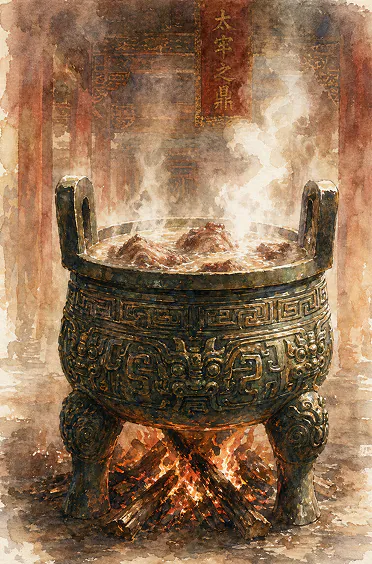
This is precisely the territory of Hexagram 50: The Caldron. In the I Ching, the Caldron is the sacred vessel used for cooking offerings in ancient Chinese rituals. Its judgment speaks directly to the process of transformation: wood below feeds the fire above, and what emerges is something consecrated, clarified, and made useful. The trigram structure—Wind (Xun) below, Fire (Li) above—mirrors this dynamic. Wind fans the flames, just as disciplined effort feeds intellectual fire. This hexagram is not about quick results or surface-level learning. It is about the slow, patient work of turning raw material into something that can sustain you and serve others. If you have ever felt that your studies should mean more than they currently do, or that you are capable of deeper understanding than you are currently achieving, The Caldron speaks directly to your situation.
Where This Guide Is Most Useful
• When you are studying material that feels disconnected from your life—whether academic theory, professional certification content, or self-directed learning—and you want to integrate it so it becomes part of who you are.
• When you feel unrecognized or undervalued in your learning journey—perhaps you are in a program where your contributions go unnoticed, or you are studying alone and wonder if the effort will ever matter to anyone else.
• When you are preparing for a significant intellectual or creative offering—a thesis, a presentation, a book, a major exam—and you need to transform scattered knowledge into something cohesive and powerful.
Understanding The Caldron in Learning & Study Context
The Caldron is not a passive container. It is a vessel that actively transforms what is placed inside it. The judgment makes this clear: "All that is visible must grow beyond itself, extend into the realm of the invisible." In learning, this means that the facts, concepts, and techniques you acquire are not ends in themselves. They are fuel for a fire that should produce something greater—understanding, wisdom, the ability to see patterns and make connections that were not obvious before. The Caldron asks you to move from collecting information to cooking it, from memorization to digestion, from knowing about something to knowing it from the inside.
The Image of the hexagram reinforces this: "The fate of fire depends on wood; as long as there is wood below, the fire burns above." In study, the wood is your raw material—the books, lectures, exercises, and experiences you gather. The fire is your active, questioning mind. But notice: the wood must be placed correctly. If it is too wet, it will not burn. If it is piled too tightly, the fire will suffocate. If there is too little, the fire will die. This is a precise metaphor for the conditions of effective learning. You need the right materials, arranged in the right way, with enough space for the fire of your mind to do its work. And you need patience—the fire does not consume everything at once. It transforms gradually, releasing the energy stored in the wood.
The trigrams deepen this understanding. Wind below represents penetration, subtle influence, the steady force of repeated effort. Fire above represents clarity, illumination, the light of understanding. Together they describe a learning process that is both gentle and powerful. You do not force understanding through brute memorization or willpower alone. Instead, you create conditions where understanding can emerge naturally—by returning to the material, by letting it simmer, by allowing questions to rise and settle. This is why Hexagram 50 is so valuable for learners who feel stuck: it reminds you that transformation is not about intensity alone, but about the right relationship between what you bring and how you tend it.
The Caldron teaches that true learning is not accumulation but transformation—raw knowledge must be cooked by sustained attention until it becomes nourishment you can live by.
How The Caldron Shows Up in Real Learning & Study Situations
The Caldron appears most vividly when you are in the middle of a serious intellectual effort and feel the gap between where you are and where you need to be. Perhaps you are studying for a comprehensive exam and the material feels overwhelming—you have read the books, taken the notes, but the connections between ideas remain elusive. This is the moment when The Caldron's structure becomes visible. The wood (your raw material) is present, but the fire (your active comprehension) has not yet caught. The solution is not to add more wood—more reading, more notes—but to tend the fire differently. Re-read with a question in mind. Explain a concept out loud to yourself. Draw a diagram that shows how ideas relate. These actions create the airflow that Wind represents, fanning the flames of understanding.
Another common scenario is the feeling of being undervalued or overlooked in your learning. Line 3 of Hexagram 50 speaks directly to this: "If the handle is altered, the ting cannot be lifted up and used, and, sad to say, the delicious food in it... cannot be eaten by anyone." In a study context, this describes a situation where your knowledge and abilities are real, but no one seems to notice or care. Perhaps you are in a class where the teacher does not call on you, or a study group where your contributions are dismissed, or a job where your expertise is ignored. The line's counsel is subtle but powerful: do not abandon your inner work. Continue to develop the substance of your understanding. The time will come when the handle is restored—when circumstances change or when you find the right vessel for your offering. The "fall of rain" that the line promises represents release, the moment when tension breaks and your work finds its audience.
Line 2 offers another recognizable pattern: "If a man concentrates on such real undertakings, he may indeed experience envy and disfavor, but that is not dangerous." In a learning environment, this often shows up as the discomfort of outgrowing your peers or your own previous self. When you commit seriously to study, you may face subtle resistance—from people who think you are trying too hard, from your own inner critic who whispers that you are not smart enough, from the culture that sometimes dismisses deep learning as impractical. The line's reassurance is that these reactions are not dangerous if you stay focused on the substance of your work. The envy and disfavor are like smoke from the fire—unpleasant but not harmful to the cooking itself.
When you feel unseen in your learning, The Caldron reminds you that the quality of what you are cooking matters more than who is watching the pot.
From Reading to Action — Applying The Caldron
Applying Hexagram 50 to your study practice begins with a shift in orientation. Instead of asking "How much do I know?" ask "What am I transforming?" This changes everything about how you approach learning. It means that the goal is not to cover material but to digest it, not to pass tests but to internalize understanding, not to accumulate credentials but to become someone who can think and act with genuine competence. The practical steps that follow come directly from the moving lines of the hexagram, each of which describes a specific situation and the appropriate response.
Line 1, at the bottom of the hexagram, speaks about clearing the vessel. "If a ting is turned upside down before being used, no harm is done—on the contrary, this clears it of refuse." In study, this means starting by clearing away what does not serve you. Before you begin a new learning project, take stock of your mental and physical workspace. What old assumptions, bad habits, or incomplete understandings are you carrying? What distractions clutter your attention? The line's metaphor of the concubine who comes to honor through her son is a reminder that humble beginnings are no obstacle—what matters is that you are willing to purify yourself and begin fresh. Practical action: spend one session before starting a new subject reviewing what you already know, identifying gaps, and setting aside any pride or fear that might block fresh learning.
Line 4 warns against inadequate preparation and divided attention. "Weak character coupled with honored place, meager knowledge with large plans, limited powers with heavy responsibility, will seldom escape disaster." In study, this shows up when you take on more than you can handle—registering for too many courses, attempting a project beyond your current skill level, or trying to learn everything at once. The remedy is honest self-assessment. Before committing to a learning goal, ask: Do I have the time, energy, and foundational knowledge this requires? If not, what can I set aside or simplify? The line's warning is not meant to discourage ambition but to protect the quality of your work. A Caldron that is too full will spill and waste its contents.
Line 5 describes the leader who remains approachable and finds able helpers. "Here we have, in a ruling position, a man who is approachable and modest in nature. As a result of this attitude he succeeds in finding strong and able helpers who complement and aid him in his work." For the learner, this means recognizing that you do not have to do everything alone. Seek out teachers, mentors, study partners, and resources that complement your own strengths and weaknesses. The key is the attitude of approachability and modesty—being open to help without shame, willing to ask questions without pretense. Practical action: identify one person who knows more than you about what you are studying and ask them a specific question. Or join a study group where you can both give and receive support.
Line 6, at the top, speaks about the sage who imparts wisdom with mildness and purity, like precious jade. "Thus the work finds favor in the eyes of the Deity, who dispenses great good fortune, and becomes pleasing to men, wherefore all goes well." This is the culmination of the learning process—the point where your transformed understanding becomes something you can offer to others. Whether you teach, write, present, or simply apply your knowledge in your work, the final stage of The Caldron is generosity. You have cooked the meal; now it is time to serve it. The line's counsel is about how you offer what you have learned: with gentleness, clarity, and purity of intention. Not to show off, but to nourish.
The Caldron's six lines map a complete learning journey: clear the vessel, stay focused on substance, resist the temptation to overreach, seek help humbly, and finally offer what you have learned with generosity.
Practical Examples
Example 1: The Graduate Student Preparing for Comprehensive Exams
Situation: Maria is a second-year doctoral student facing her comprehensive exams in six months. She has read hundreds of articles and books, but when she tries to explain the major debates in her field, the connections feel fuzzy. She feels pressure from her advisor and peers and worries she will fail.
How to read it through Hexagram 50: Maria has plenty of wood—her reading is extensive. But the fire is not catching because she has been accumulating without digesting. This is the situation of the early lines of The Caldron, particularly Line 1's call to clear the vessel. She needs to stop adding new material and instead turn her existing knowledge over and over, asking questions: How does this author's argument connect to that one? What assumptions do they share? Where do they disagree fundamentally?
Next step: Maria should spend one week doing nothing but creating concept maps of the material she already has. For each major topic, she draws a central idea and maps the scholars who have contributed to it, noting agreements and disagreements. This act of spatial organization helps the fire catch—the wood is arranged so the flame can spread. After this week, she can return to reading, but now she reads with a map in mind, placing each new piece of information where it belongs.
Example 2: The Self-Taught Programmer Who Feels Invisible
Situation: James has been teaching himself web development for two years. He has built several impressive projects and can discuss architecture patterns with confidence. But he works alone, has no formal credentials, and when he applies for jobs, he gets no response. He wonders if his effort has been wasted.
How to read it through Hexagram 50: James is living Line 3 of The Caldron—the handle has been altered, and the delicious food cannot be eaten. His knowledge is real and valuable, but the vessel (his current situation) has no way to lift it. The line's counsel is not to give up but to continue developing the substance of his work while waiting for the handle to be restored. The "fall of rain" that the line promises will come—perhaps through a networking connection, a portfolio review that leads to a referral, or a project that gains visibility.
Next step: James should focus on making his work visible in ways he has not tried. He can contribute to open-source projects, write technical blog posts explaining his projects, or attend local meetups where he can show his work to real people. The key is to keep cooking—continue building and learning—while actively seeking the right handles for his vessel. The line promises that the time will come when the difficulties are resolved.
Example 3: The Undergraduate Overwhelmed by Course Load
Situation: Priya is a third-year engineering student who registered for five demanding courses this semester. She is falling behind in all of them, sleeping poorly, and feeling like she is learning nothing deeply. She thought she could handle the load but now realizes she was overconfident.
How to read it through Hexagram 50: This is a textbook case of Line 4: "Weak character coupled with honored place, meager knowledge with large plans, limited powers with heavy responsibility." Priya's ambition exceeded her current capacity. The line's warning is clear—this situation will not end well unless she changes course. The Caldron is not about how much you can pile in; it is about how well you transform what you have.
Next step: Priya needs to reduce her load immediately. She should drop one course (or two, if necessary) and focus on doing excellent work in the remaining ones. This is not failure—it is the wisdom of the Caldron, which knows that a vessel that is too full cannot cook properly. She should also assess her study methods: is she reading passively? Is she reviewing material regularly? The reduction in quantity will allow an increase in quality, and she will learn more deeply from three courses than she would from five.
Each of these examples shows that The Caldron's wisdom is practical: it tells you when to add fuel, when to wait, when to ask for help, and when to offer what you have made.
Common Mistakes
• Confusing accumulation with transformation. Many learners believe that reading more, watching more lectures, or taking more notes equals learning. The Caldron insists that the real work is cooking—processing, connecting, applying. A library of unread books is not knowledge; it is potential fuel that has not been lit.
• Expecting immediate results. The Caldron's fire does not burn everything at once. It takes time for understanding to deepen, for patterns to emerge, for knowledge to become second nature. Learners who expect to master a subject in a few weeks are like someone who keeps opening the oven to check if the bread is done—they let the heat escape and slow the process.
• Neglecting the vessel itself. The Caldron is not just about the fire and the wood; the vessel matters. In study, the vessel is your mind and body—your health, your environment, your habits. Trying to learn when you are exhausted, distracted, or disorganized is like trying to cook in a cracked pot. The contents will leak out.
• Forgetting that the meal is meant to be shared. The final purpose of The Caldron is offering—the transformed knowledge is meant to nourish others. Learners who hoard their understanding, who never teach or write or apply what they know, miss the culmination of the process. The hexagram ends with the sage imparting wisdom, not keeping it secret.
Frequently Asked Questions
How is Hexagram 50 different from Hexagram 46 (Pushing Upward) for study?
Hexagram 46 describes steady, upward progress—climbing a mountain step by step. It is about advancement and growth in a straightforward sense. Hexagram 50, The Caldron, is about transformation rather than simple progress. It describes a process where raw material is fundamentally changed into something new. If you are studying for incremental improvement, Pushing Upward may apply. If you are trying to integrate knowledge so deeply that it changes how you think and act, The Caldron is your guide.
Can The Caldron apply to group study or collaborative learning?
Yes, powerfully so. The hexagram's image of wood feeding fire can describe a group where each person contributes different fuel—knowledge, perspective, energy—and the collective fire of discussion transforms it into shared understanding. Line 5's counsel about finding able helpers applies directly to study groups. The key is that the group must function as a single vessel, with each member playing a role that serves the whole.
What does it mean if I get The Caldron as a response to a question about whether I should continue my studies?
It is strongly affirmative, but with a condition. The hexagram says the work is worthwhile and will lead to great good fortune and success. However, it also asks you to examine how you are approaching your studies. Are you merely accumulating information, or are you actively transforming it? Are you patient with the process? Are you willing to clear away what does not serve you? The Caldron says yes to your question, but it also asks you to cook your knowledge properly.
How do I know if I am in Line 3 of The Caldron—unrecognized but valuable?
You feel it as a specific kind of frustration. You know your material well, you can explain it clearly to yourself, but no one in your current environment seems to recognize or value what you know. You may be in a class where your contributions are ignored, a job where your expertise is not used, or a self-study situation where you have no one to share your understanding with. The line's counsel is to continue developing your substance while waiting for the right opportunity. The "fall of rain" will come—the release of tension and the recognition you seek.
Is The Caldron only for academic study, or does it apply to practical skill learning?
It applies to any form of learning that involves transformation. If you are learning a craft, a trade, a sport, or an art, The Caldron's principles hold. The wood is the practice, the exercises, the mistakes. The fire is the gradual internalization of skill until it becomes second nature. The offering is the work you produce or the service you provide. The key is the same: do not just go through the motions; let the practice change you.
Closing Reflection
The Caldron does not promise that learning will be easy or quick. It promises that if you approach your studies with the right relationship between fuel and fire, between effort and patience, between accumulation and transformation, you will produce something of genuine value—knowledge that nourishes you and can nourish others. The hexagram's final image is of the sage offering wisdom with the mildness and purity of jade, finding favor with both the divine and the human. This is the culmination of learning: not just knowing, but becoming someone whose knowledge serves the world. The work of study, when done rightly, is sacred work. Tend your fire well, and the meal will be worth the waiting.
Turn this guide into your own reading
After reading the explanation, cast with a real question. We will carry your question into the reading flow so the result can be interpreted and saved.
Sources & References
Zhouyi / I Ching primary text
The received text of the Book of Changes, including the Judgment, Image, and line statements.
The I Ching or Book of Changes, Richard Wilhelm / Cary F. Baynes
Princeton University Press translation used as a major English-language reference point for names, structure, and commentary framing.
The Sacred Books of China: The Texts of Confucianism, James Legge
Classical English reference used for comparative reading of source terminology and commentarial tradition.
The Classic of Changes, Richard John Lynn
Modern scholarly translation consulted for comparative interpretation and editorial cross-checking.
Related Hexagrams
Continue from this guide into specific hexagram study.
Related Guides
Continue with adjacent guides for more context and deeper study.