
Hexagram Love
Hexagram 5 (Waiting [Nourishment]) in Love: I Ching Guidance for Relationships
What does Hexagram 5 (Waiting [Nourishment]) reveal about love and relationships? Waiting is not mere empty hoping. It has the inner certainty of reaching the goal. Such certainty alone gives that light which leads to success. This leads to t... Explore how the I Ching guides emotional connection, dating, and partnership dynamics.
Hexagram 5 (Waiting [Nourishment]) in Love: I Ching Guidance for Relationships
You’ve been dating someone for six months. The connection is real—you share values, you laugh easily, the physical chemistry is undeniable. But something feels suspended. They haven’t introduced you to their friends. Conversations about the future are met with warm but vague smiles. You find yourself checking your phone more often than you’d like, replaying their last message, wondering if you should push for clarity or pull back to protect yourself. You’re not in crisis, exactly. But you’re not at peace, either. You’re waiting.
This is the territory of Hexagram 5, known as Waiting [Nourishment]. In the I Ching, this hexagram describes a situation where danger lies ahead—represented by the upper trigram Water (Kan), the abysmal—while strength and clarity lie below, in the trigram Heaven (Qian). The Judgment tells us that waiting is not empty hoping. It carries an inner certainty of reaching the goal, and that certainty alone provides the light that leads to success. For those navigating love and relationships, this hexagram offers a radically different framework: not waiting for something to happen, but waiting in a way that nourishes you. It asks you to hold your ground with truthfulness, patience, and good cheer, even when the outcome is uncertain.
If you’ve ever felt stuck in a romantic limbo—unsure whether to wait, leave, or push harder—this guide is for you. We’ll explore what Waiting [Nourishment] means for relationships, how to recognize its patterns in your life, and how to move through this phase without losing yourself.
Where This Guide Is Most Useful
• You are in a relationship that feels stalled or asymmetrical—you’re ready for more commitment, but your partner seems hesitant or unready. You’re unsure whether to wait or walk away.
• You have recently ended a relationship and are in the “in-between” period—not yet healed, not ready to date, but restless with the emptiness. You need to learn how to wait well.
• You are single and actively hoping for a partner, but nothing is materializing—you’ve done the work, put yourself out there, and still feel like you’re waiting for rain that won’t come.
Understanding Waiting [Nourishment] in Love & Relationships
The name of this hexagram is deceptively gentle. Waiting sounds passive, even weak. But the I Ching’s Judgment makes clear that this is anything but passive resignation. It says: “Waiting is not mere empty hoping. It has the inner certainty of reaching the goal.” In love, this means waiting is only fruitful when it is grounded in a deep, honest conviction about what you want—and who you are.
The trigram structure is key here. Below, Heaven (Qian) represents strength, creativity, and initiative. Above, Water (Kan) represents danger, the unknown, and emotional depth. The danger is real—you could get hurt, rejected, or disappointed. But Heaven is below Water, meaning your inner strength is the foundation. You are not a victim of circumstances. You are a strong person choosing to wait because the timing is not yet right, not because you lack the courage to act.
In relationships, this hexagram often appears when you are facing a “great water”—a significant step like moving in together, getting engaged, having a difficult conversation, or committing to a long-distance future. The danger is that you might rush in prematurely, driven by anxiety or impatience, and find yourself stuck in the mud (as Line 3 warns). Or you might withdraw entirely, mistaking caution for wisdom. Waiting [Nourishment] offers a third path: remain present, stay truthful with yourself, and let the situation ripen.
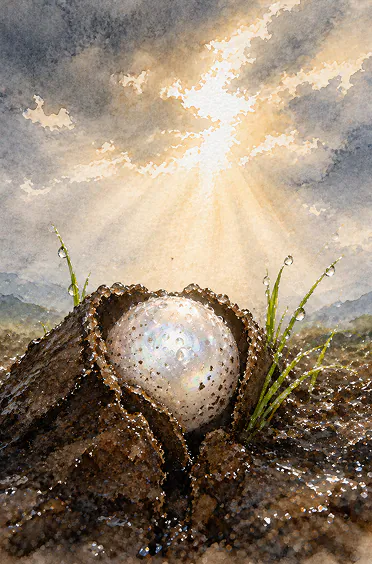
The Image reinforces this: “When clouds rise in the sky, it is a sign that it will rain. There is nothing to do but to wait until the rain falls.” You cannot make it rain by worrying. But you can fortify yourself—eating and drinking, finding gladness and good cheer—so that when the rain comes, you are ready to receive it. In love, this means tending to your own life, your friendships, your creative work, your physical health. The waiting period is not dead time. It is nourishment time.
Takeaway: Waiting [Nourishment] is not about passively hoping your partner will change. It is about actively cultivating the inner certainty and strength to meet whatever comes—whether that is union or release.
How Waiting [Nourishment] Shows Up in Real Love & Relationships Situations
Imagine you’ve been in a relationship for two years. You love each other, but your partner is ambivalent about marriage. They say they need more time. You feel the weight of uncertainty pressing on your chest. Every conversation about the future feels like walking on thin ice. This is Waiting [Nourishment] in its classic form. The danger (Water) is real—you might invest years and still not get the commitment you want. But your strength (Heaven) is also real—you know what you want, and you are capable of acting on that knowledge.
What makes this hexagram so powerful is that it distinguishes between two kinds of waiting. One is anxious, grasping, and exhausting. You check your phone constantly. You rehearse conversations in your head. You try to control outcomes through subtle manipulation—being extra nice, pulling back, dropping hints. This is not Waiting [Nourishment]; it is waiting that depletes you. The other kind of waiting is grounded, calm, and truthful. You acknowledge the uncertainty without letting it define your worth. You continue to live your life fully. You speak your truth when the moment is right, and then you let go of the result.
Another common scenario: you are newly single after a long relationship. You feel the urge to fill the emptiness immediately—dating apps, rebound flings, distraction. But something in you knows you need to wait. The clouds have not yet gathered. The rain has not yet come. If you force a new relationship now, you may find yourself in mud (Line 3)—stuck, half-in and half-out, vulnerable to harm. Waiting [Nourishment] asks you to trust the fallow period. To eat and drink, to find gladness and good cheer, to let yourself be nourished by solitude.
The lines of this hexagram describe the progression of waiting. In Line 1, the danger is far off; you are still on the open plain. This is the early stage of a relationship or the early stage of a breakup. Conditions are simple. The advice: continue living a regular life. Do not waste your strength prematurely. In Line 2, the danger draws closer. Disagreements arise. You may be tempted to blame your partner or yourself. The advice: stay calm. Slander (or self-criticism) will be silenced if you do not gratify it with injured retorts. In Line 3, you have made a premature start and gotten stuck. You are in the mud. The advice: be cautious. Recognize your mistake without self-flagellation. In Line 4, the situation is dire—blood seems imminent. This is the crisis point. The only way out is to stand fast and let fate take its course. In Line 5, there is an interval of peace. Enjoy it. Fortify yourself. Do not abandon your goal. In Line 6, the waiting is over. You fall into the pit. But then—unexpectedly—help arrives. Keep your mind alert. Greet the new turn with respect.
Takeaway: Waiting [Nourishment] in relationships is not a single static state. It is a process with phases. Knowing which phase you are in helps you respond wisely rather than reactively.
From Reading to Action: Applying Waiting [Nourishment]
How do you move from recognizing the pattern to living it? The first step is uncompromising truthfulness with yourself. The Judgment says: “It is only when we have the courage to face things exactly as they are, without any sort of self-deception or illusion, that a light will develop out of events.” In love, this means asking hard questions: Am I waiting because I genuinely believe this relationship has a future, or because I am afraid of being alone? Am I staying because I love this person, or because I am invested in a fantasy of who they might become? Am I patient, or am I avoiding conflict?
The second step is to distinguish between waiting for and waiting in. Waiting for is future-oriented and anxious. It says: “I will be happy when X happens.” Waiting in is present-oriented and grounded. It says: “I am fully alive right now, even in uncertainty.” The Image tells us to fortify the body with food and drink and the mind with gladness and good cheer. This is not a metaphor for comfort eating. It is a practice. When you feel the ache of waiting, ask yourself: What would nourish me today? A walk in the woods? A phone call with a friend? Time to paint, write, cook, dance? Waiting [Nourishment] is an active practice of self-care.
The third step is to watch the moving lines. If you have consulted the I Ching and received a changing line in Hexagram 5, that line offers specific guidance. For example, if you received Line 2 (Waiting on the Sand) , you may be in a phase where disagreements are cropping up. The advice: stay calm. Do not escalate. Let small grievances pass. If you received Line 5 (Waiting at the Feast) , you are in an interval of peace. The advice: enjoy it. Do not ruin the present moment by worrying about the future. If you received Line 6 (One Falls into the Pit) , you may be facing an ending or a crisis. The advice: do not withdraw in bitterness. Stay alert. Help may come from an unexpected direction.
Takeaway: Applying Waiting [Nourishment] means acting on what is within your control—your truthfulness, your self-care, your responses—while releasing what is not—the timing, the other person’s readiness, the final outcome.
Practical Examples
Example 1: The Ambivalent Partner
Situation: You have been dating for a year. You want to move in together. Your partner says they love you but “aren’t ready.” You feel stuck between hope and resentment.
How to read it: This is Waiting [Nourishment] with the danger of the abyss (Kan) above you. Your partner’s ambivalence is the water you must cross. Your inner strength (Qian) is your clarity about what you want. The danger is that you will either push too hard (falling into the mud of Line 3) or suppress your needs entirely (losing yourself in false patience).
Next step: Practice uncompromising truthfulness. Tell your partner what you want, without ultimatums or drama. Then wait—not passively, but with full engagement in your own life. Set a personal timeline for how long you are willing to wait. Use that time to nourish yourself. If the rain does not come, you will know what to do.
Example 2: The Post-Breakup Void
Situation: You ended a three-year relationship six months ago. Everyone says you should “get back out there,” but you feel hollow. You try dating apps and feel worse.
How to read it: This is Waiting [Nourishment] in its most nourishing form. The clouds are gathering, but the rain has not yet fallen. The Image tells you to eat and drink and find gladness and good cheer. The danger is that you will force the rain—jump into a new relationship to avoid the emptiness—and end up stuck in mud.
Next step: Commit to a season of intentional waiting. No dating. No scanning for potential partners. Instead, fill your life with what nourishes you: friendships, movement, creativity, rest. Trust that the rain will come when the clouds are full. Your job is to be ready.
Example 3: The Long-Distance Limbo
Situation: You and your partner live in different cities. You have a plan to close the distance in eight months, but the waiting is excruciating. You argue more than usual. You wonder if the relationship can survive the distance.
How to read it: This is Waiting [Nourishment] with the “great water” clearly in view. The Judgment says that inner certainty gives the power to cross the great water. Your challenge is to maintain that certainty without letting anxiety erode it. The lines warn against blame (Line 2) and premature action (Line 3).
Next step: Create rituals of connection that sustain you during the wait. Weekly video dates. Shared playlists. A countdown calendar that celebrates progress rather than emphasizing absence. When arguments arise, pause. Ask: Is this about the distance, or about something deeper? Nourish the relationship with small, consistent acts of care. The crossing will come.
Common Mistakes
• Mistaking Waiting [Nourishment] for indefinite tolerance. This hexagram does not tell you to wait forever. It tells you to wait with inner certainty. If you have no certainty—if you are waiting because you are afraid to leave—you are not practicing Waiting [Nourishment]; you are practicing avoidance.
• Using “patience” as an excuse to avoid difficult conversations. Waiting [Nourishment] requires uncompromising truthfulness. If you are silent about your needs because you don’t want to rock the boat, you are not waiting wisely. You are hiding.
• Confusing Waiting [Nourishment] with Chien (Obstruction). The Judgment explicitly distinguishes this hexagram from Obstruction. In Waiting, you are sure of your cause. You have inner cheerfulness. If you feel hopeless, stuck, or blocked at every turn, you may be in a different hexagram entirely.
• Neglecting self-nourishment during the wait. The Image is not decorative. It is instruction. If you spend the waiting period obsessing, analyzing, or suffering, you miss the point. The waiting is meant to nourish you, not deplete you.
Frequently Asked Questions
How long should I wait before giving up on a relationship?
Waiting [Nourishment] does not prescribe a specific timeline. It asks you to wait with inner certainty. That certainty will tell you when the waiting has become harmful. A good rule of thumb: if the waiting makes you smaller, less truthful, or more anxious over time, it is time to act—whether by having a direct conversation or by leaving.
Does this hexagram mean I should stay with someone who isn’t ready for commitment?
Not necessarily. The hexagram describes a phase, not a permanent state. If you are waiting without inner certainty—without a clear sense of what you want and why—you may be in denial rather than wisdom. Reflect on Line 5: “The height of wisdom is to allow people enough recreation to quicken pleasure in their work until the task is completed.” If your partner is using “time” to avoid growth, that is not waiting; that is obstruction.
What if I’m the one who needs more time—should I feel guilty?
No. Waiting [Nourishment] applies to both sides of a relationship. If you need more time before committing, honor that. But be truthful with your partner. Do not leave them in the mud of uncertainty. The hexagram values uncompromising truthfulness above all.
Can Waiting [Nourishment] apply to being single and wanting a partner?
Absolutely. This is one of its most powerful applications. The “great water” is the unknown of partnership. The waiting is the single life. The Judgment says you can cross that water—find a partner—but only if you do not let impatience or despair erode your inner certainty. Nourish yourself now. The clouds will gather when they are ready.
What does “crossing the great water” mean in a love context?
It means taking a significant, risky step: moving in together, getting married, having a difficult conversation, ending a relationship, or committing to a long-term future. The “great water” is the danger you must face. Waiting [Nourishment] gives you the strength to cross it when the time is right.
Closing Reflection
Waiting [Nourishment] asks you to trust that the rain will come—not because the universe owes you anything, but because clouds do eventually release their water. Your task is not to make it rain. Your task is to be ready: fed, rested, truthful, and cheerful. In love, this means holding your desires with open hands, neither grasping nor abandoning them. It means living fully in the present even as you hope for the future. It means knowing that the waiting itself is not empty time—it is the soil in which your readiness grows. When the rain finally falls, you will not be caught off guard. You will be nourished, strong, and ready to receive.
Turn this guide into your own reading
After reading the explanation, cast with a real question. We will carry your question into the reading flow so the result can be interpreted and saved.
Sources & References
Zhouyi / I Ching primary text
The received text of the Book of Changes, including the Judgment, Image, and line statements.
The I Ching or Book of Changes, Richard Wilhelm / Cary F. Baynes
Princeton University Press translation used as a major English-language reference point for names, structure, and commentary framing.
The Sacred Books of China: The Texts of Confucianism, James Legge
Classical English reference used for comparative reading of source terminology and commentarial tradition.
The Classic of Changes, Richard John Lynn
Modern scholarly translation consulted for comparative interpretation and editorial cross-checking.
Related Hexagrams
Continue from this guide into specific hexagram study.
Related Guides
Continue with adjacent guides for more context and deeper study.