
Hexagram Health
Hexagram 23 (Splitting Apart) in Health: I Ching Guidance for Wellbeing and Vitality
What does Hexagram 23 (Splitting Apart) suggest about health and wellbeing? This pictures a time when inferior people are pushing forward and are about to crowd out the few remaining strong and superior men. Under these circumstances, w... Explore how the I Ching frames the balance of energy, rest, and renewal.
Hexagram 23 (Splitting Apart) in Health: I Ching Guidance for Wellbeing and Vitality
Introduction
You wake up one morning and feel it—that subtle erosion of vitality you can't quite name. Perhaps a chronic condition has flared up again, or the cumulative weight of stress has finally caught up with you. Your usual strategies—pushing harder, finding the right supplement, booking another appointment—seem to make things worse. You're not sick enough to stop, but not well enough to thrive. This is the territory of Hexagram 23, known as Splitting Apart, and it describes a phase of life when forces of depletion are actively undermining your foundation, often from within.
In the classical text, Splitting Apart pictures a time when inferior people are pushing forward and crowding out the few remaining strong and superior individuals. The hexagram's structure—Mountain (Gen) above, Earth (Kun) below—shows a steep peak resting on a broad plain. When the mountain lacks a wide base, it must topple. The Judgment warns that under these circumstances, it is not favorable to undertake anything. The wise response is to submit to the bad time and remain quiet. This is not passivity born of fear, but a strategic recognition that some conditions cannot be forced—they must be endured.
If you've been fighting against your body or your circumstances with diminishing returns, this article will help you recognize when you're in a Splitting Apart phase and show you how to respond with wisdom rather than resistance. The ancient guidance here is counterintuitive: sometimes the most powerful health move you can make is to stop trying to fix things and instead focus on preserving what remains.
Where This Guide Is Most Useful
• You're experiencing a slow, unexplained decline in energy or health that doesn't respond to your usual interventions—restorative sleep isn't restoring, good nutrition isn't nourishing, and you feel like you're losing ground despite doing everything "right."
• You're caught in a cycle of chronic illness or recurring symptoms where each flare-up strips away a little more of your resilience, and you sense that the current approach of attacking symptoms is actually weakening your overall system.
• You feel isolated in your health struggle—friends and family don't understand why you can't just "push through," and the pressure to maintain normal productivity is actively undermining your recovery.
Understanding Splitting Apart in Health and Wellbeing Context
To grasp what Hexagram 23 means for your health, you must first understand its core dynamic: a process of gradual erosion that proceeds from the bottom up. The Image of the mountain resting on the earth is crucial here. When the mountain is steep and narrow—when it rises proudly without a broad base—it must topple. The same applies to your health. If you've built your wellbeing on narrow foundations—perhaps on a single treatment protocol, an extreme diet, or sheer willpower—you are vulnerable to Splitting Apart.
The lower trigram Earth (Kun) represents your foundation: your basic physical constitution, your daily habits, your support systems, and the ground of your being. The upper trigram Mountain (Gen) represents stillness, stability, and the outer appearance of strength. In a healthy state, the mountain rests securely on the broad earth. But in Hexagram 23, the earth is being hollowed out from below. The Judgment makes clear that this is a time condition, not a personal failure. The alternation of increase and decrease, fullness and emptiness, is a law of heaven. You cannot counteract these conditions through effort alone.
What makes this hexagram particularly challenging in the health domain is our cultural conditioning. We are taught to fight illness, to overcome obstacles, to push through pain. The Judgment of Splitting Apart directly contradicts this: "It is not cowardice but wisdom to submit and avoid action." This does not mean abandoning all care for yourself. Rather, it means recognizing that some health crises are not problems to be solved but seasons to be endured. When you are in a phase of depletion, every attempt to "fix" yourself may actually accelerate the splitting apart, because you are drawing on reserves that are already exhausted.
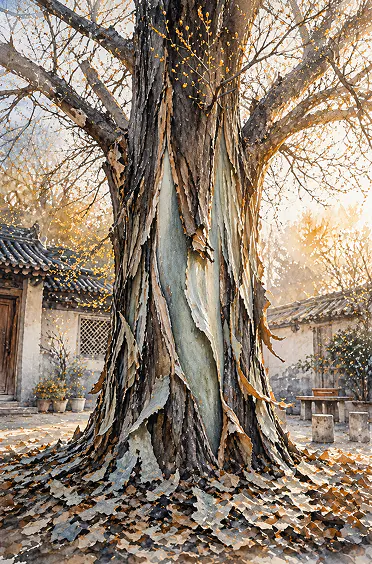
The mountain does not grow taller by pushing upward when its base is eroding. It must first allow the earth to settle and broaden beneath it.
How Splitting Apart Shows Up in Real Health and Wellbeing Situations
The dynamics of Splitting Apart manifest in recognizable patterns that many people experience but struggle to name. One common scenario is the person who has been managing a chronic condition through sheer discipline—strict diet, rigorous exercise, meticulous supplement regimens—only to find that their system begins to rebel against the very structure that once supported them. This is the splitting apart of the foundation. The mountain has become too steep, too narrow, too rigid. The earth beneath it is being compressed and hollowed out.
Another pattern involves the accumulation of small stressors that individually seem manageable but collectively erode your vitality. You might be handling work pressure, family obligations, financial strain, and a minor health issue simultaneously. Each one alone is manageable, but together they create a condition of Splitting Apart. The key insight from the hexagram is that these forces are not attacking from outside—they are burrowing from within, like termites in a wooden beam. By the time you notice the damage, the structure is already compromised.
The most subtle manifestation of Splitting Apart appears in people who have been "strong" for too long. They are the ones others rely on, the caregivers, the high performers, the ones who never complain. But beneath their capable exterior, their foundations are being hollowed out by suppressed emotions, unexpressed needs, and the exhaustion of perpetual giving. The hexagram's line 4 describes a point where the disaster affects not just the resting place but the occupant himself. This is the health crisis that seems to come from nowhere but has actually been years in the making.
What makes Splitting Apart particularly dangerous is that it often presents as something else. You might interpret your declining energy as a need for more effort, when in fact you need less. You might think you need a new treatment protocol, when what you need is to stop treating and start resting. The hexagram's wisdom is to recognize the pattern before it reaches its destructive conclusion. The Image tells us that those who rule must rest on the broad foundation of the people. In personal health terms, this means your wellbeing must rest on a broad foundation of basic care, not on the narrow peak of heroic effort.
When you feel yourself splitting apart, the first question is not "What should I do?" but "What am I trying to hold together that needs to be released?"
From Reading to Action: Applying Splitting Apart
Applying the wisdom of Hexagram 23 requires a radical shift in perspective. The Judgment is explicit: it is not favorable to undertake anything. This means your primary task during a Splitting Apart phase is not to fix, heal, or improve—but to preserve, protect, and wait. The action here is non-action, but it is a disciplined non-action. You must actively resist the impulse to intervene, to push harder, to find the solution. This is perhaps the hardest thing for modern health seekers to do.
The moving lines offer specific guidance for different stages of the splitting process. If you are in the early stages (line 1), where inferior influences are just beginning their destructive burrowing, the text warns that "there is nothing to do but wait." This might mean recognizing that a minor symptom or a small setback is not yet a crisis requiring intervention. You watch, you rest, you do not escalate. If you are further along (line 2), where the danger draws close and rest is disturbed, the advice is to "adjust to the time and promptly avoid the danger." This could mean canceling commitments, stepping back from social obligations, or temporarily abandoning your usual health regimen in favor of basic survival care.
Line 3 offers a more hopeful possibility. Here, an individual finds themselves in an evil environment to which they are committed by external ties, but they have an inner relationship with a superior principle. In health terms, this might mean you are trapped in a medical system or a treatment approach that is actually harmful, but you maintain an inner connection to what truly supports your wellbeing. This line encourages you to free yourself from the way of the inferior people around you—even if it means going against medical advice or family expectations.
Line 5 is particularly significant for health. Here, the dark force undergoes a change and submits to the guidance of the strong principle. This is the turning point where your body or your situation begins to cooperate rather than resist. The image of a princess leading her maids-in-waiting like a shoal of fishes to her husband suggests that when you align with your deeper wisdom, your symptoms and challenges can be led into a new relationship with your health. This is not about conquering illness but about establishing a new order based on cooperation rather than conflict.
Line 6 describes the end of the splitting apart. "When misfortune has spent itself, better times return. The seed of the good remains." This is the promise of Hexagram 23: that what is essential survives. The fruit falls to the ground, but from its seed, new life sprouts. In health terms, this means that even after a devastating illness or a period of profound depletion, the core of your vitality remains. Your task is not to rebuild what was lost but to allow what remains to take root and grow.
The seed of health is never destroyed. It can only be buried. Your job during Splitting Apart is to protect the seed, not to force the harvest.
Practical Examples
Example 1: The Autoimmune Flare-Up
Situation: Maria has been managing her autoimmune condition for three years with a strict elimination diet, targeted supplements, and careful stress management. Despite her diligence, she enters a flare that doesn't respond to her usual protocols. Her joints are inflamed, her energy is gone, and she feels like all her careful work is being undone.
How to Read It: Maria is in the territory of line 2 of Hexagram 23. The danger has drawn close to her person—her rest is disturbed. Her usual approach of active management is no longer working because the foundation itself is being eroded. The hexagram advises her to adjust to the time and avoid the danger. This means she should not escalate her interventions. More supplements, more restrictions, more effort will only accelerate the splitting apart.
Next Step: Maria needs to strip her approach down to absolute basics. For the duration of the flare, she should focus only on what preserves her core vitality: hydration, gentle warmth, and complete rest. She must stop measuring, tracking, and optimizing. Her task is to become like the earth—docile, receptive, and still. She waits for the splitting to reach its end, trusting that the seed of her health remains.
Example 2: The Burnout That Won't Heal
Situation: James has been in a demanding leadership role for seven years. He took a three-month sabbatical, changed his diet, started therapy, and began exercising regularly. Yet he still wakes up exhausted. His body feels heavy, his mind foggy, and he wonders if something is fundamentally wrong with him.
How to Read It: James is experiencing Splitting Apart at the level of line 4. The disaster has affected not just his resting place but the occupant himself. His foundation has been hollowed out over years of giving without adequate replenishment. The fact that his sabbatical and lifestyle changes haven't "fixed" him is not a sign that he's doing something wrong—it's a sign that the depletion runs deeper than surface-level interventions can reach.
Next Step: James needs to accept that he cannot heal on a timeline. The hexagram's stillness is not a three-month break but a fundamental reorientation. He should consider stepping back from leadership entirely, at least temporarily. He needs to let go of the identity of "the strong one who overcomes." His healing will come not from doing more but from allowing himself to be carried by others—the carriage of public support mentioned in line 6. He must let the mountain rest on the earth.
Example 3: The Caregiver's Hidden Decline
Situation: Priya has been caring for her aging mother for two years while maintaining her own career and family. She prides herself on being capable and uncomplaining. Recently, she's developed mysterious symptoms—headaches, digestive issues, and a constant sense of dread. Doctors can find nothing wrong.
How to Read It: Priya is in the situation of line 3 of Hexagram 23. She finds herself in an evil environment (the unsustainable caregiving situation) to which she is committed by external ties (love, duty, cultural expectation). But she has an inner relationship with a superior principle—her own deep knowing that this is too much. The hexagram tells her that freeing herself from the way of inferior people around her is not wrong, even if it means disappointing others.
Next Step: Priya must recognize that her symptoms are not the problem but the message. The splitting apart is happening in her foundation, and her body is telling her that she cannot continue. She needs to set boundaries that feel radical: hiring help, saying no to additional responsibilities, and allowing herself to be "selfish" about her health. The hexagram assures her that this opposition to the expectations of others is not wrong. She must become like the mountain—still and immovable in her commitment to her own wellbeing.
What feels like selfishness during Splitting Apart is actually the most profound form of responsibility. You cannot carry others when your own foundation is crumbling.
Common Mistakes
• Mistaking Splitting Apart for a problem to solve. The most common error is to treat this hexagram as a call to action. Readers assume that "splitting apart" means something is broken and needs fixing. In fact, the hexagram warns against action. Trying to "fix" a Splitting Apart situation is like trying to repair a house while the foundation is still eroding—you only accelerate the collapse.
• Confusing stillness with giving up. The hexagram's advice to submit and remain quiet is often misinterpreted as fatalism or passivity. In reality, this stillness is a strategic choice. It requires more discipline to do nothing than to do something. The difference between wise stillness and giving up is that stillness is chosen with awareness, while giving up is chosen from despair.
• Ignoring the early warnings. Lines 1 and 2 describe subtle signs of splitting that are easy to dismiss. People often wait until line 4—when the disaster is undeniable—before they take the hexagram seriously. By then, the damage is much harder to reverse. The wisdom of Hexagram 23 is to recognize the pattern early and respond with stillness before the splitting becomes severe.
• Applying the wrong hexagram's advice. Splitting Apart is often confused with Hexagram 18 (Work on What Has Been Spoiled) or Hexagram 24 (Return). These hexagrams call for active repair or renewal. But Hexagram 23 explicitly says it is not favorable to undertake anything. Using the wrong hexagram's guidance during a Splitting Apart phase can cause significant harm, as you end up pushing against a current that needs to flow in the opposite direction.
Frequently Asked Questions
How is Hexagram 23 different from regular burnout?
Burnout is a modern concept that describes depletion from overwork, but Hexagram 23 describes a more fundamental process of structural erosion. Burnout can often be addressed with rest and lifestyle changes. Splitting Apart requires a complete cessation of effort and a willingness to let the old structure fall away. The hexagram suggests that the foundation itself needs to be rebuilt, not just refilled.
Does Splitting Apart mean I should stop all medical treatment?
Not necessarily. The hexagram advises against undertaking new initiatives, but it does not forbid maintaining essential care. The key is discernment: if your current treatment is itself a source of depletion or a narrow foundation, you may need to reconsider it. But basic, stabilizing care—like hydration, gentle movement, and rest—is not "undertaking anything" in the hexagram's sense. Consult with your healthcare provider about what constitutes essential versus excessive intervention.
How long does a Splitting Apart phase typically last?
The hexagram gives no timeline. The duration depends on how deeply the foundation has been eroded and how completely you are able to practice stillness. Some people experience Splitting Apart for weeks, others for months or even years. The key is not to rush the process. Line 6 promises that when misfortune has spent itself, better times return. Trust that the splitting will reach its natural end.
Can I prevent Splitting Apart from happening?
To some extent, yes. The Image of the mountain resting on the earth suggests that prevention lies in building a broad foundation. This means cultivating multiple sources of health—not just one diet or one exercise regimen or one treatment approach. It means maintaining social connections, emotional outlets, and spiritual practices alongside physical care. A broad foundation is harder to undermine than a narrow peak.
What should I do if I'm in Splitting Apart but have responsibilities I can't drop?
This is the painful reality of line 3—being committed to an evil environment by external ties. The hexagram's guidance is that you must find a way to free yourself, even if it seems impossible. This might mean delegating, asking for help, accepting a lower standard of performance, or making difficult choices about priorities. The alternative—continuing to push through—will lead to the complete collapse described in line 4. Protecting your foundation is not optional; it is essential.
Closing Reflection
Splitting Apart is not a hexagram of despair but of profound honesty. It asks you to look at your health without the filters of optimism or fear, and to see what is actually happening. The mountain cannot stand on a narrow base forever. The seed cannot sprout until the fruit has fallen and rotted. There is a time for building and a time for letting go, and Hexagram 23 teaches you to recognize the latter with the same clarity you bring to the former. Your vitality is not measured by how much you can withstand but by how wisely you can yield to the seasons of your own life. When you stop trying to hold everything together, you may discover that what remains is more than enough to begin again.
Turn this guide into your own reading
After reading the explanation, cast with a real question. We will carry your question into the reading flow so the result can be interpreted and saved.
Sources & References
Zhouyi / I Ching primary text
The received text of the Book of Changes, including the Judgment, Image, and line statements.
The I Ching or Book of Changes, Richard Wilhelm / Cary F. Baynes
Princeton University Press translation used as a major English-language reference point for names, structure, and commentary framing.
The Sacred Books of China: The Texts of Confucianism, James Legge
Classical English reference used for comparative reading of source terminology and commentarial tradition.
The Classic of Changes, Richard John Lynn
Modern scholarly translation consulted for comparative interpretation and editorial cross-checking.
Related Hexagrams
Continue from this guide into specific hexagram study.
Related Guides
Continue with adjacent guides for more context and deeper study.