
Hexagram Finance
Hexagram 60 (Limitation) in Finance: I Ching Guidance for Wealth and Money Matters
What does Hexagram 60 (Limitation) mean for finances? Limitations are troublesome, but they are effective. If we live economically in normal times, we are prepared for times of want. To be sparing saves us from hum... Discover how the I Ching guides resource management, timing of financial decisions, and the mindset behind lasting wealth.
Hexagram 60 (Limitation) in Finance: I Ching Guidance for Wealth and Money Matters
You know that uneasy feeling when your bank account is healthy, yet something whispers that you're spending too freely? Or perhaps you've experienced the opposite: a period of such strict austerity that life felt joyless and constricted. In both cases, you're brushing against the central truth of Hexagram 60 (Limitation) — the ancient I Ching hexagram that speaks directly to how we handle resources, boundaries, and the delicate art of enoughness.
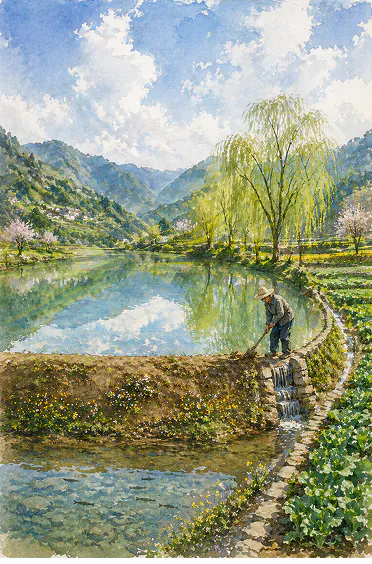
Hexagram 60 appears in the I Ching sequence as the sixtieth entry, formed by Water (Kan) above and Lake (Dui) below. The Judgment tells us plainly: "Limitations are troublesome, but they are effective." This is not a hexagram about deprivation or punishment. Rather, it describes the natural, necessary boundaries that give shape to our financial lives — just as the shores of a lake give form to water, and the seasons give meaning to the year. If you've been wrestling with questions about budgeting, spending, saving, or the ethics of wealth, this hexagram offers surprisingly practical guidance that has served thoughtful people for over two thousand years.
Where This Guide Is Most Useful
• You feel financially adrift — income is flowing, but you have no structure for where it goes, and you sense that your lack of boundaries is creating subtle anxiety rather than freedom
• You're recovering from a financial overreach — a failed investment, an overspending binge, or a business expansion that exceeded your capacity, and you need wisdom for how to reset without shame
• You're in a position of financial authority — managing family money, leading a company's finances, or advising others on wealth — and you need to set limits that are effective without being oppressive
Understanding Limitation in Finance and Wealth
The Judgment of Hexagram 60 opens with a paradox that every financially mature person eventually recognizes: "Limitations are troublesome, but they are effective." We don't naturally love boundaries. A budget feels like a cage. A savings target feels like a chore. Yet the I Ching insists that these very constraints are what make financial life workable. The lake cannot be a lake without its shores; water without containment simply disperses into mud. Similarly, money without boundaries disperses into anxiety, waste, and missed opportunities.
The trigram structure deepens this insight. Water above — the image of the abyss, of danger, of the unpredictable flow of resources — sits over Lake below — a contained, joyful body of water. This is the tension at the heart of all finance: the unlimited, flowing potential of wealth (Water) must be held by the bounded, intentional structures we create (Lake). When these two forces work together, we have a system that can receive abundance without being overwhelmed. When they fall out of balance, we either hoard joylessly or spend recklessly.
The Image commentary is especially pointed for our modern financial context: "Unlimited possibilities are not suited to man; if they existed, his life would only dissolve in the boundless." Think of what this means for the person with unlimited credit, or the entrepreneur with infinite growth targets, or the inheritor of sudden wealth. Without limits, financial life doesn't become more free — it becomes formless. The I Ching teaches that we "achieve significance through discrimination and the setting of limits." In financial terms, this means that your wealth only becomes meaningful when you decide what it is for — and what it is not for.
"If we live economically in normal times, we are prepared for times of want. To be sparing saves us from humiliation." — Judgment of Hexagram 60
How Limitation Shows Up in Real Finance and Wealth Situations
The most common way Hexagram 60 manifests in financial life is through the tension between two kinds of limitation: those we choose wisely, and those imposed on us by circumstance. The person who sets a reasonable spending limit on dining out experiences the first kind — a voluntary boundary that preserves freedom in other areas. The person who suddenly loses their job and must cut all discretionary spending experiences the second — a painful but necessary adaptation. Both are expressions of Limitation, but the quality of experience differs dramatically.
Consider the familiar pattern of the "lifestyle creep" that accompanies career advancement. You get a raise, and within months your expenses have risen to meet it. Nothing has changed in your financial reality except that you now earn more and spend more. Hexagram 60 would recognize this as a failure of conscious limitation — you have allowed the Water of increased income to simply fill a larger Lake, rather than using the boundary to create surplus that could be directed toward deeper purposes. The hexagram's wisdom is not to avoid the raise, but to deliberately set a new limit that preserves the old spending level while redirecting the surplus toward savings, investment, or generosity.
Another classic manifestation appears in the entrepreneur who cannot say no to opportunities. Every new project, every expansion, every "strategic pivot" seems promising, but the business becomes bloated, unfocused, and financially fragile. Hexagram 60 speaks directly to this: the limitation must be applied to the limitation itself. "It is necessary to set limits even upon limitation." For the entrepreneur, this might mean deciding that the company will only pursue three product lines, or will not take on debt beyond a certain ratio, or will maintain a minimum of six months operating reserve. These are not restrictions on success — they are the conditions that make sustainable success possible.
The most painful form of Limitation in finance is the one we resist. When we overspend, overinvest, or overextend ourselves, we eventually hit a natural boundary — the credit card is declined, the margin call comes, the partnership dissolves. The I Ching is remarkably unsentimental about this: "If he gives himself over to extravagance, he will have to suffer the consequences, with accompanying regret. He must not seek to lay the blame on others." This is not moralizing; it is pattern recognition. Financial boundaries are not punishments, they are facts. The question is whether we will set them consciously or have them imposed on us by crisis.
"In limitation we must observe due measure. If a man should seek to impose galling limitations upon his own nature, it would be injurious." — Judgment of Hexagram 60
From Reading to Action — Applying Limitation
Applying Hexagram 60 to your financial life begins with a diagnostic question: Where are my financial boundaries too loose, and where are they too tight? The hexagram is not an argument for maximal austerity; it is an argument for appropriate limits. The Image speaks of the lake containing "a definite amount of the infinite quantity of water." Your task is to determine your lake's right size — not to drain it to a puddle or to try to hold the ocean.
Line 1 — "Discretion is of prime importance in preparing the way for momentous things." This line speaks to the early, quiet phase of financial limitation. Before you make a major purchase, investment, or career change, there is a preparatory period where discretion — keeping your plans private, gathering information, not overcommitting — is the wise path. Confucius's commentary on this line warns that "where disorder develops, words are the first steps." In financial terms, this means not announcing your plans before they are ready, not signaling your intentions to competitors or salespeople, and not letting premature enthusiasm commit you to a course of action before you've done your homework.
Line 2 — "When the time for action has come, the moment must be quickly seized." This is the complement to Line 1. Hesitation has its season, and action has its season. The image is of water collecting in a lake until it is full, then finding its outlet. In your financial life, this might describe the moment when a savings goal is reached, an opportunity window opens, or a market condition shifts. The danger here is not overaction but underaction — missing the moment because you've become habituated to delay. If you've been saving for a down payment and the right house appears, this line says: act. The limitation that served you in the saving phase is no longer needed in the purchasing phase.
Line 5 — "If a man in a leading position applies the limitation first to himself, demanding little from those associated with him, and with modest means manages to achieve something, good fortune is the result." This is perhaps the most powerful line for anyone who manages money for others — whether as a parent, a CFO, a financial advisor, or a business owner. The temptation is to impose financial discipline on others while exempting yourself. Hexagram 60 warns that this provokes resistance and failure. The leader who drives a company-wide cost-cutting initiative while maintaining their own lavish expense account is violating this principle. The parent who lectures their children about saving while carrying credit card debt is doing the same. Effective limitation always begins at home.
"When, however, the limitation is a natural one... it necessarily leads to success, for then it means a saving of energy." — Line 4 Commentary
Practical Examples
Example 1: The Too-Loose Budget
Situation: Maria earns $85,000 a year. She has no formal budget, telling herself she'll "be reasonable." At the end of most months, she's surprised by how little is left. She feels financially anxious despite adequate income.
How to read it: This is Hexagram 60's basic pattern — the absence of conscious limitation creates formless anxiety. Maria's financial life has no "lake shores." The Water of her income disperses without direction. The Judgment's warning about humiliation from lack of economy applies here, not as shame but as a simple description of consequences.
Next step: Maria needs to set one clear, non-negotiable limit: a fixed savings transfer that happens automatically on payday. Before she touches any spending, 15% of her income moves to a separate account. This single limitation — applied to herself, not imposed from outside — creates the structure from which freedom can grow. She can spend the rest without guilt, because the limit has already been honored.
Example 2: The Overly Strict Saver
Situation: James, 62, has saved aggressively for retirement. He lives on 40% of his income, drives a 15-year-old car, and feels guilty about any discretionary spending. His net worth is solid, but he is unhappy and his relationships are strained by his frugality.
How to read it: Hexagram 60 warns explicitly against "galling limitations upon his own nature." James has taken a virtue — thrift — and pushed it past the point of wisdom. Line 6 speaks to this: "If one is too severe in setting up restrictions, people will not endure them." In James's case, he himself is the one who cannot endure his own restrictions. The limitation has become an end in itself rather than a means to a meaningful life.
Next step: James needs to apply the principle of "setting limits even upon limitation." He should create a "permission to spend" budget — a fixed monthly amount that he is required to use for enjoyment, gifts, or experiences. This is not an invitation to recklessness; it is a recognition that the purpose of financial limitation is to enable life, not to constrict it.
Example 3: The Overextended Entrepreneur
Situation: Priya runs a growing consulting firm. She keeps saying yes to new clients, new service offerings, and new hires. Revenue is up, but margins are thin, team morale is dropping, and she feels constantly overwhelmed. She fears that if she says no, she'll lose momentum.
How to read it: This is the classic failure of Line 3 — "If an individual is bent only on pleasures and enjoyment, it is easy for him to lose his sense of the limits that are necessary." For Priya, the "pleasure" is the dopamine hit of growth and the fear of missing opportunities. She has lost the sense that limitation is what makes sustainable growth possible. The Water is rising, but the Lake has no shores — it is just spreading into a swamp.
Next step: Priya needs to set three clear, public limits: a maximum number of clients she will serve at once, a minimum margin threshold below which she will not take work, and a policy that she will not add new service lines without sunsetting an existing one. She should announce these limits to her team and her clients. The act of making them public — of "determining for herself what her duty is" — transforms them from restrictions into commitments. This is Line 5 in action: the leader applying limitation to herself first.
"The individual attains significance as a free spirit only by surrounding himself with these limitations and by determining for himself what his duty is." — Image Commentary
Common Mistakes
• Confusing limitation with deprivation — Hexagram 60 is not about suffering or punishing yourself. It is about creating the boundaries that make financial freedom meaningful. A budget that leaves no room for joy is not wisdom; it is a misunderstanding of the hexagram's central teaching about "due measure."
• Applying limits to others before yourself — The most common failure in financial leadership is to impose restrictions on employees, family members, or clients that you are unwilling to follow yourself. Hexagram 60's Line 5 is explicit: effective limitation begins with self-limitation.
• Treating all limitations as permanent — The hexagram describes a pattern of change, not a fixed state. The limitation that serves you in one season may be harmful in another. The same person who needs strict budgeting in their accumulation phase may need generous spending in their distribution phase. Flexibility within structure is the goal.
• Ignoring the emotional dimension — Many people approach financial limitation as a purely mechanical exercise — set the budget, follow the rules, done. But Hexagram 60 is deeply concerned with how limitations feel. The Judgment warns against "galling limitations" that injure the spirit. Effective financial boundaries must be emotionally sustainable, not just mathematically correct.
Frequently Asked Questions
What does Hexagram 60 mean for budgeting?
Hexagram 60 is essentially the I Ching's guide to conscious budgeting. The Judgment's statement that "limitations are troublesome, but they are effective" describes the experience of every person who has ever maintained a budget: it requires effort, but it works. The key insight from the hexagram is that the budget should be neither too loose (Line 3's warning about extravagance) nor too tight (Line 6's warning about severity). The right budget is one that preserves your energy and values while giving your money direction.
How is this different from just being frugal?
Frugality is a personal habit; Hexagram 60 describes a whole-system approach to boundaries. The hexagram is not about spending as little as possible, but about spending within appropriate limits — and those limits are determined by your context, your values, and your stage of life. The Image uses the lake as its metaphor: the lake does not try to hold as little water as possible; it holds exactly the amount its shores define. Hexagram 60 asks you to define your own shores, not to empty your lake.
Can Hexagram 60 help with investment decisions?
Yes, particularly through the guidance of Lines 1 and 2. Line 1 advises discretion and preparation before major moves — do your research, keep your plans quiet, don't overcommit prematurely. Line 2 advises decisive action when the time is right — once your analysis is complete and the opportunity is clear, hesitation becomes a mistake. The hexagram also warns against the temptation of unlimited growth (Line 3) and the danger of imposing rigid limits that don't fit the situation (Line 6).
What if I'm already in financial trouble?
Hexagram 60 is especially relevant for recovery situations. The Judgment's teaching that "limitations are troublesome, but they are effective" is a realistic comfort: the trouble you're experiencing now — the strict budget, the debt repayment plan, the lifestyle reduction — is real, but it is also the path to stability. Line 3's warning against blaming others is particularly important here. The hexagram encourages you to take responsibility for the limits you now face, not as punishment, but as the foundation for rebuilding.
Is there such a thing as too much limitation?
Absolutely. The Judgment is explicit: "If a man should seek to impose galling limitations upon his own nature, it would be injurious." Line 6 warns that excessive severity provokes rebellion — even against oneself. The hexagram's deepest teaching is that limitation itself must be limited. A financial plan that leaves no room for joy, generosity, or spontaneity is not wisdom; it is a misunderstanding of the hexagram's purpose, which is to use boundaries to create a meaningful life, not to shrink life to fit boundaries.
Closing Reflection
Hexagram 60 (Limitation) offers a paradox that every financially mature person must eventually embrace: the boundaries that feel most restrictive are often the ones that make genuine freedom possible. The lake does not resent its shores; the shore is what allows the lake to exist at all. Your financial life — whether modest or abundant — will take shape only where you consciously draw lines. The wisdom of this hexagram is not to avoid limitation, but to practice it with discernment, applying it first to yourself, adjusting it to the season, and remembering that the purpose of every boundary is to create a space where something valuable can grow. When you set your limits with care and intention, you are not shrinking your life — you are giving it form.
Turn this guide into your own reading
After reading the explanation, cast with a real question. We will carry your question into the reading flow so the result can be interpreted and saved.
Sources & References
Zhouyi / I Ching primary text
The received text of the Book of Changes, including the Judgment, Image, and line statements.
The I Ching or Book of Changes, Richard Wilhelm / Cary F. Baynes
Princeton University Press translation used as a major English-language reference point for names, structure, and commentary framing.
The Sacred Books of China: The Texts of Confucianism, James Legge
Classical English reference used for comparative reading of source terminology and commentarial tradition.
The Classic of Changes, Richard John Lynn
Modern scholarly translation consulted for comparative interpretation and editorial cross-checking.
Related Hexagrams
Continue from this guide into specific hexagram study.
Related Guides
Continue with adjacent guides for more context and deeper study.