
Hexagram Love
Hexagram 54 (The Marrying Maiden) in Love: I Ching Guidance for Relationships
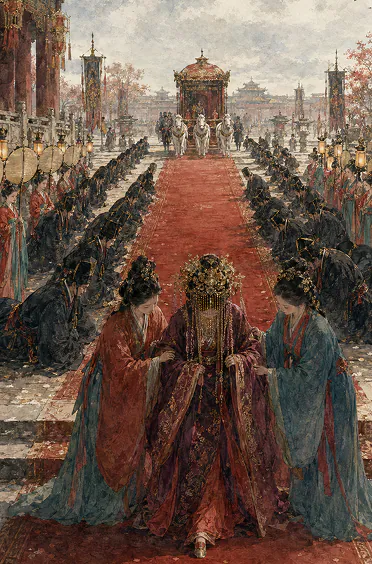
What does Hexagram 54 (The Marrying Maiden) reveal about love and relationships? A girl who is taken into the family, but not as the chief wife, must behave with special caution and reserve.
Hexagram 54 (The Marrying Maiden) in Love: I Ching Guidance for Relationships
You've been in a relationship for months now, and something feels subtly off. You love this person deeply—perhaps more than anyone you've ever known—but you can't shake the sense that you're always adjusting, always tiptoeing, always trying to prove that you belong. You're the one who rearranges your schedule, who holds back your honest feelings to keep the peace, who wonders if you're truly seen as an equal partner or just someone who happened to arrive at the right time. The affection is real, but the structure feels fragile, and you're exhausted from holding it together.
This is the territory of Hexagram 54, The Marrying Maiden. One of the most misunderstood hexagrams in the I Ching, it does not describe literal marriage or literal maidenhood. Instead, it names a specific relational pattern: a bond entered through personal inclination rather than formal arrangement, where affection—not law or tradition—is the primary glue. The Judgment warns that such relationships demand “special caution and reserve,” because without fixed duties and rights, everything depends on tact, timing, and the willingness to stay in one’s proper place. The trigram structure—Thunder above, Lake below—pictures the restless energy of attraction (Thunder) stirring the deep, receptive waters of feeling (Lake). The image is beautiful, but the text is blunt: “Every relationship between individuals bears within it the danger that wrong turns may be taken, leading to endless misunderstandings and disagreements.”
If you've ever loved someone without the security of clear roles, social approval, or mutual commitment, this hexagram speaks directly to your situation. It does not judge you for being in such a bond. It simply asks: Can you stay without grasping? Can you give without losing yourself?
Where This Guide Is Most Useful
• You are in a relationship that lacks clear social or legal structure — perhaps a long-term partnership without marriage, a cross-cultural relationship with different expectations, or a bond where one partner holds more power or status than the other.
• You feel you are giving more than you receive — emotionally, practically, or in terms of commitment — and you’re unsure whether to speak up or step back.
• You are considering entering a relationship that feels “unequal” — in age, status, life stage, or emotional availability — and you want to know if it can work, and if so, how.
Understanding The Marrying Maiden in Love & Relationships Context
The Judgment of Hexagram 54 opens with a startling image: “A girl who is taken into the family, but not as the chief wife, must behave with special caution and reserve.” For modern readers, this language can feel archaic or even offensive. But the I Ching is not endorsing polygamy or patriarchy. It is using a concrete social arrangement from ancient China to illuminate a universal relational dynamic: the experience of being the “secondary” partner in a bond that matters deeply to you but is not structured around your needs.
In love and relationships, this shows up whenever affection exists without formal equality. Think of the partner who moves to a new city for their lover's career, giving up their own professional network. The person who enters a relationship with someone still legally married to another. The younger partner in a significant age gap, who constantly feels they must prove their maturity. The one who loves more openly, more vulnerably, while the other remains guarded. In each case, the bond is real—Thunder stirs the Lake—but the architecture of the relationship is precarious.
The Image commentary is crucial here: “Thunder stirs the water of the lake, which follows it in shimmering waves. This symbolizes the girl who follows the man of her choice.” The key word is follows. In The Marrying Maiden, one partner has taken the lead, and the other has responded. This is not inherently wrong—the text says that “spontaneous affection is the all-inclusive principle of union.” But it creates a pattern where the follower must constantly read the leader's signals, adapt to their rhythms, and suppress their own initiative. Over time, this can erode self-worth.
The upper trigram, Thunder (Zhen), represents movement, shock, and the initiating force. The lower trigram, Lake (Dui), represents joy, openness, and receptivity. When Thunder moves over the Lake, the water responds—it shimmers, it follows. But Lake is also deep and still on its own. The danger is that the follower forgets their own depth, becoming nothing but a reflection of the leader’s energy. The hexagram’s advice is not to leave, but to maintain inner steadiness while outwardly yielding. “If on the other hand a man fixes his mind on an end that endures, he will succeed in avoiding the reefs that confront the closer relationships of people.”
Affection without structure requires constant awareness. The Marrying Maiden teaches that love is not enough—you also need conduct.
How The Marrying Maiden Shows Up in Real Love & Relationships Situations
In practice, Hexagram 54 describes relationships where the emotional bond is strong but the social or structural container is weak. This often creates a painful asymmetry: one partner feels secure; the other feels provisional. The “secondary” partner may be treated with genuine affection, but they are not consulted on major decisions, not introduced to family, not included in long-term planning. They are loved, but not integrated.
A recognizable scenario: You have been dating someone for two years. They say they love you, and you believe them. But they have not introduced you to their children from a previous marriage. They have not changed their online dating profile. They have not discussed moving in together. Every time you try to bring up the future, they say, “Let's just enjoy what we have.” You feel like a guest in your own relationship. This is The Marrying Maiden dynamic—you are in the house, but not as the chief wife.
Another pattern: You are the one who pursued the relationship. You made the first move, you planned the early dates, you carried the emotional labor of building intimacy. Now, months later, you still feel like you’re the one doing most of the work. Your partner is warm and responsive, but never initiates. You feel like you're pulling them along. The hexagram's warning about “wrong turns” and “endless misunderstandings” applies here: when one person always leads, the follower can begin to resent being led, and the leader can begin to resent the burden. The shimmering waves grow choppy.
The Image says we must “constantly remain mindful of the end.” This does not mean predicting whether the relationship will last. It means keeping in view what kind of relationship you are actually building. If you drift along, letting affection carry you without intentional structure, you will eventually crash. The Marrying Maiden asks: Are you willing to do the patient work of building a container for your love, even if it takes years? Or are you hoping that love alone will make everything work?
The hexagram does not say unequal relationships cannot succeed. It says they require extraordinary discipline—more discipline than equal ones.
From Reading to Action: Applying The Marrying Maiden
The practical wisdom of Hexagram 54 lies in its six moving lines, each of which describes a specific relational posture. When you consult the I Ching and receive this hexagram, one or more of these lines will be “moving,” indicating where your current situation requires attention. Here are the key lines for love and relationships:
Line 1 (Six at the beginning): “The girl who enters the family with the consent of the wife…” This line advises the follower to accept their position willingly, not to try to supplant the primary partner. In modern terms: if you have entered a relationship where you are not the central priority—perhaps your partner has children, a demanding career, or another partner—do not fight for the top spot. Instead, find satisfaction in the role you have. The line says you can “accomplish something through the kindliness of your nature.” This is not about settling; it is about choosing your battles. If you can be content with a secondary role, the relationship can work. If you cannot, you must leave.
Line 2 (Nine in the second): “The one-eyed man who can still see.” This is a line about disappointment and loyalty. Your partner has failed you—perhaps through infidelity, neglect, or simple absence. Yet you still see the good in them. The line does not tell you to stay or go. It simply says: Maintain your inner light. Do not become bitter. Do not let their failure define your worth. Whether you stay or leave, do it with clarity, not resentment.
Line 4 (Nine in the fourth): “The girl who lets the time for marriage pass by.” This is a line about patience and self-respect. You have not found the right partner, and you are refusing to settle. Society may pressure you, but the I Ching says “there is no harm in this.” The line promises that “even though belatedly, she finds the husband intended for her.” For modern readers: do not rush into a relationship just because you are lonely or because your friends are pairing up. The right bond will come when you are ready for it.
Line 5 (Six in the fifth): “The sovereign I gave his daughter in marriage.” This is the most auspicious line in the hexagram. It describes a person of high status who willingly adapts to a partner of lower status, “forgetting her rank in her marriage.” If you are the more powerful partner—older, richer, more established—this line asks you to set aside your advantages. Do not use your status as a shield. Meet your partner as an equal. The line compares this to the moon before it is full, “not directly facing the sun.” Power must be wielded with restraint.
Line 6 (Six at the top): “The woman takes an empty basket.” This is a warning: the relationship has become hollow ritual. You are going through the motions—saying “I love you,” having dinner together, attending family events—but the substance is gone. The line says this “bodes no good for a marriage.” If you are in this situation, you must either revitalize the bond or end it. Pretending is not kindness.
To apply The Marrying Maiden is to ask: Am I acting from genuine affection, or from fear of being alone? Am I building structure, or just drifting?
Practical Examples
Example 1: The Partner Who Always Adapts
Situation: Maya has been dating Carlos for three years. He is a successful surgeon with irregular hours. She is a freelance designer. She schedules her entire life around his availability. She has moved apartments twice to be closer to his hospital. She has stopped seeing friends who don't fit his schedule. Carlos is affectionate and grateful, but he has never offered to adjust his life for her.
How to read it: This is the classic Marrying Maiden pattern—Thunder above, Lake below. Maya is the Lake, always responding to Carlos's Thunder. She has become so focused on following that she has lost her own center. The Judgment's warning about “tactful reserve” has been misinterpreted as total self-erasure.
Next step: Maya needs to study Line 5 of the hexagram. She is not the “sovereign” here—Carlos is. But she can still practice the spirit of the line by naming her own needs without apology. She should set one non-negotiable boundary: a standing weekly date that Carlos must work around. If he cannot meet this, the relationship lacks the mutual adaptation required for longevity.
Example 2: The One Who Loves More
Situation: Jamal is deeply in love with Priya. He told her he loved her after three months. She said she “cared about him deeply” but wasn't ready for that word. Now, eight months in, Jamal feels constantly off-balance. He initiates all the conversations about the future. He plans the trips. He buys the thoughtful gifts. Priya receives them warmly but never reciprocates in kind.
How to read it: Jamal is in the position of the “girl” in The Marrying Maiden—the one who follows, even though he is not literally female. He has invested more emotional capital, and the power imbalance is growing. The hexagram warns that “relationships based on personal inclination depend in the long run entirely on tactful reserve.” Jamal has not been tactful; he has been over-eager.
Next step: Jamal should pull back. Not to punish Priya, but to restore balance. He can study Line 1, which advises against trying to “supplant the mistress of the house.” In this case, the “mistress” is Priya’s own emotional pace. He cannot force her to match his intensity. He must let her come to him. If she does not, he will have his answer.
Example 3: The Relationship That Has Gone Cold
Situation: David and Elena have been married for twelve years. They still live together, still co-parent, still say “I love you” at bedtime. But they haven’t had a real conversation in months. They haven’t had sex in a year. They go through the motions of marriage—dinner with the kids, holiday gatherings, joint tax returns—but there is no warmth.
How to read it: This is Line 6 in action: “The woman takes an empty basket.” The ritual is preserved, but the substance is gone. The hexagram warns that this “bodes no good.” David and Elena are not in a marriage; they are in a performance of a marriage. The Marrying Maiden’s core teaching—that affection must be the principle of union—has been forgotten.
Next step: David and Elena must decide whether they want to rebuild the affection or end the performance. If they choose to rebuild, they need to start with small, genuine gestures of care, not grand declarations. A shared meal without phones. A walk where they talk about something real. If they cannot find the will to do this, they should separate with dignity. The hexagram is clear: empty ritual is worse than no ritual at all.
In each example, the key is not to change the other person, but to change your own conduct. The Marrying Maiden is about what you do, not what you get.
Common Mistakes
• Assuming the hexagram is about literal marriage or gender roles. The Marrying Maiden uses ancient Chinese marriage customs as a metaphor for any relationship where affection is the primary bond but structure is weak. It applies equally to men, women, nonbinary people, and same-sex couples. To reduce it to a commentary on female submission is to miss its universal insight about power dynamics in love.
• Believing the hexagram tells you to stay in an unequal relationship. The text advises caution and reserve, but it does not command you to accept mistreatment. Line 6 warns that hollow relationships must end. Line 2 honors loyalty but does not require it. The hexagram helps you see your situation clearly; it does not tell you what to do with that clarity.
• Thinking “tactful reserve” means hiding your feelings. The Judgment says relationships based on personal inclination “depend in the long run entirely on tactful reserve.” This does not mean silence or self-suppression. It means knowing when to speak and when to wait, when to assert and when to yield. True reserve is a form of power, not weakness.
• Ignoring the warning about “wrong turns.” The Image says that every relationship “bears within it the danger that wrong turns may be taken, leading to endless misunderstandings and disagreements.” Many people read The Marrying Maiden and focus only on the romance of “following the heart.” They miss the caution. This hexagram is not a green light; it is a yellow light. Proceed with care.
Frequently Asked Questions
Does Hexagram 54 mean I should leave my partner?
Not necessarily. The Marrying Maiden describes a pattern, not a verdict. It asks you to examine whether your relationship is built on genuine mutual affection or on one person’s constant accommodation. If the latter, the hexagram advises you to either restore balance through conscious conduct or to recognize that the bond cannot sustain itself. The moving lines will give you more specific guidance.
Is The Marrying Maiden always about unequal relationships?
Yes and no. The hexagram specifically addresses bonds where one partner has more social power, emotional investment, or structural advantage. But every relationship has imbalances at certain times. The Marrying Maiden’s wisdom about “tactful reserve” and “mindfulness of the end” applies to any love relationship, because all love requires the willingness to sometimes follow and sometimes lead.
What if I am the “Thunder” partner—the one with more power?
Then you have a special responsibility. Study Line 5, which describes the “sovereign” who voluntarily sets aside status to meet their partner as an equal. The hexagram warns that if you use your power carelessly, you will create “endless misunderstandings and disagreements.” Your task is to wield your advantages with restraint, and to actively build structures that protect the more vulnerable partner.
Can a relationship survive if it starts as a “Marrying Maiden” dynamic?
Yes, but only if both partners consciously evolve the bond. The hexagram does not condemn relationships that begin unequally; it simply warns that they require more work. If the follower can maintain their inner steadiness (Line 1) and the leader can practice humility (Line 5), the relationship can grow into genuine partnership. The key is to move from “following” to “walking together.”
How do I know which moving line applies to me?
When you consult the I Ching, the hexagram will be generated through coin tosses or yarrow stalks. The “moving” lines are those that change from yin to yang or vice versa. Each moving line has a specific text and commentary. If you received Hexagram 54 with a moving line in the second position, for example, you should focus on the theme of loyalty in the face of disappointment. If you are not using the I Ching for divination, you can still reflect on which line best describes your current situation.
Closing Reflection
The Marrying Maiden is not a hexagram about settling for less. It is a hexagram about seeing clearly what is actually there. In love, we often confuse intensity with depth, passion with permanence, affection with equality. This hexagram asks you to distinguish between them. It honors the reality of spontaneous affection—the thunder that stirs the lake—but it refuses to pretend that affection alone is enough. Love needs structure. Love needs conduct. Love needs the willingness to stay mindful of the end, even when the beginning is intoxicating. If you are in a bond that asks you to follow, do not follow blindly. Follow with your eyes open, your feet steady, and your heart fully your own. That is the only way to make the marriage maiden's path your own.
Turn this guide into your own reading
After reading the explanation, cast with a real question. We will carry your question into the reading flow so the result can be interpreted and saved.
Sources & References
Zhouyi / I Ching primary text
The received text of the Book of Changes, including the Judgment, Image, and line statements.
The I Ching or Book of Changes, Richard Wilhelm / Cary F. Baynes
Princeton University Press translation used as a major English-language reference point for names, structure, and commentary framing.
The Sacred Books of China: The Texts of Confucianism, James Legge
Classical English reference used for comparative reading of source terminology and commentarial tradition.
The Classic of Changes, Richard John Lynn
Modern scholarly translation consulted for comparative interpretation and editorial cross-checking.
Related Hexagrams
Continue from this guide into specific hexagram study.
Related Guides
Continue with adjacent guides for more context and deeper study.