
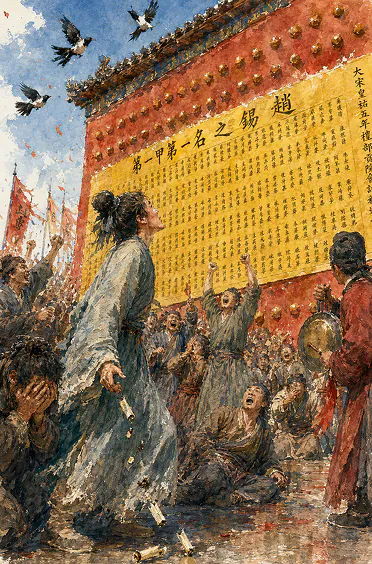
Hexagram Career
Hexagram 63 (After Completion) in Career: I Ching Guidance for Work and Professional Life
What does Hexagram 63 (After Completion) mean for your career? The transition from the old to the new time is already accomplished. In principle, everything stands systematized, and it is only in regard to details that succ... Learn how the I Ching guides professional decisions, leadership, timing, and workplace dynamics.
Hexagram 63 (After Completion) in Career: I Ching Guidance for Work and Professional Life
You've just closed a major deal. Your project launched on time and under budget. The promotion you've been working toward for three years finally came through. And now, instead of feeling triumphant, you feel something unexpected: unease. A quiet sense that this peak might be the beginning of a decline, if you're not careful. This isn't paranoia—it's wisdom. In the I Ching, this precise moment has a name: Hexagram 63, After Completion.
The name itself is a paradox. "After Completion" suggests an ending, but the hexagram's structure—Water (Kan) above, Fire (Li) below—tells a different story. Water and fire are natural enemies, yet here they are poised in perfect balance, generating energy like steam in a kettle. The Judgment warns that this harmony is both a gift and a trap: "Everything proceeds as if of its own accord, and this can all too easily tempt us to relax and let things take their course without troubling over details. Such indifference is the root of all evil."
If you've ever achieved something significant and then watched it slowly unravel because you stopped paying attention, you already know what this hexagram describes. It's not about failure—it's about what happens after success. The moment when the system is working, the machine is humming, and the temptation to coast becomes almost irresistible. This guide will help you recognize that moment in your own career and show you how to navigate it with the clarity and caution this hexagram demands.
Where This Guide Is Most Useful
• You have just achieved a major career milestone—a promotion, a successful product launch, a completed merger—and you sense that maintaining this success will require a different kind of effort than achieving it did.
• You are in a period of apparent stability where everything seems to be working, but you feel a nagging sense that small details are being overlooked, and you're not sure how to address them without disrupting the whole system.
• You are leading a team or organization through a post-crisis phase where the immediate danger has passed, but the risk of complacency and decay is higher than anyone wants to admit.
Understanding After Completion in Career & Work Context
The core insight of Hexagram 63 is that completion is not a destination—it's a condition that requires constant maintenance. In the career context, this means that reaching a goal is never the end of the story. The promotion, the successful quarter, the completed project—these are not finish lines. They are platforms from which new challenges emerge, often more subtle and dangerous than the ones you've already overcome.
The Image of the hexagram—water over fire, a kettle boiling—is particularly relevant to professional life. Think of your career as that kettle. The fire (Li) represents your drive, ambition, and creative energy. The water (Kan) represents the systems, structures, and external demands of your work environment. When these two elements are in proper balance, you generate productive energy. But if the water boils over, the fire is extinguished. If the heat is too intense, the water evaporates. The balance is inherently unstable.
This is why the Judgment emphasizes that "in principle, everything stands systematized, and it is only in regard to details that success is still to be achieved." In career terms, this means the big picture is handled—you've built the right team, secured the right position, or completed the major deliverables. But the details—the follow-up emails, the relationship maintenance, the quality control, the succession planning—these are where the real work of After Completion lies.
The trigram structure reinforces this lesson. Water above (danger, difficulty) and Fire below (clarity, illumination) create a situation where clarity must guide you through ongoing danger. Your insight and intelligence (Fire) must remain active even when the external environment seems calm (Water). The moment you assume the danger has passed is precisely when you become most vulnerable.
Takeaway: After Completion is not a state of rest—it is a state of heightened vigilance. Your greatest career achievements require your most careful attention, not your least.
How After Completion Shows Up in Real Career & Work Situations
The pattern of Hexagram 63 appears most often in careers that have reached a plateau of success. You've solved the obvious problems, built functional systems, and earned recognition. Now you face a subtler challenge: the slow creep of entropy. Meetings that used to be sharp and decisive become routine. Quality standards that were once non-negotiable start to slip. The energy that drove your early success is replaced by a comfortable but dangerous inertia.
One common manifestation is the "post-project letdown." After a major initiative—a product launch, a system migration, a fundraising round—the team naturally wants to rest. But the Judgment warns that this relaxation, if unchecked, becomes the root of decay. The leader who understands After Completion knows that the period immediately following a success is actually the most critical for consolidation. This is when you reinforce the processes that made the success possible, document lessons learned, and address the minor issues that could become major problems.
Another recognizable scenario is the "successful but stagnant" career. You've reached a position of authority or expertise, and the external rewards keep coming—but internally, you feel a growing sense of unease. The work that once challenged you now feels routine. You're coasting on past achievements. This is the After Completion trap: the very systems that brought you success now threaten to hold you back because they've become too comfortable.
The hexagram also speaks to organizational dynamics. In companies that have just undergone a major transition—a merger, a leadership change, a pivot—there's a natural tendency to declare victory and move on. But the sixth line warns: "After crossing a stream, a man's head can get into the water only if he is so imprudent as to turn back." Looking back at past success with self-congratulation is dangerous. The organization must keep moving forward, addressing the new challenges that emerge from the new situation.
Takeaway: After Completion shows up as the quiet erosion of excellence. It's not a crisis—it's a gradual decline that you can only see if you're looking for it.
From Reading to Action — Applying After Completion
Applying the wisdom of Hexagram 63 requires a shift in mindset. Instead of seeing completion as an ending, you must see it as the beginning of a new phase of stewardship. Your task is no longer to achieve—it is to maintain, refine, and protect what you've built. This demands a different kind of discipline, one that is less dramatic but no less demanding.
Start by conducting a "post-completion audit." Review every system, relationship, and process that contributed to your success. Ask yourself: What is working because of deliberate design, and what is working because of momentum? The lines that are most vulnerable are the ones you haven't thought about recently. The fifth line of the hexagram warns against empty ritual—the appearance of activity without genuine substance. In career terms, this means checking whether your daily work still has real purpose or has become hollow routine.
The moving lines offer specific guidance for different phases of the After Completion cycle. Line 1 warns against "pressing forward" too aggressively after a transition. If you've just achieved something significant, resist the urge to immediately chase the next big thing. Instead, consolidate. The line's image of the fox that gets only its tail wet crossing the water suggests that if you proceed with caution, any missteps will be minor.
Line 2 addresses the situation where your superiors or colleagues withhold their trust, even after you've proven yourself. The warning is clear: "Do not seek it." Do not throw yourself away on the world by groveling for recognition. Instead, wait and develop your personal worth quietly. In the After Completion phase, those who have achieved power often become arrogant and stop nurturing new talent. If you find yourself in this position, the counsel is to maintain your integrity and wait for the cycle to turn.
Line 3 speaks to the danger of expansion after success. The "Illustrious Ancestor" refers to a ruler who waged long colonial wars after putting his realm in order. In career terms, this means resisting the temptation to overextend. Don't take on new projects, new teams, or new responsibilities just because you can. Expansion after completion requires extreme caution, especially regarding who you bring into your circle. The line warns against treating new territories—or new roles—as dumping grounds for people who didn't work out elsewhere.
Takeaway: The action After Completion demands is not heroic—it is meticulous. Audit, consolidate, resist expansion, and maintain your integrity even when recognition is slow in coming.
Practical Examples
Example 1: The Post-Launch Slump
Situation: Maria just launched a new software product that exceeded all revenue targets. The team is exhausted and wants to celebrate. But Maria notices that customer support tickets are piling up, documentation is incomplete, and several key features have known bugs that were deferred for the launch.
How to read it: This is a classic After Completion scenario. The major transition (the launch) is accomplished. The system is working, but the details are not. Maria's intuition about the deferred issues is correct—these are the "details" the Judgment warns about. The temptation to relax and celebrate must be balanced with the discipline of consolidation.
Next step: Maria schedules a "completion sprint" for the two weeks following the launch. The team celebrates for one day, then focuses exclusively on the deferred bugs and documentation. She explicitly frames this as part of the success, not an afterthought. She communicates to stakeholders that this consolidation period is essential for long-term stability.
Example 2: The Promoted Manager's Dilemma
Situation: James was promoted to department head six months ago. The department is meeting all its metrics, and his boss is happy. But James feels like he's lost his edge. He's spending most of his time in meetings and administrative work, and his creative contributions have dwindled to nothing.
How to read it: James is experiencing the fifth line's warning about empty ritual. The outward forms of success are present—meetings are held, reports are filed, metrics are met—but the inner substance is missing. The system is running on momentum, not genuine engagement. This is the After Completion danger: the appearance of success masking the beginning of decay.
Next step: James conducts a personal audit. He identifies which meetings and tasks are genuinely necessary and which are habitual. He delegates or eliminates the latter. He blocks two hours each day for deep, creative work. He also schedules one-on-one conversations with his direct reports to rebuild the genuine connection that has been lost to administrative overhead.
Example 3: The Acquisition Integration
Situation: Priya's company was acquired six months ago. The deal closed successfully, and the integration is proceeding smoothly on paper. But Priya notices that the acquired team's best engineers are starting to leave, and the cultural friction that everyone assumed would resolve itself is actually getting worse.
How to read it: This is the third line's scenario—expansion after completion. The acquisition (the "colonial war") is accomplished, but the territory is being mismanaged. The acquirer is treating the acquired team as secondary, not investing in genuine integration. The line warns that "the territory won at such bitter cost must not be regarded as an almshouse for people who... are thought to be quite good enough."
Next step: Priya advocates for a dedicated integration team with real authority. She proposes that key members of the acquired team be given visible roles in the combined organization, not sidelined. She also recommends a cultural audit to identify the specific friction points rather than assuming they will resolve naturally.
Takeaway: Each of these examples shows the same pattern: success achieved, details neglected, decay beginning. The remedy is always the same: disciplined attention to what is being overlooked.
Common Mistakes
• Mistaking After Completion for a permanent state. Some readers interpret the hexagram's name as meaning "you've made it, relax." In fact, the hexagram warns that completion is inherently unstable and requires constant effort to maintain. The moment you relax is the moment decline begins.
• Ignoring the details because the big picture is working. The Judgment explicitly warns against this. The details are not minor—they are where the future success or failure of the entire system will be decided. The line between excellence and mediocrity is drawn in the details that everyone else is ignoring.
• Trying to expand too quickly after a success. The third line's warning about colonial expansion applies directly to career decisions. Taking on new responsibilities, new teams, or new projects immediately after a major achievement can overextend your resources and dilute your focus. The wise move is to consolidate first.
• Confusing activity with progress. The fifth line's warning about empty ritual is especially relevant in corporate environments where busyness is mistaken for productivity. After Completion requires genuine substance, not the appearance of effort. If your calendar is full but your impact is diminishing, you are caught in this trap.
Frequently Asked Questions
What does Hexagram 63 mean for someone who has just been promoted?
After Completion describes your situation precisely. The promotion is a major transition that has been accomplished. Now your task is to consolidate your position, understand the new system you're operating in, and pay close attention to the details that will determine your long-term success. Resist the urge to immediately make big changes or take on new projects.
How is Hexagram 63 different from Hexagram 64 (Before Completion)?
Hexagram 64 (Before Completion) describes the period of transition itself—the crossing of the stream, the uncertainty before the goal is reached. Hexagram 63 describes the period immediately after the crossing, when the danger is past but the need for vigilance is highest. One is about achieving; the other is about maintaining.
Can After Completion be a positive hexagram for career decisions?
Yes, but the positivity is conditional. The hexagram describes a favorable situation—you have achieved what you set out to do—but it warns that this favorability depends on your continued attention and caution. It is positive in the sense that you have a solid foundation to build on, but negative if you interpret it as permission to coast.
What does the water-over-fire trigram mean in a work context?
Water (the upper trigram) represents the external environment of your career—the systems, structures, and demands of your workplace. Fire (the lower trigram) represents your inner drive, clarity, and creative energy. When these are in balance, you generate productive energy. When they are out of balance, either the external demands overwhelm your inner resources (water extinguishes fire) or your drive burns out the systems that support you (fire evaporates water).
How should I interpret the line about "not seeking" recognition from superiors?
This comes from the second line and is a warning against desperate office politics. In the After Completion phase, those in power may become arrogant and stop recognizing new talent. If you find yourself in this position, the counsel is to maintain your integrity and develop your worth quietly, rather than groveling for attention. The line promises that what is genuinely yours will come to you in time.
Closing Reflection
The wisdom of Hexagram 63 is perhaps the most difficult to practice because it asks us to be most vigilant precisely when we feel most secure. After a career success, every instinct tells us to celebrate, to rest, to enjoy what we've earned. And celebration and rest are not wrong—but they must be balanced with the discipline of stewardship. The system you've built, the position you've achieved, the team you've assembled—these are not monuments to be admired. They are living things that require constant attention. The difference between a career that peaks and declines and a career that sustains its excellence over decades is often nothing more than the willingness to keep tending the details long after everyone else has declared the work complete.
Turn this guide into your own reading
After reading the explanation, cast with a real question. We will carry your question into the reading flow so the result can be interpreted and saved.
Sources & References
Zhouyi / I Ching primary text
The received text of the Book of Changes, including the Judgment, Image, and line statements.
The I Ching or Book of Changes, Richard Wilhelm / Cary F. Baynes
Princeton University Press translation used as a major English-language reference point for names, structure, and commentary framing.
The Sacred Books of China: The Texts of Confucianism, James Legge
Classical English reference used for comparative reading of source terminology and commentarial tradition.
The Classic of Changes, Richard John Lynn
Modern scholarly translation consulted for comparative interpretation and editorial cross-checking.
Related Hexagrams
Continue from this guide into specific hexagram study.
Related Guides
Continue with adjacent guides for more context and deeper study.