
Hexagram Career
Hexagram 53 (Development [Gradual Progress]) in Career: I Ching Guidance for Work and Professional Life
What does Hexagram 53 (Development [Gradual Progress]) mean for your career? The development of events that leads to a girl’s following a man to his home proceeds slowly. The various formalities must be disposed of before the marriage ta... Learn how the I Ching guides professional decisions, leadership, timing, and workplace dynamics.
Hexagram 53 (Development [Gradual Progress]) in Career: I Ching Guidance for Work and Professional Life
Introduction
You've been in your role for eighteen months now. The work is solid, the feedback positive, yet that promotion you were eyeing still hasn't materialized. Colleagues who joined after you seem to be moving faster, and you're starting to wonder: Should I push harder? Should I demand what I deserve? Or is there something I'm missing about the timing of my own career?
This is precisely the kind of crossroads where the ancient wisdom of Hexagram 53, known as Development [Gradual Progress], offers its most clarifying counsel. The hexagram's judgment speaks of a process that unfolds in stages—like the formalities that must be completed before a marriage can take place, or the careful vetting required before appointing an official to a position of trust. Its structure, with Wind (Xun) above and Mountain (Gen) below, describes a dynamic where gentle, penetrating influence rises from a foundation of inner stillness and stability. The wind moves slowly up the mountain, reshaping the landscape not through force, but through patient, persistent presence.
If you've been feeling the tension between your ambition and your current pace of progress, this hexagram invites you to reconsider what genuine advancement actually looks like. Development [Gradual Progress] is not about stagnation—far from it. It describes a kind of growth that is inevitable when conditions are right, but which cannot be rushed without destroying what is being built. Let's explore what this pattern means for your work life.
Where This Guide Is Most Useful
• You are early in a new career path or role and feel uncertain about whether you're moving fast enough, or whether your slow start signals failure.
• You are building a long-term project, reputation, or skill that requires cumulative effort—and you need reassurance that steady, incremental work is actually the wisest strategy.
• You are trying to influence others—a team, an organization, or a client base—and finding that direct persuasion doesn't work; you sense that a more gradual, relationship-based approach is needed.
Understanding Development [Gradual Progress] in Career & Work Context
The judgment of Hexagram 53 is remarkably specific about how lasting progress happens. It uses the metaphor of a marriage: the various formalities must be disposed of before the union takes place. In a career context, this translates to the foundational work that must be completed before you can step into a larger role or responsibility. Skipping steps—demanding authority before you've earned trust, seeking influence before you've built competence—creates structures that cannot hold.
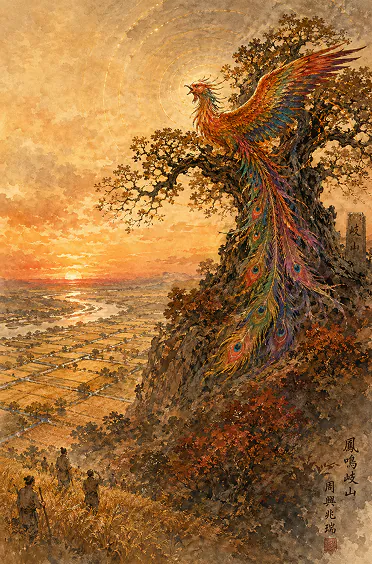
The Image reinforces this with the picture of a tree growing on a mountain. Unlike a swamp plant that shoots up quickly and dies just as fast, the mountain tree grows slowly, its roots deep in stable ground, its branches visible from afar because it has taken the time to become substantial. The trigrams deepen this wisdom: Mountain (Gen) below represents stillness, the inner stability that allows you to remain calm while growth happens. Wind (Xun) above represents gentle penetration, the adaptable, persistent quality that gradually shapes circumstances without confrontation.
What makes this hexagram so relevant to modern work life is its emphasis on correct relationships of cooperation. Development [Gradual Progress] is not about solitary achievement—it's about how you enter into systems of mutual dependence. Whether you are joining a new team, seeking a promotion within an established hierarchy, or building a client base, the quality of your relationships determines the quality of your progress. Hasty action disrupts these relationships. Steady, respectful development strengthens them.
The judgment also warns against the agitator's approach—the person who tries to force change through dramatic speeches or confrontational tactics. Such influence never lasts. In your career, this might look like the manager who tries to overhaul a team culture in a week, or the entrepreneur who burns through partnerships by demanding too much too fast. Development [Gradual Progress] teaches that lasting influence comes from cultivating your own personality and competence first, so that others are drawn to your example rather than pushed by your demands.
The key insight: Career progress that endures is built like a tree on a mountain—slowly, from solid ground, with roots that deepen before branches can rise. The wind of influence does not shout; it persists.
How Development [Gradual Progress] Shows Up in Real Career & Work Situations
You will recognize the pattern of Hexagram 53 in your professional life when you find yourself in a situation where the process matters as much as the outcome. This is not the hexagram for emergencies or sudden opportunities. It is the hexagram for the long, steady climb—the kind of progress that feels almost imperceptible on a daily basis but becomes unmistakable when you look back over months or years.
One common manifestation is the onboarding period in a new organization. When you join a company with an established culture, you cannot simply announce your ideas and expect immediate buy-in. You must first learn the formalities—how decisions are made, who holds informal influence, what values are truly honored versus merely stated. The person who tries to rush this process is seen as arrogant or naive. The person who moves gradually, building relationships and demonstrating competence, eventually finds that their influence grows naturally. This is the wind moving up the mountain: gentle, persistent, and ultimately transformative.
Another manifestation is in skill development. Mastery of any complex craft—whether it's software engineering, sales, leadership, or creative work—follows the pattern of Development [Gradual Progress]. There are no shortcuts. The musician who practices scales for years before attempting concertos, the writer who produces pages of mediocre drafts before finding their voice, the leader who makes small mistakes in low-stakes situations before handling major crises—all are living out this hexagram. The danger comes when impatience drives you to skip foundational work, leaving you with a fragile competence that crumbles under pressure.
A third scenario involves organizational change. If you are trying to shift the culture of a team or company, Hexagram 53 warns against dramatic interventions. Real change happens when you model new behaviors consistently, when you build coalitions one conversation at a time, when you allow people to come to new understanding at their own pace. The agitator's approach—the town hall speech, the ultimatum, the restructuring announcement—may create temporary movement, but it will not create lasting transformation. The wind on the mountain does not uproot trees; it gradually shapes their growth.
The key insight: Development [Gradual Progress] appears whenever the quality of your relationships and the depth of your competence matter more than the speed of your advancement. Recognize it by the feeling that you are building something that needs time to become solid.
From Reading to Action — Applying Development [Gradual Progress]
Moving from understanding this hexagram to living it requires a shift in how you measure progress. If you are currently in a Development [Gradual Progress] phase, your usual metrics—titles, salary increases, public recognition—may be misleading. The real work happening beneath the surface is invisible. Here are practical steps based on the hexagram's structure and its moving lines.
First, cultivate inner calm. The Mountain trigram beneath the hexagram is your foundation. Before you can influence your external career situation, you must stabilize your internal state. This means accepting the pace of your development without anxiety. When you feel the urge to push, rush, or demand, pause. Ask yourself: Am I trying to force something that needs more time? The answer, in a Hexagram 53 situation, is almost always yes. Practice patience as a discipline, not a resignation.
Second, become gentle and penetrating in your approach. The Wind trigram shows the outer form your efforts should take. Instead of confronting obstacles directly, find ways to flow around them. Instead of demanding change, model it. Instead of arguing for your ideas, demonstrate their value through consistent action. This is not weakness—it is the most effective form of influence over time. The wind cannot be stopped by walls; it simply moves around them.
Third, pay attention to the specific line positions if you are consulting the I Ching for guidance. The moving lines of Hexagram 53 use the metaphor of wild geese in gradual flight, each line representing a stage of development:
• Line 1 (Retiring): You are just starting out, like a young person entering the workforce. No one is helping you yet. Accept the slowness of your first steps. The danger of criticism from others will keep you from being reckless. Let it.
• Line 2 (Peaceful): You have found a safe position—a job that provides stability. Do not hoard your good fortune. Share credit, offer help, build community. This is the foundation for the next stage.
• Line 3 (Going Astray): You are tempted to rush into conflict or to push beyond your current capacity. This is a warning line. Do not provoke a fight. Hold your ground, defend yourself if attacked, but do not escalate. The plateau is dry and unsuitable for the goose.
• Line 4 (Straightforward): You find yourself in an awkward situation—perhaps a role that doesn't quite fit, or a project outside your expertise. Be flexible. Find the flat branch where you can get a foothold. Adaptability, not rigidity, will carry you through.
• Line 5 (Splendid): You have reached a position of influence, but you may feel isolated or misunderstood by those above you. Deceitful people may be creating distance between you and your superior. Do not despair. In time, misunderstandings will clear. Continue doing good work.
• Line 6 (Completion): Your work is complete. You have risen to a height where your example becomes a light for others. Your life itself becomes the teaching. This is the culmination of a life lived in gradual, steady development.
The key insight: Action in a Development [Gradual Progress] phase means doing the right thing at the right stage—not pushing for the next stage before the current one is complete. Each line is a checkpoint. Check your position honestly.
Practical Examples
Example 1: The New Manager
Situation: You have just been promoted to manage a team of experienced professionals who have been with the company longer than you. You feel pressure to establish authority quickly and implement changes to prove your worth.
How to read it: This is classic Hexagram 53 territory. The judgment warns against hasty action in establishing relationships of cooperation. Your team needs to see your competence and trust your judgment before they will follow your direction. If you rush to change processes or assert authority, you will create resistance.
Next step: Spend your first 90 days in learning mode. Have one-on-one conversations with each team member. Learn what works and what doesn't from their perspective. Build relationships before you build systems. Let your influence grow naturally as people see your competence and care. This is the slow formalities before the marriage—they cannot be skipped.
Example 2: The Entrepreneur Building a Client Base
Situation: You have launched a consulting practice. You have the skills and the vision, but clients are not coming as quickly as you hoped. You are tempted to discount your rates dramatically or make grandiose promises to close deals.
How to read it: The Image of the tree on the mountain applies here. A reputation built slowly on consistent quality will last. A reputation built on flashy promises will collapse. The wind of your influence must penetrate gradually, through referrals, case studies, and word-of-mouth built over time.
Next step: Focus on doing exceptional work for the clients you have, even if they are small. Let each engagement be a seed that grows into the next. Share your knowledge publicly through writing or speaking—this is the gentle, penetrating influence of the Wind trigram. Resist the temptation to grow faster than your reputation can support.
Example 3: The Mid-Career Professional Seeking a Pivot
Situation: After fifteen years in one industry, you want to move into a completely different field. You have the transferable skills, but no network and no credentials in the new domain. You feel like you are starting from zero.
How to read it: This is Line 1 of Hexagram 53—the shore is reached, but you are alone and hesitant. The judgment's advice about gradual development applies directly: "The development must be allowed to take its proper course. Hasty action would not be wise." You cannot expect to jump into a senior role in a new field immediately.
Next step: Accept that you are in an entry-level position in terms of reputation, even if not in terms of skill. Take a course, do pro bono work, find a mentor in the new field. Let each small step build on the previous one. The wild goose does not fly from the water to the summit in one leap—it rests at the shore, then the cliff, then the tree, then the mountain. Each stage is necessary.
The key insight: In every example, the temptation is to rush. The wisdom of Development [Gradual Progress] is to trust the process, even when it feels slow. The tree on the mountain grows at its own pace, and it is the strongest tree in the forest.
Common Mistakes
• Confusing gradual progress with no progress at all. This is the most frequent error. Because Development [Gradual Progress] does not produce dramatic daily results, people assume they are stuck. In reality, deep foundational work is happening beneath the surface. The tree's roots grow invisibly before the branches rise.
• Trying to force the next stage before the current one is complete. The six lines of the hexagram describe a sequence that cannot be skipped. Jumping from Line 1 (the shore) to Line 5 (the summit) without passing through the intermediate stages creates instability. In career terms, this looks like accepting a promotion you are not ready for, or taking on responsibilities beyond your current capacity.
• Interpreting the hexagram's caution against haste as a reason to be passive. Development [Gradual Progress] is not an excuse for inaction. The wind is constantly moving, even if gently. You must be actively working on your own development—cultivating skills, building relationships, refining your character. The slow pace refers to the results, not the effort.
• Applying this hexagram to situations that require decisive, immediate action. Not every career situation calls for gradual progress. If you are in an emergency—a toxic work environment, a financial crisis, an ethical violation—this hexagram's advice may be inappropriate. Development [Gradual Progress] applies to situations where the quality of relationships and the depth of competence are the primary factors. Know when to use it and when to set it aside.
Frequently Asked Questions
Does Hexagram 53 mean I should stay in a job I hate?
No. Development [Gradual Progress] describes a pattern of growth, not a command to remain in an unsuitable situation. If your current role is actively harmful or fundamentally misaligned with your values, this hexagram is not telling you to endure it. It is telling you that when you do find the right path, you must allow it to unfold gradually. Leaving a bad situation can be the first step of a new gradual process.
How do I know if I'm in a Development [Gradual Progress] phase versus a stagnation phase?
The key difference is direction. In a Development phase, you are making consistent, if slow, forward movement. You are learning, building relationships, and developing competence. In a stagnation phase, you are neither moving forward nor building anything. If you can point to small but real progress over the past month—a new skill, a stronger relationship, a clearer understanding—you are in Development. If you cannot, you may need to reconsider your situation.
What if my colleagues are advancing faster than me? Does this hexagram mean I'm falling behind?
This is the most painful aspect of Hexagram 53. The judgment acknowledges that "the very gradualness of the development makes it necessary to have perseverance." Your colleagues' faster progress may be real, or it may be an illusion—they may be building on fragile foundations. But even if their progress is genuine and faster than yours, that does not invalidate your path. The tree on the mountain and the swamp plant grow at different rates for different purposes. Compare yourself only to your own trajectory.
Can Development [Gradual Progress] apply to a team or organization, or only to individuals?
Absolutely. The hexagram speaks directly to "correct relationships of co-operation" and to influencing "public opinion and the mores of the people." A leader trying to transform an organization's culture is living out this hexagram. A team building a new process or product is living out this hexagram. The principles are the same: gradual, persistent, relationship-based progress that cannot be forced.
Which moving line is most important for career questions?
Line 3 (Going Astray) is often the most critical for career questions because it warns against the most common mistake: rushing into conflict or pushing beyond your current capacity. If you draw this line, take it as a clear signal to hold your position and avoid escalation. Line 2 (Peaceful) is also significant because it reminds you to share your good fortune with others—a crucial principle for building the relationships that will carry you to the next stage.
Closing Reflection
Development [Gradual Progress] asks you to trust something that modern career culture actively discourages: the slow, invisible work that precedes visible success. It asks you to measure your progress not by the height of your position, but by the depth of your roots. The tree on the mountain does not compete with the trees in the valley. It grows at its own pace, in its own season, and in time it becomes visible from afar precisely because it took the time to become substantial. Your career, like that tree, will have its season of rapid growth and its seasons of consolidation. The wisdom of Hexagram 53 is knowing which season you are in, and having the patience to let it complete itself before the next one begins.
Turn this guide into your own reading
After reading the explanation, cast with a real question. We will carry your question into the reading flow so the result can be interpreted and saved.
Sources & References
Zhouyi / I Ching primary text
The received text of the Book of Changes, including the Judgment, Image, and line statements.
The I Ching or Book of Changes, Richard Wilhelm / Cary F. Baynes
Princeton University Press translation used as a major English-language reference point for names, structure, and commentary framing.
The Sacred Books of China: The Texts of Confucianism, James Legge
Classical English reference used for comparative reading of source terminology and commentarial tradition.
The Classic of Changes, Richard John Lynn
Modern scholarly translation consulted for comparative interpretation and editorial cross-checking.
Related Hexagrams
Continue from this guide into specific hexagram study.
Related Guides
Continue with adjacent guides for more context and deeper study.