
Hexagram Finance
Hexagram 50 (The Caldron) in Finance: I Ching Guidance for Wealth and Money Matters
What does Hexagram 50 (The Caldron) mean for finances? While THE WELL relates to the social foundation of our life, and this foundation is likened to the water that serves to nourish growing wood, the present hexagr... Discover how the I Ching guides resource management, timing of financial decisions, and the mindset behind lasting wealth.
Hexagram 50 (The Caldron) in Finance: I Ching Guidance for Wealth and Money Matters
You've built something real. A portfolio that took years to assemble. A business that survived the early grind. Maybe you've even achieved a level of financial security that once seemed distant. But now you sense something shifting. The old strategies that got you here feel like they're running out of fuel. You're not in crisis, but you're restless—like a pot that's been simmering so long it needs to be taken off the fire, emptied, and put to a new purpose.
This is the territory of Hexagram 50, known as The Caldron (or Ting in Chinese). In the I Ching's sequence, it follows Hexagram 49 (Revolution), suggesting that after the upheaval of radical change comes the need for a vessel to hold what's been transformed. The Caldron is not about acquiring more—it's about what you're cooking, how you're cooking it, and what you're willing to sacrifice to make the meal sacred. The Judgment speaks of offering sacrifice to the divine, of visible things extending into the invisible realm. The trigram structure—Fire above, Wind below—shows flame being fed by wood, a process of sustained, purposeful burning.
If you feel your financial life has become routine, or if you're sensing that your money needs a higher purpose than mere accumulation, you've come to the right place. This is not a hexagram for beginners or for times of scarcity. It's for those who have substance and now face the question: What shall I do with this fire?
Where This Guide Is Most Useful
• You have accumulated significant assets or income but feel a lack of meaning or direction in how you manage them. The Caldron addresses the transition from building wealth to stewarding it with purpose.
• You are preparing for a major financial decision that involves risk, legacy, or transformation—selling a business, making a large philanthropic commitment, or restructuring your investments around values rather than returns alone.
• You sense that your current financial strategy is "burning" inefficiently—you're working hard but not seeing the kind of growth or fulfillment that justifies the effort, and you need to reconfigure the vessel itself.
Understanding The Caldron in Finance & Wealth Context
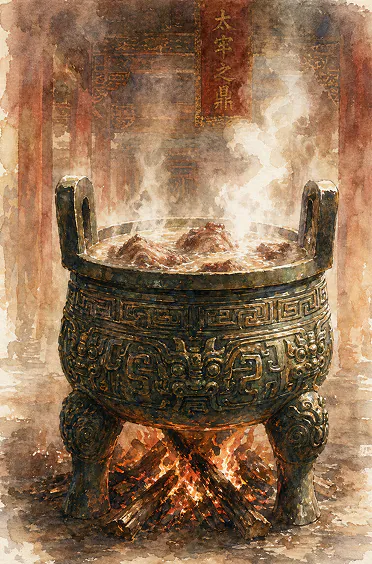
The Caldron is an ancient bronze cooking vessel, used in Chinese ritual to prepare offerings for the gods. In the I Ching's cosmology, it represents the cultural superstructure of society—the visible institutions, rituals, and refinements that elevate life beyond mere survival. The Judgment makes this explicit: "All that is visible must grow beyond itself, extend into the realm of the invisible." In financial terms, this means your money must eventually serve something larger than your own comfort or security.
The trigram structure is crucial here. Fire above (Li, the clinging) represents clarity, illumination, and the transformative power of awareness. Wind below (Xun, the penetrating) represents gentle persistence, adaptability, and the ability to enter into situations gradually. Together, they depict a flame that burns steadily because it has the right fuel and the right draft. In finance, this translates to a strategy where your higher vision (fire) is fed by consistent, well-managed practices (wind). The fire doesn't rage out of control; it cooks deliberately.
The Image commentary deepens this: "The fate of fire depends on wood; as long as there is wood below, the fire burns above." This is a direct statement about resource management. The wood is your capital, your time, your energy. The fire is what you produce with it—income, impact, legacy. The Caldron asks you to examine the relationship between the two. Are you feeding the fire with the right kind of wood? Is your vessel—your financial structure, your business model, your investment approach—properly designed to hold the heat? A crack in the pot means everything leaks out.
What makes The Caldron especially relevant for finance is its emphasis on sacrifice. The Judgment says "the highest earthly values must be sacrificed to the divine." This does not mean giving away all your money. It means that in order for your wealth to reach its highest potential, you must be willing to let go of the parts of it that are stagnant, ego-driven, or misaligned with your deeper purpose. Sacrifice in the I Ching is not loss—it is refinement. You burn off the impurities so that what remains is pure and potent.
How The Caldron Shows Up in Real Finance & Wealth Situations
The Caldron appears in financial life when you have reached a plateau of competence. You know how to make money. You may even know how to keep it. But you sense that the next level of growth—whether in wealth, impact, or satisfaction—requires a fundamental redesign of your approach, not just more effort.
One common scenario is the entrepreneur who has built a successful company but now feels trapped by it. The business generates cash, but the founder's energy is depleted. The Caldron here asks: Is this vessel still serving its purpose, or has it become a container for old habits and unexamined fears? The fire (your vision) may be burning low because the wood (your daily routines, your team, your business model) has become damp or mismatched. The solution is not to chop more wood—it's to change the wood itself.
Another situation involves inheritance or sudden wealth. Money arrives that was not earned through your own fire. The Caldron warns that such wealth must be handled with ritual care. It must be placed in a proper vessel, not dumped into existing accounts or spent impulsively. The hexagram's emphasis on sacrifice suggests that some portion of this windfall should be dedicated to something beyond personal enrichment—a foundation, a cause, a long-term trust that honors the source of the wealth. Otherwise, the fire will burn unevenly, and the pot may crack.
A third pattern is the investor who has been successful with growth stocks or aggressive strategies but now feels the need for a more balanced, sustainable approach. The Caldron's fire-above-wind structure favors steady, penetrating growth over explosive gains. This is not the hexagram for day trading or speculation. It is for the patient cook who knows that a good broth takes hours, not minutes. The lines speak of "delicious food" that must be properly handled. If your portfolio is full of valuable assets but you lack the structure to manage them wisely, you are like a cook with excellent ingredients and a broken pot.
The Caldron teaches that wealth is not an end but a medium. The question is not "How much do I have?" but "What am I cooking with this fire?"
From Reading to Action: Applying The Caldron
Hexagram 50 is unusually rich in practical guidance because its six moving lines describe a sequence of actions, from preparation to completion. To apply The Caldron in your financial life, you must work through these stages deliberately.
Line 1 at the beginning: "A ting is turned upside down before being used." This is the clearing phase. Before you can cook anything new, you must empty the old pot. In financial terms, this means auditing your current holdings, accounts, and commitments. What is stale? What is merely habitual? A "concubine's son" may come to be honored—meaning that something you have overlooked or undervalued (a small account, a forgotten skill, a modest side income) may become significant if you give it proper attention. Action: Do a complete financial inventory. Sell positions that no longer serve your purpose. Close accounts that drain your attention. Clear the pot.
Line 2: "There is food in the ting. My comrades are envious of me." Once the pot is clean and you begin cooking, envy may arise. This is the phase where you have something valuable, and others notice. The line advises that as long as you focus on your actual achievements, the envy of others cannot harm you. In finance, this means staying committed to your strategy even when others question it or wish they had what you have. Do not let comparison derail your cooking. Action: Identify one financial goal that is genuinely yours, not borrowed from social expectations. Protect it with quiet discipline.
Line 3: "The handle of the ting is altered. One is impeded in his enjoyment." This is the most painful line in the hexagram. It describes having excellent ingredients (wealth, talent, opportunity) but no way to lift the pot—no handle. You are in the wrong environment, or your skills are not matched to your position. The line promises that "the time is bound to come, sooner or later, when the difficulties will be resolved." The rain will fall. But for now, you must endure the frustration of being unseen. Action: If you feel stuck in a financial role that doesn't use your strengths, begin quietly preparing an exit. Do not force it. Wait for the release.
Line 4: "The legs of the ting are broken." This is a warning about overreach. You have taken on a responsibility that exceeds your capacity, or you have surrounded yourself with people who weaken your efforts. Confucius's comment on this line is devastating: "Weak character coupled with honored place, meager knowledge with large plans, limited powers with heavy responsibility, will seldom escape disaster." In finance, this means avoiding leverage you cannot manage, partnerships with untrustworthy people, or investments in areas you don't understand. Action: Audit your financial relationships. Are your advisors, partners, or collaborators strengthening or weakening your position? Cut ties where necessary.
Line 5: "The ting has yellow handles, golden carrying rings." This is the central line of the hexagram and the most auspicious. Yellow is the color of balance and the center. Golden rings are strong and beautiful. This line describes a leader who is approachable and modest, and who therefore attracts capable helpers. In finance, this is the phase where your wealth becomes a platform for collaboration. You don't have to do everything yourself. Action: Delegate. Hire. Partner. Find people who complement your strengths and share your values. The Caldron works best when many hands tend the fire.
Line 6: "The ting has rings of jade." Jade combines hardness with soft luster. This is the completion phase, where your financial vessel is not only functional but beautiful and refined. The work finds favor with the divine and becomes pleasing to others. This is the stage of legacy—where your wealth serves purposes beyond your own lifetime. Action: Establish structures that will outlast you—trusts, endowments, philanthropic commitments, succession plans. Make your Caldron a gift to the future.
The Caldron's six lines trace a complete arc: clear the pot, endure envy, survive frustration, avoid overreach, gather helpers, and build for legacy. Each stage has its own wisdom.
Practical Examples
Example 1: The Entrepreneur Who Has Outgrown Her Business
Situation: Maria built a successful consulting firm over 15 years. Revenue is stable, but she feels drained. She no longer recognizes the company she created—it's become a machine that demands her constant attention. She's considering selling but feels guilty about abandoning her team.
How to read it: This is Line 3 of The Caldron—the handle has been altered. Maria has the ingredients (a profitable business, loyal clients, deep expertise) but cannot lift the pot. The vessel no longer fits her hands. The hexagram says the time will come when the difficulties resolve, but she must not force it. The guilt she feels is the "impediment" of the line—it prevents her from enjoying what she has built.
Next step: Maria should begin a quiet process of preparing the business for sale or succession, but without announcing it prematurely. She needs to strengthen her team (Line 5 energy) so that the business can run without her. She should also set aside a portion of the eventual sale proceeds for a purpose that matters to her—this is the sacrifice that the Judgment calls for. The Caldron does not ask her to abandon her creation; it asks her to transform it into something that serves a larger purpose.
Example 2: The Inheritor Who Feels Unworthy
Situation: James inherited $2 million from his grandmother. He never expected this money and feels uncomfortable having it. He's kept it in cash for two years, paralyzed by the fear of making a mistake. His friends tell him to invest aggressively, but he hesitates.
How to read it: This is Line 1 of The Caldron—the pot must be turned upside down and cleared. James's discomfort is the "refuse" that needs to be emptied. The money itself is not the problem; his relationship to it is. The line mentions a "concubine's son" who comes to be honored—something lowly that rises. For James, this might mean starting small. He doesn't need to deploy all the capital at once.
Next step: James should take a small portion of the inheritance (say, 5%) and use it for something that honors his grandmother's values—a scholarship, a donation to her favorite charity, or an investment in a cause she cared about. This act of sacrifice transforms the money from a burden into a vessel of meaning. Then, with the remaining funds, he should work with a fee-only advisor to create a conservative, values-aligned portfolio. The Caldron does not demand heroism; it demands respect for the vessel.
Example 3: The Investor Who Needs to Change Strategy
Situation: David has been a successful growth-stock investor for a decade. His returns have been excellent, but he's increasingly anxious about market volatility. He knows he should diversify into more stable assets, but he fears missing out on future gains. His portfolio is concentrated in three tech stocks.
How to read it: This is Line 4 of The Caldron—the legs are broken. David has taken on more risk than his current capacity can support. The "inferior people" in this line are not bad people; they are the habits and assumptions that no longer serve him. The growth-stock mentality has become a weakness because it lacks the balance that the hexagram requires. The Caldron needs a stable base.
Next step: David should immediately reduce his concentration in any single stock or sector. He needs to sell enough to bring his portfolio into balance—this is the sacrifice of potential gains for the sake of stability. Then he should build a diversified portfolio that includes bonds, real assets, and international exposure. The "golden carrying rings" of Line 5 suggest he should work with a financial planner who can provide the balance he lacks. The Caldron's fire burns steadily, not explosively.
Common Mistakes
• Mistaking The Caldron for a get-rich-quick hexagram. The Caldron is about refinement, not acquisition. Readers sometimes assume that because the Judgment promises "great good fortune and success," this hexagram predicts a windfall. In fact, the fortune comes from proper preparation and sacrifice, not from luck or aggressive action.
• Ignoring the sacrifice element. The most uncomfortable part of The Caldron is its demand that "the highest earthly values must be sacrificed to the divine." In finance, this means letting go of something you value—a position, a habit, an identity—in order to make room for something higher. Readers who skip this step find that their financial pot remains cracked.
• Applying the hexagram to situations of scarcity. The Caldron assumes you already have substance. It is not for someone who is struggling to make ends meet or who needs basic financial survival skills. If you try to use this hexagram when you have nothing in the pot, you will misunderstand its meaning. The Caldron begins with a full vessel that needs to be transformed, not an empty one that needs to be filled.
• Treating the lines as independent predictions. The six lines of Hexagram 50 form a progression, not a menu of options. Readers sometimes pick a single line that feels relevant and ignore the sequence. But the wisdom of The Caldron unfolds over time. You cannot jump from Line 1 to Line 6 without passing through the difficulties of Lines 3 and 4. Patience is built into the structure.
Frequently Asked Questions
What does The Caldron mean for my investment portfolio?
The Caldron suggests that your portfolio should be treated as a vessel for long-term nourishment, not a vehicle for quick gains. The fire-above-wind structure favors steady, sustainable growth. Review your holdings for balance and alignment with your deeper values. If any position feels like it's burning too hot or too cold, it may need to be adjusted.
Is Hexagram 50 a good sign for starting a new business?
It can be, but only if you already have the resources and experience to cook something substantial. The Caldron is not for the novice. If you are starting from scratch, a different hexagram would be more appropriate. If you have capital, skills, and a clear vision, The Caldron supports the venture—provided you are willing to sacrifice the parts of your plan that are ego-driven or impractical.
How does the "sacrifice" in The Caldron apply to money?
Sacrifice in this context means letting go of financial behaviors or assets that have become obstacles to your growth. It might mean selling a stock you are emotionally attached to, closing a business that no longer fulfills you, or giving away a portion of your wealth to a cause you believe in. The sacrifice is not punitive; it is purifying. It makes the vessel ready for something better.
Can The Caldron help me with debt?
The Caldron is not primarily about debt, but its principles can apply. If you are in debt, you are like a pot that has been filled with something you did not choose. Line 1's advice to "turn the ting upside down" suggests a radical clearing—a debt management plan that sacrifices short-term comfort for long-term freedom. The hexagram's emphasis on proper structure also warns against taking on new debt until the vessel is sound.
What if I get Line 3 (the altered handle) in a financial reading?
This is a difficult line, but not a hopeless one. It means you have the substance (the food) but lack the means to use it effectively. You may be in the wrong job, the wrong market, or the wrong partnership. The line promises eventual release ("the rain falls"), but you must endure the frustration without forcing change. Prepare quietly. Do not waste your energy trying to fix a broken handle—wait for the right conditions to build a new one.
Closing Reflection
The Caldron asks you to see your financial life as a sacred vessel, not a storage container. The money you have is not the point; what you cook with it is. If you feel that your wealth has become stagnant or meaningless, it may be time to turn the pot over and start fresh. If you are in a season of difficult frustration, know that the rain will come. And if you are ready to build something that outlasts you, gather your helpers, refine your materials, and tend the fire with patience. The Caldron does not promise easy wealth. It promises something rarer: the satisfaction of having used your resources well, in service of something that matters. That is good fortune enough.
Turn this guide into your own reading
After reading the explanation, cast with a real question. We will carry your question into the reading flow so the result can be interpreted and saved.
Sources & References
Zhouyi / I Ching primary text
The received text of the Book of Changes, including the Judgment, Image, and line statements.
The I Ching or Book of Changes, Richard Wilhelm / Cary F. Baynes
Princeton University Press translation used as a major English-language reference point for names, structure, and commentary framing.
The Sacred Books of China: The Texts of Confucianism, James Legge
Classical English reference used for comparative reading of source terminology and commentarial tradition.
The Classic of Changes, Richard John Lynn
Modern scholarly translation consulted for comparative interpretation and editorial cross-checking.
Related Hexagrams
Continue from this guide into specific hexagram study.
Related Guides
Continue with adjacent guides for more context and deeper study.