
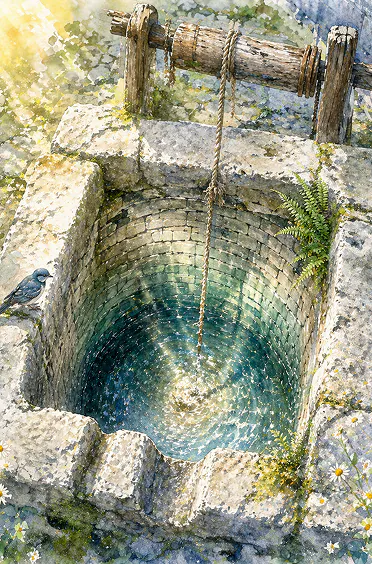
Hexagram Health
Hexagram 48 (The Well) in Health: I Ching Guidance for Wellbeing and Vitality
What does Hexagram 48 (The Well) suggest about health and wellbeing? In ancient China the capital cities were sometimes moved, partly for the sake of more favorable location, partly because of a change in dynasties. The style of... Explore how the I Ching frames the balance of energy, rest, and renewal.
Hexagram 48 (The Well) in Health: I Ching Guidance for Wellbeing and Vitality
Introduction
You've tried the elimination diet, the morning meditation app, the expensive supplement regimen, and the sleep optimization protocol. Each one worked—for a few weeks. Then something slipped. You missed a day, then a week, and suddenly you're back where you started, wondering why sustainable health feels so elusive. The problem isn't your willpower or your knowledge. The problem is that you've been treating health like a renovation project when it's actually more like a well.
Hexagram 48 (The Well) from the I Ching offers a radically different way to think about wellbeing. The Judgment tells us that while dynasties rise and fall and architectural styles change, "the shape of the well has remained the same from ancient times to this day." This is the I Ching's way of saying that beneath all our modern wellness trends and biohacking fads, there is something timeless and foundational about human health. The trigram structure—Water (K'an) above, Wind (Sun) below—depicts wood drawing water upward, a natural, organic process of nourishment that doesn't require force or cleverness, only access to what is already there.
If you're tired of chasing the next health breakthrough only to feel depleted again, this reading is for you. Hexagram 48 doesn't promise a quick fix. It invites you to stop digging new holes and instead tend the well you already have.
Where This Guide Is Most Useful
• You feel overwhelmed by conflicting health advice and need a way to distinguish what is foundational from what is merely trendy
• You've experienced a health setback or plateau and sense that surface-level changes won't address the deeper issue
• You want to build health practices that are sustainable, not heroic—practices you can maintain through life's inevitable disruptions
Understanding The Well in Health & Wellbeing Context
The Judgment of Hexagram 48 makes a striking claim: "Life is also inexhaustible. It grows neither less nor more; it exists for one and for all." This is not a mystical assertion about eternal youth. It is a practical observation about the nature of vitality itself. Real health is not a finite resource you can deplete. It is a wellspring that, when properly accessed, renews itself continuously. The problem is not that the water runs out. The problem is that we often fail to draw from it correctly—or we break the jug.
The Image of the hexagram shows wood (the trigram Sun, associated with penetration and gentle growth) reaching down into water (K'an, associated with depth and danger) and drawing it upward. This is the organic model of health. The superior person, the text says, "organizes human society, so that, as in a plant organism, its parts co-operate for the benefit of the whole." Applied to health, this means your wellbeing is not the product of any single intervention. It is the result of a system—sleep, nutrition, movement, connection, purpose—working together like roots drawing water through a tree.
Hexagram 48 challenges the modern assumption that health is something you achieve through aggressive optimization. The well does not need to be reinvented. It needs to be kept clear, accessible, and in use. The Judgment warns of two dangers: superficiality ("any merely superficial ordering of life that leaves its deepest needs unsatisfied is as ineffectual as if no attempt at order had ever been made") and carelessness ("by which the jug is broken"). In health terms, superficiality looks like chasing supplements while ignoring sleep. Carelessness looks like pushing through chronic stress until your body forces a breakdown.
The well metaphor also addresses the loneliness of modern health culture. The well is a communal resource. Its purpose is to serve everyone who comes to it. Your health practices, when they are truly aligned with The Well, do not isolate you in a bubble of self-optimization. They make you more available to others, more grounded, more generous. The well that is only for oneself is not really a well at all.
Takeaway: True vitality comes not from finding a new source of health, but from clearing the access to the one you already have. The well is there. Your task is to draw from it wisely.
How The Well Shows Up in Real Health & Wellbeing Situations
The most recognizable pattern of Hexagram 48 in health is the experience of having good resources but failing to use them. Line 2 describes this precisely: "The water itself is clear, but it is not being used." You know you should sleep eight hours. You know you should eat more vegetables. You know you should take that walk instead of scrolling. The knowledge is there. The water is clear. But the jug is broken—some habit, some avoidance, some hidden resistance is preventing you from actually drinking.
This is not a failure of information. It is a failure of access. Hexagram 48 suggests that when we cannot draw from our own well, we often drift toward inferior substitutes. The line says that when the well is neglected, "only fish will stay, and whoever comes to it, comes only to catch fish." In modern terms, this is the person who knows they need rest but settles for caffeine and willpower. They know they need genuine connection but settle for social media validation. They know they need meaningful movement but settle for the gym because it's efficient. The water is there, but they are not drinking it.
Another common pattern is the experience of being in a "lining the well" phase, described in Line 4. "If a well is being lined with stone, it cannot be used while the work is going on. But the work is not in vain." This corresponds to times when you must withdraw from activity to restore your foundations. Perhaps you are recovering from illness, healing an injury, or working through a period of burnout. During this time, you cannot serve others or perform at your usual level. This can feel like failure, especially in a culture that values productivity above all. But Hexagram 48 reassures you that this restoration work is essential. The well that is not properly lined will fill with debris. The time you spend shoring up your foundations is not wasted.
Line 5 offers the most hopeful image: "A well that is fed by a spring of living water is a good well." This describes a person whose health practices are not forced but flow naturally from a deep source. They do not have to grit their teeth to eat well or exercise. The practices have become part of who they are. But the line also contains a warning: the character for "good fortune" is omitted. Why? Because "the all-important thing about a well is that its water be drawn." Having a deep well of vitality means nothing if you do not actually use it to live your life. The healthiest person in the world who never does anything meaningful with their health is not fortunate at all.
Takeaway: The water is not the blessing. The drinking is. Health is not a possession to accumulate but a practice to perform. Every day, you must choose to draw.
From Reading to Action: Applying The Well
To work with Hexagram 48 in your health journey, begin by asking yourself: What is my well? Not what should be my well, according to the latest podcast or influencer. What actually nourishes you at a level deeper than preference? This might be a daily walk, a particular way of eating, a relationship, a creative practice, or simply the act of sitting in silence for ten minutes. The well is whatever reliably restores you when you are depleted.
The moving lines offer specific guidance for different situations:
If you are in Line 1 territory—feeling stuck in "swampy lowlands," as if your life energy is being submerged in mud—the advice is stark. You have likely been compromising your health for so long that you have lost touch with your own standards. The line says, "He who throws himself away is no longer sought out by others." This is not punishment. It is consequence. When you abandon your own wellbeing, you become unreliable to everyone. The first step is to recognize that you have been settling for the swamp when the well is still there. You must decide that you are worth drawing water for.
If you resonate with Line 2—knowing what to do but not doing it—the issue is not knowledge but the broken jug. What is broken in your routine? Is it the container of your schedule? Your environment? Your support system? The line suggests that neglecting the vessel of your practice leads to deterioration. You must fix the jug before you can draw water. This might mean redesigning your kitchen so healthy eating is easier, or setting an actual bedtime alarm, or finding an accountability partner who will not let you slide.
Line 3 describes the situation of being ready but unrecognized. "An able man is available. He is like a purified well whose water is drinkable. But no use is made of him." In health terms, this often applies to people who have done the inner work—healed their relationship with food, learned to manage stress, developed genuine self-care—but who feel unseen or undervalued in their current environment. The line's advice is bittersweet: the sorrow belongs to those who know the well's value. Your task is not to force others to drink. It is to remain clear and available, trusting that the right people and circumstances will eventually find you.
Line 4's "lining the well" phase requires patience. If you are in recovery or rebuilding, do not rush to be useful. The work you are doing now—resting, healing, reorganizing—is the work. It will bear fruit later, but only if you complete it.
Line 5 calls you to become a person from whom health flows naturally. This is not about perfection. It is about integration. When your health practices are so embedded in your life that they require no special effort, you become a source of vitality for yourself and others. But remember: the water must be drawn. Do not hoard your health. Use it to live fully.
Line 6 represents the culmination: a well that serves everyone. "No matter how many come, all find what they need, for the well is dependable." This is the person whose health is so robust and generous that it spills over into the lives of others. They have energy for their family, presence for their friends, resilience for their work. The well never runs dry because it is fed by a spring.
Takeaway: Each line of Hexagram 48 describes a different relationship to your own vitality. Wherever you are, the work is the same: clear the access, fix the vessel, draw the water.
Practical Examples
Example 1: The Burnout Recoverer
Situation: After three years of working sixty-hour weeks, you have crashed. Your sleep is shattered, your digestion is a mess, and you cannot remember the last time you felt rested. You know you need to slow down, but every instinct screams that you are being lazy. You feel guilty for resting.
How to read it: This is Line 4, the lining of the well. You are in the restoration phase, and the work you are doing now—resting, healing, refusing to push—is not a detour from your real life. It is the most important work you will ever do. The well cannot give water while it is being repaired. Your only job right now is to complete the repairs.
Next step: Give yourself permission to do nothing productive for a defined period—one week, two weeks, a month. Use that time to sleep, eat simply, walk slowly, and let your nervous system settle. Do not try to optimize your recovery. Just let it happen. The well will be usable again when it is ready, not when you decide it should be.
Example 2: The Information Overloader
Situation: You have read every health book, tried every diet, and own a meditation cushion you barely use. You can explain the science of circadian rhythms, but you go to bed at midnight anyway. You know exactly what you should do, and you do none of it.
How to read it: This is Line 2. The water is clear, but the jug is broken. Your problem is not lack of knowledge. It is that the vessel of your daily practice cannot hold the water. You have been collecting information as a substitute for action, hoping that the right fact will finally flip a switch. It won't.
Next step: Choose one practice—just one—and make it so easy you cannot fail. Drink a glass of water when you wake up. Walk for five minutes after lunch. Go to bed ten minutes earlier. Fix the jug by making the container small enough to hold. Once that practice is stable, you can add another. The well does not need more water. It needs a functioning vessel.
Example 3: The Isolated Healer
Situation: You have done years of inner work. You eat well, you exercise, you meditate, you have processed your trauma. But you feel lonely in your health. Your friends still drink too much and sleep too little. Your family thinks you are extreme. You wonder if your health practices are isolating you.
How to read it: This is Line 3, the purified well that no one drinks from. Your sorrow is real, and it is shared by those who recognize your value. But the line does not tell you to abandon your well. It tells you to remain clear. The prince will come—the right community, the right relationships, the right opportunities to share your vitality.
Next step: Stop trying to convince others to drink from your well. Instead, focus on being a clear, reliable source for those who are already thirsty. This might mean finding a community of like-minded people, or it might simply mean accepting that your health practices are for you first. The well that tries to force people to drink becomes a nuisance. The well that simply offers its water becomes a blessing.
Takeaway: Every health situation is a relationship to your own well. The work is always to clear, to repair, to draw, and to offer.
Common Mistakes
• Mistaking the well for a magic source. The Well is not a promise of perfect health or immunity from struggle. It is a model for sustainable practice. The water must be drawn daily. Reading about the well does not quench thirst.
• Thinking you need a new well. When health efforts fail, the temptation is to abandon everything and start over with a completely different system. Hexagram 48 suggests that the well you already have is sufficient. The problem is likely access, not source.
• Confusing the well with the vessel. The well is the source of vitality. The jug is your daily practice. Many people focus entirely on finding deeper water (more knowledge, better supplements) while neglecting the jug (sleep schedule, meal prep, consistent movement). A perfect well with a broken jug yields nothing.
• Believing the well is only for yourself. The final line of Hexagram 48 emphasizes that the well serves everyone. If your health practices make you selfish, withdrawn, or judgmental of others, you have misunderstood the hexagram. True vitality overflows. It does not hoard.
Frequently Asked Questions
What does The Well mean for chronic illness?
The Well does not promise cure. It offers a framework for sustainable living with whatever condition you face. The water is still there, even if you must draw it more carefully. Focus on clearing access to what nourishes you—rest, gentle movement, meaningful connection—rather than fighting against your limitations. The well that serves a village with a single bucket is still a good well.
How is The Well different from other health hexagrams?
Hexagram 48 is unique in its emphasis on foundation and sustainability. Other health-related hexagrams might address acute situations (like Hexagram 3, Difficulty at the Beginning, which describes the chaos of starting something new) or crises (like Hexagram 29, The Abysmal, which deals with danger and falling). The Well is about the steady, ongoing practice of drawing vitality. It is not dramatic. It is essential.
Can The Well help with mental health?
Absolutely. The well metaphor applies directly to psychological and emotional wellbeing. Your mind has a natural spring of resilience, clarity, and peace. But if you never sit still long enough to draw from it, you will remain thirsty. Practices like therapy, journaling, meditation, and honest conversation are ways of lowering the bucket. The water is there.
What if my well feels completely dry?
This feeling is common, especially after prolonged stress or illness. The Judgment of Hexagram 48 insists that life is inexhaustible—it "grows neither less nor more." What feels like a dry well is usually a blocked one. You may need to clear debris (unprocessed emotions, toxic relationships, unsustainable habits) before the water can flow again. This is the lining-the-well phase. It takes time, but it is not hopeless.
How do I know if I am drawing from the right well?
The right well is the one whose water actually nourishes you. Not the one that looks impressive. Not the one that works for your friend. Not the one that has the most scientific validation. If a practice leaves you more depleted than restored, it is not your well, no matter how pure its water appears. Trust your body's response. The right well will make you want to drink again tomorrow.
Takeaway: The questions that matter are not about finding the perfect well, but about learning to draw from the one you have. The water is there. Keep lowering the bucket.
Closing Reflection
The Well asks you to stop searching for health as if it were a hidden treasure and to start tending it as a daily practice. The water does not need to be discovered. It needs to be drawn. This is both more humble and more liberating than the heroic model of health that promises transformation through a single dramatic change. You do not need to reinvent yourself. You need to return to what has always sustained you—sleep, nourishment, movement, connection, rest—and do it again, and again, and again. The well does not care about your ambition or your credentials. It only responds to the bucket. Lower it. Draw. Drink. Repeat. This is the oldest health advice in the world, and it has never stopped being true.
Turn this guide into your own reading
After reading the explanation, cast with a real question. We will carry your question into the reading flow so the result can be interpreted and saved.
Sources & References
Zhouyi / I Ching primary text
The received text of the Book of Changes, including the Judgment, Image, and line statements.
The I Ching or Book of Changes, Richard Wilhelm / Cary F. Baynes
Princeton University Press translation used as a major English-language reference point for names, structure, and commentary framing.
The Sacred Books of China: The Texts of Confucianism, James Legge
Classical English reference used for comparative reading of source terminology and commentarial tradition.
The Classic of Changes, Richard John Lynn
Modern scholarly translation consulted for comparative interpretation and editorial cross-checking.
Related Hexagrams
Continue from this guide into specific hexagram study.
Related Guides
Continue with adjacent guides for more context and deeper study.